(Peer-Reviewed) Luminescent YAG:Ce³⁺ 3D micro-structures via multi-photon laser lithography
Robertas Virkėtis ¹, Greta Merkininkaitė ¹, Artūr Harnik ³, Ugnė Ūsaitė ¹, Dominykas Dapšys ³, Arturo Susarrey-Arce ⁴, Simas Šakirzanovas ¹ ², Mangirdas Malinauskas ³
¹ Faculty of Chemistry and Geosciences, Vilnius University, Naugarduko Str. 24, Vilnius LT-03225, Lithuania
² Department of Chemical Engineering and Technology, Center for Physical Sciences and Technology, Saulėtekio Ave. 3, Vilnius LT-10257, Lithuania
³ Laser Research Center, Physics Faculty, Vilnius University, Saulėtekio Ave. 10, Vilnius LT-10223, Lithuania
⁴ Department of Chemical Engineering, Mesoscale Chemical Systems, MESA+ Institute, University of Twente, P.O. Box 217, Enschede 7500 AE, Netherlands
Opto-Electronic Advances, 2026-08-25
Abstract
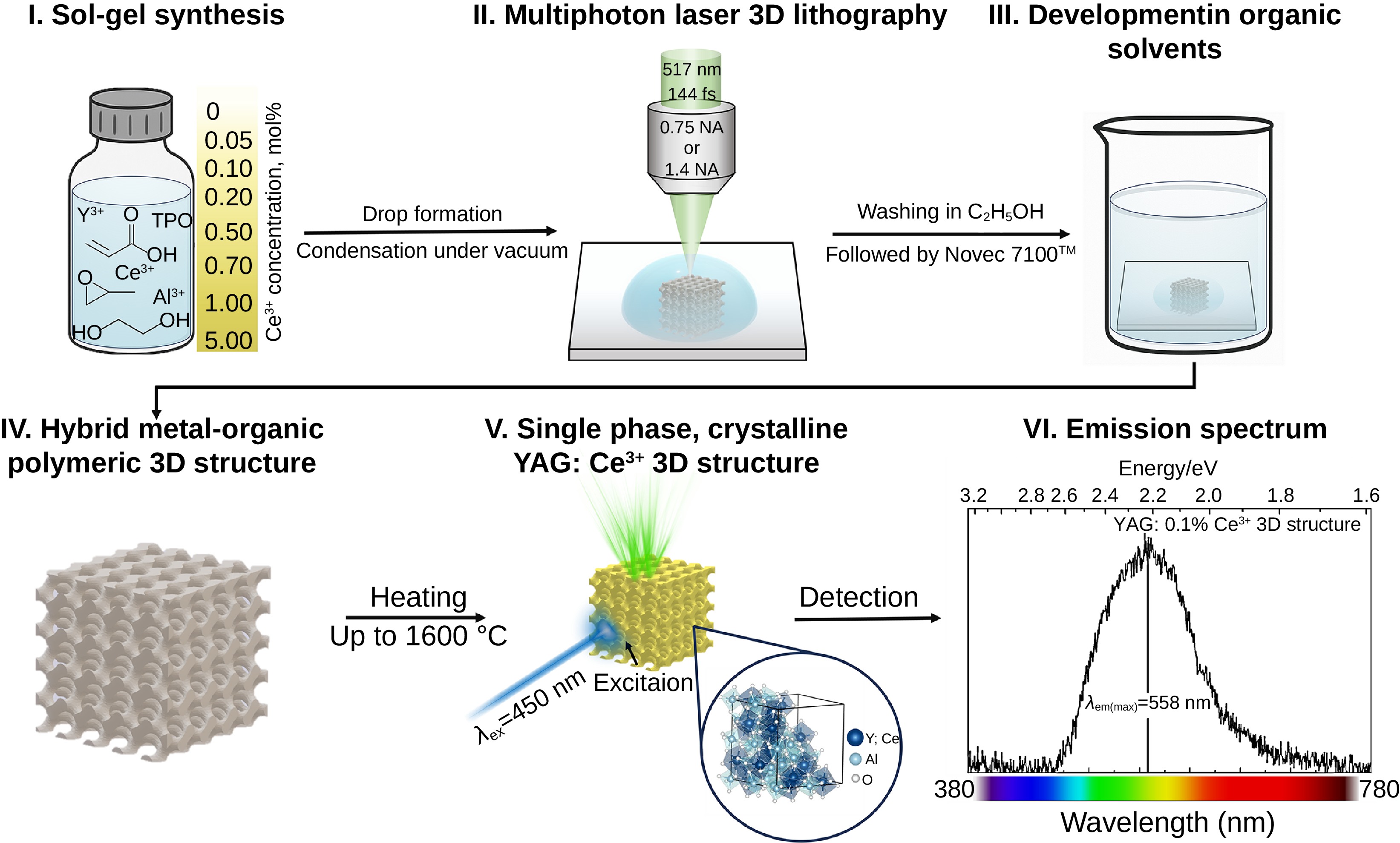
This work addresses the challenge of fabricating crystalline single-phase luminescent 3D microstructures by demonstrating a fabrication process of yttrium aluminum garnet doped with cerium (YAG:Ce³⁺) 3D micro-objects. Precursors were synthesized via a sol-gel method and characterized by refractive index (RI) measurements, Fourier-transform infrared spectroscopy (FT-IR), and thermogravimetric (TG) analysis to verify chemical composition changes during photopolymerization and thermal treatment.
Multiphoton laser 3D lithography (MP3DL) was employed to produce hybrid metal-organic 3D structures, which were subsequently converted into crystalline ceramics through controlled 3-step annealing. Structural analysis by X-ray diffraction (XRD) confirmed the formation of single-phase cubic YAG across Ce³⁺ concentrations up to 5 mol-% in 3D objects, while scanning electron microscopy (SEM) revealed isotropic shrinkage (ca. 39%) and well-preserved geometries with sub-micrometer features after pyrolysis.
The smallest feature of a crystalline 3D object achieved was 0.48 μm with a spatial resolution down to 2.4 μm. Luminescence measurements showed characteristic Ce³⁺ emission centered at 558 nm, with maximum intensity at 2 mol-% doping. These findings establish a reliable pathway to fabricate thermally stable, high-resolution, luminescent single-phase YAG:Ce³⁺ 3D micro-objects, enabling their integration into optoelectronic and photonic applications.
A 36 × 240 Gbps hybrid mode/wavelength division multiplexing transmitter using lithium niobate on insulator
Mingyu Zhu, Weihan Wang, Ruitao Ma, Aoyun Gao, Chun Gao, Zexu Wang, Fei Huang, Zhenyuan Bao, Dajian Liu, Jiaxuan Gan, Zejie Yu, Huan Li, Weike Zhao, Daoxin Dai
Opto-Electronic Advances
2026-08-25
Light-perception-based interactive control of an underwater digital twin hand
Jinlong Lu, Chao Zhang, Hengchang Nong, Dongying Wang, Hongyu Zhou, Junjie Weng, Yuehua Deng, Yang Yu, Qiang Bian, Jianfa Zhang, Chaofan Zhang, Zhenrong Zhang, Junbo Yang
Opto-Electronic Advances
2026-07-10
Unlocking home-based nocturnal health management: A fiber-optic approach for early detection of cardiorespiratory rhythm disorders
Hanyu Jin, Hao Li, Zhuolin Chen, Liangye Li, Zurui Wang, Kai Zhou, Weijian Hang, Zhipeng Chen, Junfeng Chen, Kai Shen, Jianfeng Wen, Chen Chen, Cunzheng Fan, Zhijun Yan, Feng Wang, Qizhen Sun
Opto-Electronic Advances
2026-07-10
A flexible wireless system for prospective photodynamic therapy applications
Rolan Mansour, Bhavani Yalagala, Vikas Vikas, Nikolas Bruce, Fawziye Tarhini, Georgios N. Arvanitakis, Mohammed Mughal, Jamie Blanche, Ahmad Taha, Jonathan Copper, Muhammad Imran, Karin Williams, Karin Oien, Mahmoud Wagih, Hadi Heidari, Robert Hadfield, David Flynn
Opto-Electronic Advances
2026-07-10
Parallel bright-field and multi-order edge imaging via wide field-of-view trichannel metalens
Xiaotong Li, Yeseul Kim, Youngsun Jeon, Junhwa Seong, Jaekyung Kim, Peng Tang, Shiqi Hu, Harit Keawmuang, Beomha Yang, Dongmin Jeon, Le Dai, Weiyan Li, Xiaodong Cai, Jinhui Shi, Yong-Sang Ryu, Trevon Badloe, Junsuk Rho
Opto-Electronic Advances
2026-07-10