(Peer-Reviewed) Video-rate wavefront capture and replay via single-shot reference-free measurement: toward holographic telepresence
Minwook Kim ¹ ², Chansuk Park ¹ ² ³, Chulmin Oh ¹ ², KyeoReh Lee ¹ ² ⁴, Herve Hugonnet ¹ ², YongKeun Park ¹ ² ⁵
¹ Department of Physics, Korea Advanced Institute of Science and Technology (KAIST), 291, Daehak-ro, Yuseong-gu, Daejeon 34141, Republic of Korea
² KAIST Institute for Health Science and Technology, KAIST, 291, Daehak-ro, Yuseong-gu, Daejeon 34141, Republic of Korea
³ Current affiliation: Samsung Electro-Mechanics, Maeyeong-ro 150, Yeongtong-gu, Suwon 16674, Republic of Korea
⁴ Current address: Department of Applied Physics, Yale University, New Haven, 06520 Connecticut, USA
⁵ Tomocube Inc., 141 Jukdong-ro, Yuseong-gu, Daejeon 34109, Republic of Korea
Opto-Electronic Advances, 2026-08-25
Abstract
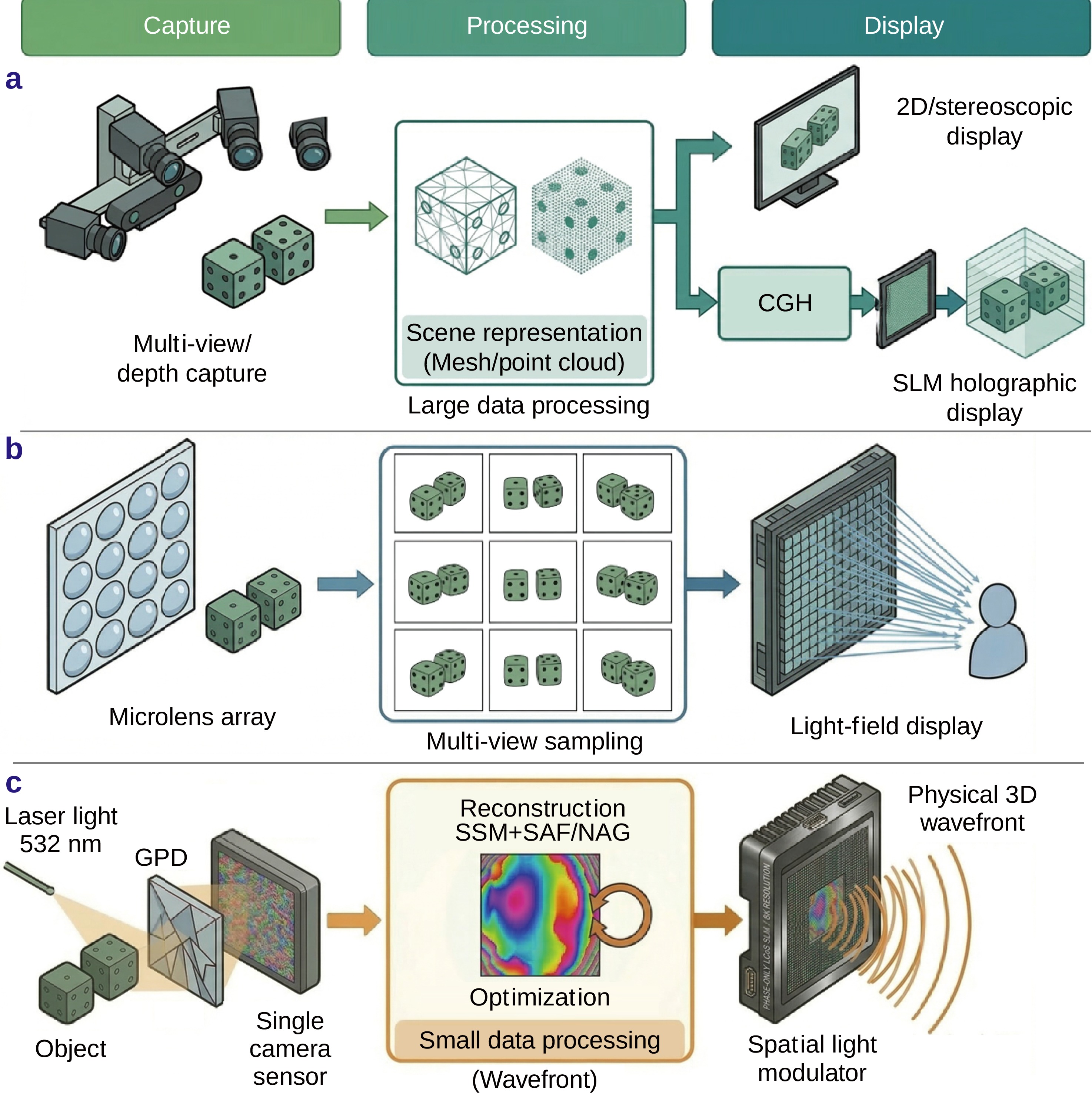
We present a reference-free holographic telepresence framework that captures and replays the complex optical wavefront of a three-dimensional scene from a single intensity speckle measurement. A pre-characterized geometric phase diffuser encodes the incident field into a deterministic speckle pattern, enabling reference-free acquisition through a calibrated, invertible forward model.
The wavefront is recovered via scattering-matrix inversion with smoothed amplitude flow and Nesterov acceleration, and directly projected onto a spatial light modulator for holographic replay. This measurement-driven pipeline eliminates interferometric reference beams and multi-frame acquisition, enabling single-shot operation at video rate (~28 fps) with sub-gigabit bandwidth. We experimentally demonstrate volumetric refocusing and dynamic three-dimensional reconstruction, confirming that the recovered field preserves physically consistent propagation behavior.
Although image quality is currently limited by coherent speckle, both experiments and simulations show systematic improvement with temporal averaging and system scaling. These results establish real-time, measurement-based wavefront capture and replay as a viable and complementary approach to model-based holographic telepresence.
A 36 × 240 Gbps hybrid mode/wavelength division multiplexing transmitter using lithium niobate on insulator
Mingyu Zhu, Weihan Wang, Ruitao Ma, Aoyun Gao, Chun Gao, Zexu Wang, Fei Huang, Zhenyuan Bao, Dajian Liu, Jiaxuan Gan, Zejie Yu, Huan Li, Weike Zhao, Daoxin Dai
Opto-Electronic Advances
2026-08-25
Light-perception-based interactive control of an underwater digital twin hand
Jinlong Lu, Chao Zhang, Hengchang Nong, Dongying Wang, Hongyu Zhou, Junjie Weng, Yuehua Deng, Yang Yu, Qiang Bian, Jianfa Zhang, Chaofan Zhang, Zhenrong Zhang, Junbo Yang
Opto-Electronic Advances
2026-07-10
Unlocking home-based nocturnal health management: A fiber-optic approach for early detection of cardiorespiratory rhythm disorders
Hanyu Jin, Hao Li, Zhuolin Chen, Liangye Li, Zurui Wang, Kai Zhou, Weijian Hang, Zhipeng Chen, Junfeng Chen, Kai Shen, Jianfeng Wen, Chen Chen, Cunzheng Fan, Zhijun Yan, Feng Wang, Qizhen Sun
Opto-Electronic Advances
2026-07-10
A flexible wireless system for prospective photodynamic therapy applications
Rolan Mansour, Bhavani Yalagala, Vikas Vikas, Nikolas Bruce, Fawziye Tarhini, Georgios N. Arvanitakis, Mohammed Mughal, Jamie Blanche, Ahmad Taha, Jonathan Copper, Muhammad Imran, Karin Williams, Karin Oien, Mahmoud Wagih, Hadi Heidari, Robert Hadfield, David Flynn
Opto-Electronic Advances
2026-07-10
Parallel bright-field and multi-order edge imaging via wide field-of-view trichannel metalens
Xiaotong Li, Yeseul Kim, Youngsun Jeon, Junhwa Seong, Jaekyung Kim, Peng Tang, Shiqi Hu, Harit Keawmuang, Beomha Yang, Dongmin Jeon, Le Dai, Weiyan Li, Xiaodong Cai, Jinhui Shi, Yong-Sang Ryu, Trevon Badloe, Junsuk Rho
Opto-Electronic Advances
2026-07-10