(Peer-Reviewed) Breaking the speed-resolution trade-off in 3.3-km non-line-of-sight imaging using scanning-free laser reflective tomography
Zewei Wang 王泽威 ¹ ² ³, Xiaoyin Li 李晓银 ¹ ², Yinghui Guo 郭迎辉 ¹ ² ³ ⁴, Hengshuo Guo 郭珩硕 ⁵, Peng Yang 杨鹏 ¹ ² ³, Fei Zhang 张飞 ¹ ² ³, Mingbo Pu 蒲明博 ¹ ² ³, Mingfeng Xu 徐明峰 ¹ ² ³, Xiangang Luo 罗先刚 ¹ ² ³
¹ State Key Laboratory of Optical Field Manipulation Science and Technology, Institute of Optics and Electronics, Chinese Academy of Sciences, Chengdu 610209, China
中国 成都 中国科学院光电技术研究所 光场调控科学技术全国重点实验室
² Research Center on Vector Optical Fields, Institute of Optics and Electronics, Chinese Academy of Sciences, Chengdu 610209, China
中国 成都 中国科学院光电技术研究所矢量光场研究中心
³ College of Materials Sciences and Opto-Electronic Technology, University of Chinese Academy of Sciences, Beijing 100049, China
中国 北京 中国科学院大学材料科学与光电技术学院
⁴ Sichuan Provincial Engineering Research Center of Digital Materials, Chengdu 610299, China
中国 成都 四川省数字材料工程研究中心
⁵ Tianfu Xinglong Lake Laboratory, Chengdu 610299, China
中国 成都 天府兴隆湖实验室
Opto-Electronic Science, 2026-06-17
Abstract
Non-line-of-sight (NLOS) imaging, which allows the recovery of hidden scenes outside the direct view, holds immense potential across numerous fields. However, conventional scanning-based NLOS imaging systems, face a fundamental trade-off between imaging speed and resolution due to their reliance on scanning relay surfaces, where dense sampling prolongs measurement.
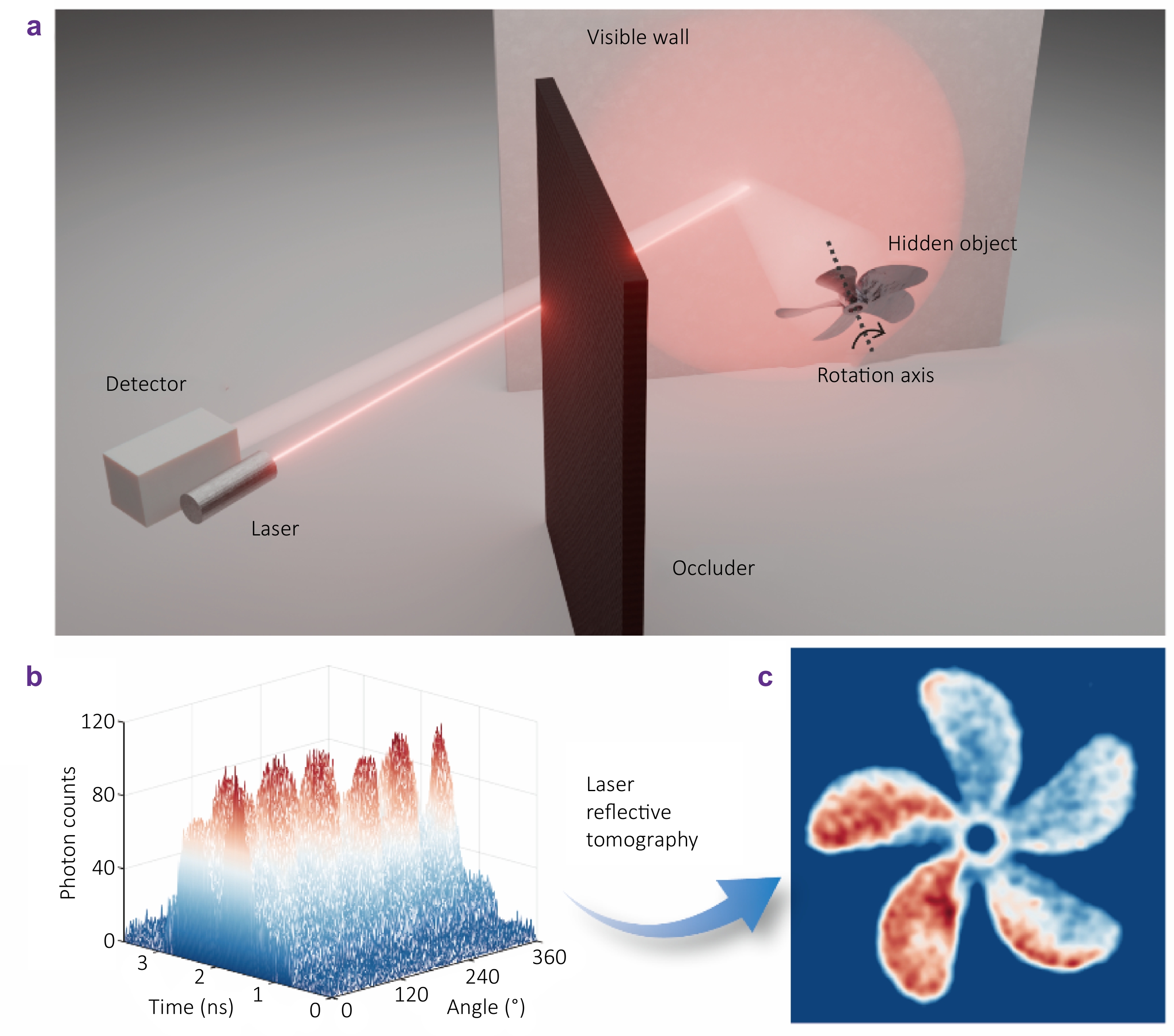
Here, we introduce a scanning-free NLOS imaging technique that adapts laser reflective tomography (LRT) to reconstruct hidden objects by exploiting the diffuse relay surface as a natural beam expander. Our method requires only single-point detection of third-bounce photons, effectively breaking through the resolution and speed limitations imposed by scanning. Compared with scanning-based approaches, it delivers a twofold enhancement in spatial resolution and a 91-fold improvement in imaging speed.
Furthermore, we extend the advantages of this method to long-range experiments, demonstrating NLOS imaging over 3.3 km with a resolution of 3 cm in 3 minutes, establishing new benchmarks in imaging range, resolution, and speed for NLOS imaging.
Ultrafast all-optical modulation of wide-bandwidth pulses enabled by silicon-metasurfaces
Kaloyan Georgiev, Khosro Zangeneh Kamali, Anton A. Trifonov, Giulia Crotti, Lyuben Petrov, Stefan Georgiev, Hristo Iliev, Lei Xu, Unai Arregui Leon, Mohsen Rahmani, Giuseppe Della Valle, Ivan Buchvarov, Dragomir Neshev
Opto-Electronic Advances
2026-09-15
Physics-informed neural fields enable blind aberration correction for partially coherent quantitative phase imaging
Shun Zhou, Xingyu Huang, Linpeng Lu, Habib Ullah, Kaiyu Du, Maciej Trusiak, Malgorzata Kujawinska, Yuzhen Zhang, Yao Fan, Qian Chen, Qinrong Zhang, Chao Zuo
Opto-Electronic Science
2026-08-26
Heterogeneously integrated micro-ring with SnS₂ for dual-functional optical modulation and photodetection
Jinyi Du, Lidan Lu, Xu Zhang, Bofei Zhu, Wenbo Bo, Yingjie Xu, Guang Chen, Yanlin He, Guanghui Ren, Xiaoping Lou, Zheng You, Lianqing Zhu
Opto-Electronic Advances
2026-08-25
Hardware-aware lightweight photonic spiking neural network for pattern classification
Shuiying Xiang, Yahui Zhang, Shangxuan Shi, Haowen Zhao, Dianzhuang Zheng, Xingxing Guo, Yanan Han, Ye Tian, Liyue Zhang, Yuechun Shi, Yue Hao
Opto-Electronic Advances
2026-08-25
PhyspeNet: An empirical physics-aware network for adaptive speckle reconstructive spectrometry
Junrui Liang, Min Jiang, Jun Li, Zhongming Huang, Junhong He, Yanting Guo, Yanzhao Ke, Jun Ye, Jiangming Xu, Jinyong Leng, Pu Zhou
Opto-Electronic Advances
2026-08-25
A 36 × 240 Gbps hybrid mode/wavelength division multiplexing transmitter using lithium niobate on insulator
Mingyu Zhu, Weihan Wang, Ruitao Ma, Aoyun Gao, Chun Gao, Zexu Wang, Fei Huang, Zhenyuan Bao, Dajian Liu, Jiaxuan Gan, Zejie Yu, Huan Li, Weike Zhao, Daoxin Dai
Opto-Electronic Advances
2026-08-25