(Peer-Reviewed) Polygonal generalized perfect spatiotemporal optical vortices
Shuoshuo Zhang 张硕硕 ¹ ², Zhangyu Zhou 周张钰 ², Qianyi Wei 韦芊屹 ², Zhongsheng Man 满忠胜 ³, Changjun Min 闵长俊 ², Wending Zhang 张文定 ¹, Yuquan Zhang 张聿全 ², Ting Mei 梅霆 ¹, Xiaocong Yuan 袁小聪 ²
¹ Key Laboratory of Light Field Manipulation and Information Acquisition, Ministry of Industry and Information Technology, School of Physical Science and Technology, Northwestern Polytechnical University, Xi'an 710129, China
中国 西安 西北工业大学物理科学与技术学院 光场调控与信息感知工业和信息化部重点实验室
² Nanophotonics Research Center, Institute of Microscale Optoelectronics & State Key Laboratory of Radio Frequency Heterogeneous, Shenzhen University, Shenzhen 518060, China
中国 深圳 深圳大学微纳光电子学研究院 射频异质异构集成全国重点实验室 纳米光子学研究中心
³ School of Physics and Optoelectronic Engineering, Shandong University of Technology, Zibo 255000, China
中国 淄博 山东理工大学物理与光电工程学院
Opto-Electronic Science, 2026-03-25
Abstract
Recently, perfect spatiotemporal optical vortices (PSTOVs) have attracted significant attention due to their topological-charge-independent radius and their ability to carry transverse orbital angular momentum. However, existing studies on PSTOVs remain largely restricted to the simplest annular intensity profiles, limiting their versatility in tailoring light-matter interactions. Extending PSTOVs toward programmable distributions is therefore highly desirable for both fundamental studies and practical applications.
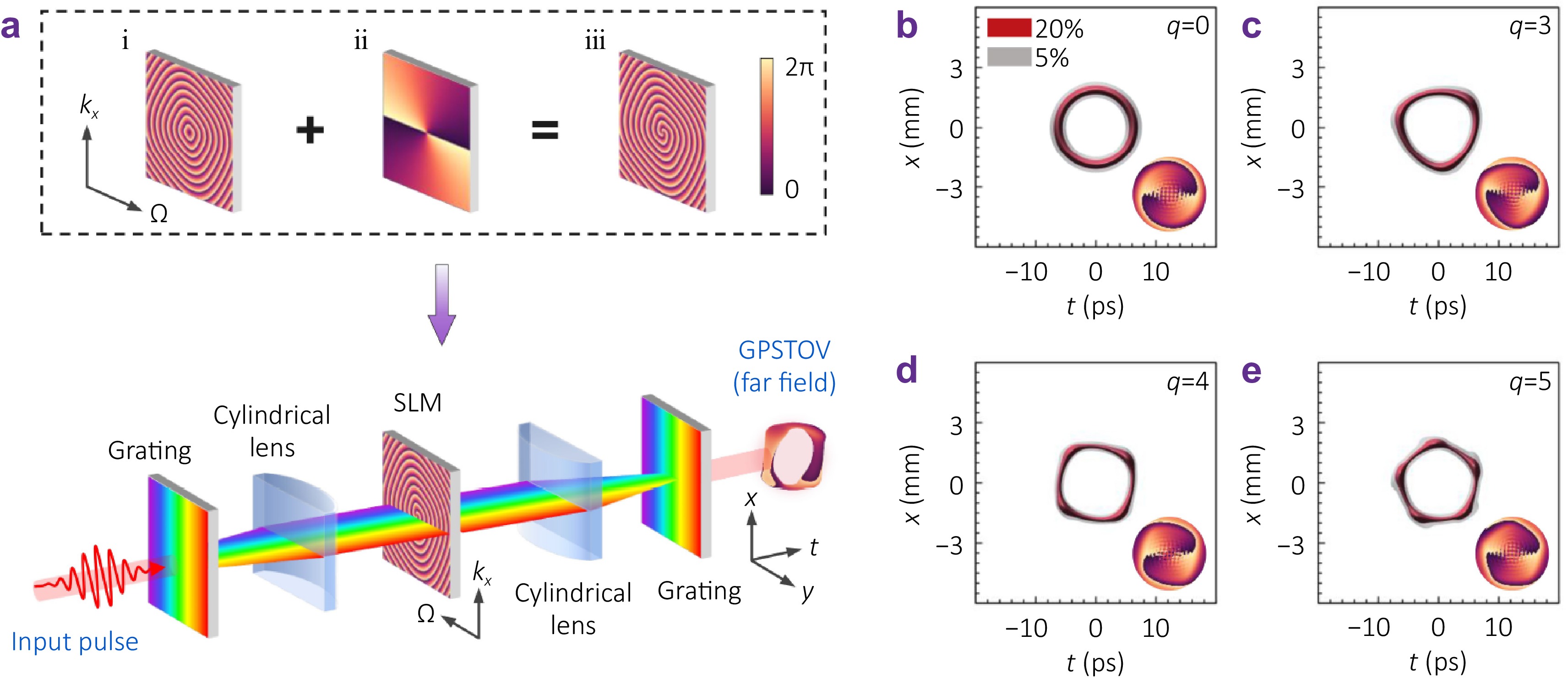
To fill this research gap, we propose the concept of generalized perfect spatiotemporal optical vortices (GPSTOVs), whose intensity profiles can be flexibly engineered while preserving their intrinsic "perfect" properties. Unlike previous complex-amplitude modulation approaches, GPSTOV pulses are generated via a pure-phase modulation scheme, enabling higher modulation efficiency and improved energy utilization.
By encoding a shape-controllable digital axicon and a vortex phase in the spatiotemporal frequency domain, we experimentally realize a family of polygonal GPSTOV pulses with tunable geometries. The measured spatiotemporal profiles agree well with theoretical predictions. Our results expand the scope of PSTOV research and hold promises for applications in optical communications, particle manipulation, and other fields requiring precise spatiotemporal control of ultrafast light pulses.
Ultrafast all-optical modulation of wide-bandwidth pulses enabled by silicon-metasurfaces
Kaloyan Georgiev, Khosro Zangeneh Kamali, Anton A. Trifonov, Giulia Crotti, Lyuben Petrov, Stefan Georgiev, Hristo Iliev, Lei Xu, Unai Arregui Leon, Mohsen Rahmani, Giuseppe Della Valle, Ivan Buchvarov, Dragomir Neshev
Opto-Electronic Advances
2026-09-15
Physics-informed neural fields enable blind aberration correction for partially coherent quantitative phase imaging
Shun Zhou, Xingyu Huang, Linpeng Lu, Habib Ullah, Kaiyu Du, Maciej Trusiak, Malgorzata Kujawinska, Yuzhen Zhang, Yao Fan, Qian Chen, Qinrong Zhang, Chao Zuo
Opto-Electronic Science
2026-08-26
Heterogeneously integrated micro-ring with SnS₂ for dual-functional optical modulation and photodetection
Jinyi Du, Lidan Lu, Xu Zhang, Bofei Zhu, Wenbo Bo, Yingjie Xu, Guang Chen, Yanlin He, Guanghui Ren, Xiaoping Lou, Zheng You, Lianqing Zhu
Opto-Electronic Advances
2026-08-25
Hardware-aware lightweight photonic spiking neural network for pattern classification
Shuiying Xiang, Yahui Zhang, Shangxuan Shi, Haowen Zhao, Dianzhuang Zheng, Xingxing Guo, Yanan Han, Ye Tian, Liyue Zhang, Yuechun Shi, Yue Hao
Opto-Electronic Advances
2026-08-25
PhyspeNet: An empirical physics-aware network for adaptive speckle reconstructive spectrometry
Junrui Liang, Min Jiang, Jun Li, Zhongming Huang, Junhong He, Yanting Guo, Yanzhao Ke, Jun Ye, Jiangming Xu, Jinyong Leng, Pu Zhou
Opto-Electronic Advances
2026-08-25
A 36 × 240 Gbps hybrid mode/wavelength division multiplexing transmitter using lithium niobate on insulator
Mingyu Zhu, Weihan Wang, Ruitao Ma, Aoyun Gao, Chun Gao, Zexu Wang, Fei Huang, Zhenyuan Bao, Dajian Liu, Jiaxuan Gan, Zejie Yu, Huan Li, Weike Zhao, Daoxin Dai
Opto-Electronic Advances
2026-08-25