(Peer-Reviewed) Multi-scale attention residual deep convolutional dealiasing network-assisted unambiguous ultra-long baseline high-precision microwave photonic angle of arrival estimation
Xianglin Chen 陈向林 ¹, Yin Li 李寅 ², Shiru Song 宋世儒 ³, Yalin Yao 姚亚林 ¹, He Cui 崔贺 ¹, Xuan Li 李璇 ⁴, Zhe Guo 郭哲 ⁴, Yinlong Tan 谭银龙 ³, Taolin Liu 刘桃林 ⁴, Tian Jiang 江天 ⁴ ⁵
¹ College of Computer Science and Technology, National University of Defense Technology, Changsha 410073, China
中国 长沙 国防科技大学计算机学院
² Defense Innovation Institute, Academy of Military Sciences, Beijing 100071, China
中国 北京 中国人民解放军军事科学院国防科技创新研究院
³ College of Advanced Interdisciplinary Studies, National University of Defense Technology, Changsha 410073, China
中国 长沙 中国人民解放军国防科技大学前沿交叉学科学院
⁴ College of Science, National University of Defense Technology, Changsha 410073, China
中国 长沙 中国人民解放军国防科技大学理学院
⁵ Hunan Research Center of the Basic Discipline for Physical States, Changsha 410073, China
中国 长沙 湖南省物态模拟与调控基础学科研究中心
Opto-Electronic Technology, 2026-03-20
Abstract
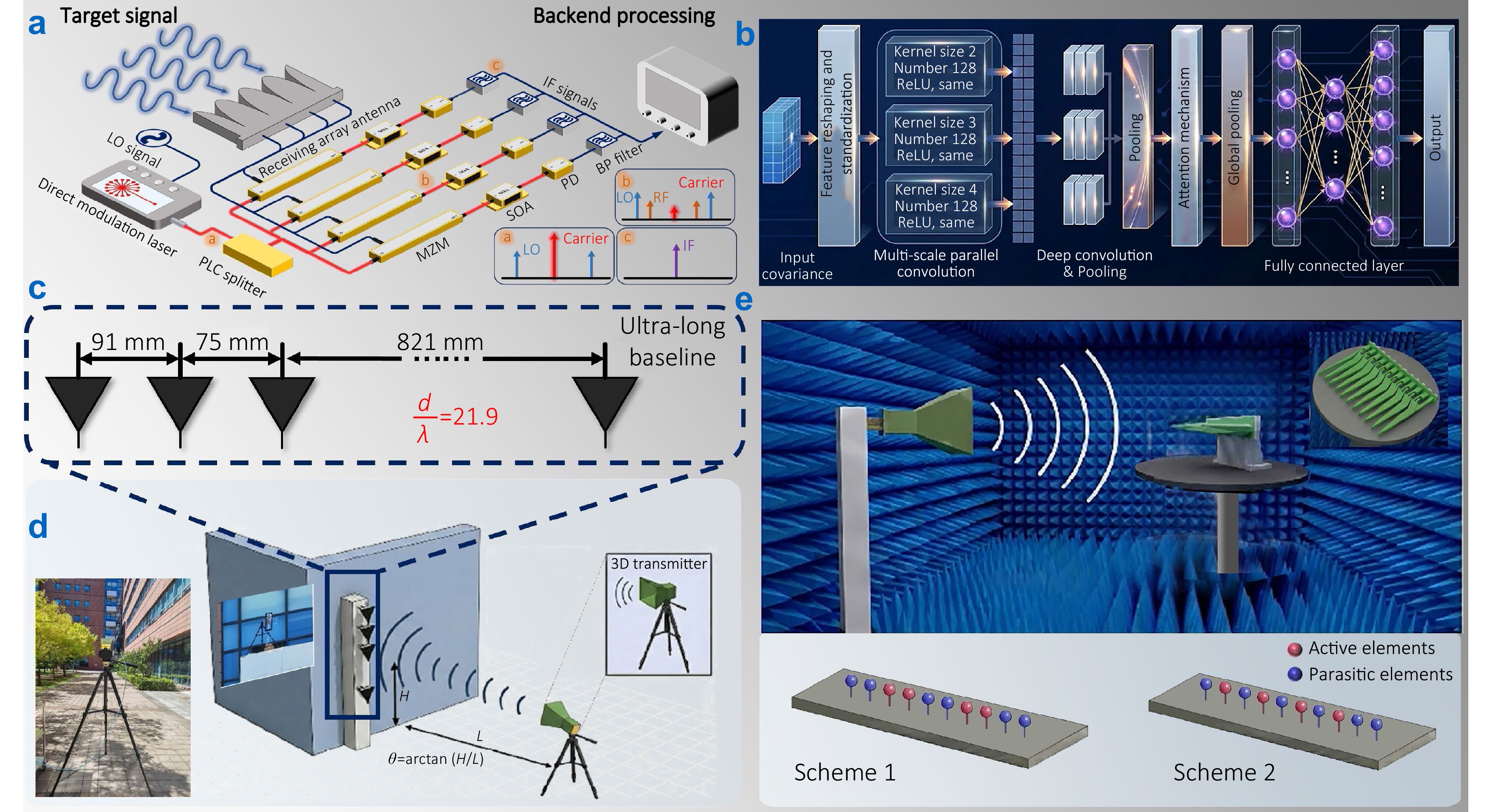
Conventional interferometric angle of arrival (AOA) estimation faces a fundamental limitation: high-precision angle measurement relies on long baselines, which easily introduce phase ambiguity. This issue is particularly pronounced in ultra-wideband (UWB) systems, where traditional ambiguity resolution methods lack robustness. To overcome this challenge, this paper introduces a microwave photonic (MWP) AOA estimation algorithm enhanced by a multi-scale attention residual deep convolutional dealiasing network (MSAR-DCDN).
The proposed method employs the MSAR-DCDN to directly learn the nonlinear relationship between the intermediate frequency (IF) phase and the signal's angle of arrival, thereby bypassing conventional ambiguity resolution and relaxing the traditional trade-off between baseline length and operational bandwidth. Simulations demonstrate that the algorithm maintains strong robustness across a wide signal-to-noise ratio (SNR) range from −10 dB to 25 dB, and achieves an angle estimation accuracy exceeding 93% even at a high baseline-to-wavelength ratio of 2. Outdoor experiments with an 821 mm ultra-long baseline (the baseline-to-wavelength ratio reaches 21.9) further validate the approach, yielding a root mean square error (RMSE) below 0.42°.
These results demonstrate a significant performance improvement over both standard interferometric techniques and their ambiguity-resolved variants. By integrating the UWB capability of MWP with the advanced MSAR-DCDN-based deep learning mechanism, this work presents a novel and effective framework for high-precision AOA estimation in intelligent photonics sensing, which mitigates the baseline length constraint of traditional methods and realizes flexible baseline configuration.
Light-perception-based interactive control of an underwater digital twin hand
Jinlong Lu, Chao Zhang, Hengchang Nong, Dongying Wang, Hongyu Zhou, Junjie Weng, Yuehua Deng, Yang Yu, Qiang Bian, Jianfa Zhang, Chaofan Zhang, Zhenrong Zhang, Junbo Yang
Opto-Electronic Advances
2026-07-10
Unlocking home-based nocturnal health management: A fiber-optic approach for early detection of cardiorespiratory rhythm disorders
Hanyu Jin, Hao Li, Zhuolin Chen, Liangye Li, Zurui Wang, Kai Zhou, Weijian Hang, Zhipeng Chen, Junfeng Chen, Kai Shen, Jianfeng Wen, Chen Chen, Cunzheng Fan, Zhijun Yan, Feng Wang, Qizhen Sun
Opto-Electronic Advances
2026-07-10
A flexible wireless system for prospective photodynamic therapy applications
Rolan Mansour, Bhavani Yalagala, Vikas Vikas, Nikolas Bruce, Fawziye Tarhini, Georgios N. Arvanitakis, Mohammed Mughal, Jamie Blanche, Ahmad Taha, Jonathan Copper, Muhammad Imran, Karin Williams, Karin Oien, Mahmoud Wagih, Hadi Heidari, Robert Hadfield, David Flynn
Opto-Electronic Advances
2026-07-10
Parallel bright-field and multi-order edge imaging via wide field-of-view trichannel metalens
Xiaotong Li, Yeseul Kim, Youngsun Jeon, Junhwa Seong, Jaekyung Kim, Peng Tang, Shiqi Hu, Harit Keawmuang, Beomha Yang, Dongmin Jeon, Le Dai, Weiyan Li, Xiaodong Cai, Jinhui Shi, Yong-Sang Ryu, Trevon Badloe, Junsuk Rho
Opto-Electronic Advances
2026-07-10