(Peer-Reviewed) Tunable compound eyes with coaxial lens-on-lens ommatidia for cooperative bi-focal imaging
Zhi-Juan Sun 孙智娟 ¹, Wei-Jian Zhong 钟伟健 ¹, Qing Cai 蔡晴 ², Yi-Fan Lu 鲁一樊 ² ³, Chang-Xu Li 李昌旭 ¹, Dong-Dong Han 韩冬冬 ¹, Yong-Lai Zhang 张永来 ¹
¹ State Key Laboratory of Integrated Optoelectronics, JLU Region, College of Electronic Science and Engineering, Jilin University, Changchun 130012, China
中国 长春 吉林大学电子科学与工程学院 集成光电子学国家重点实验室
² Department of Oral Implantology, School and Hospital of Stomatology, Jilin University, Changchun 130012, China
中国 长春 吉林大学口腔医学院 口腔种植科
³ Jilin Provincial Key Laboratory of Science and Technology for Stomatology Nanoengineering, Jilin University, Changchun 130012, China
中国 长春 吉林大学 吉林省口腔科学纳米工程重点实验室
Opto-Electronic Advances, 2026-02-09
Abstract
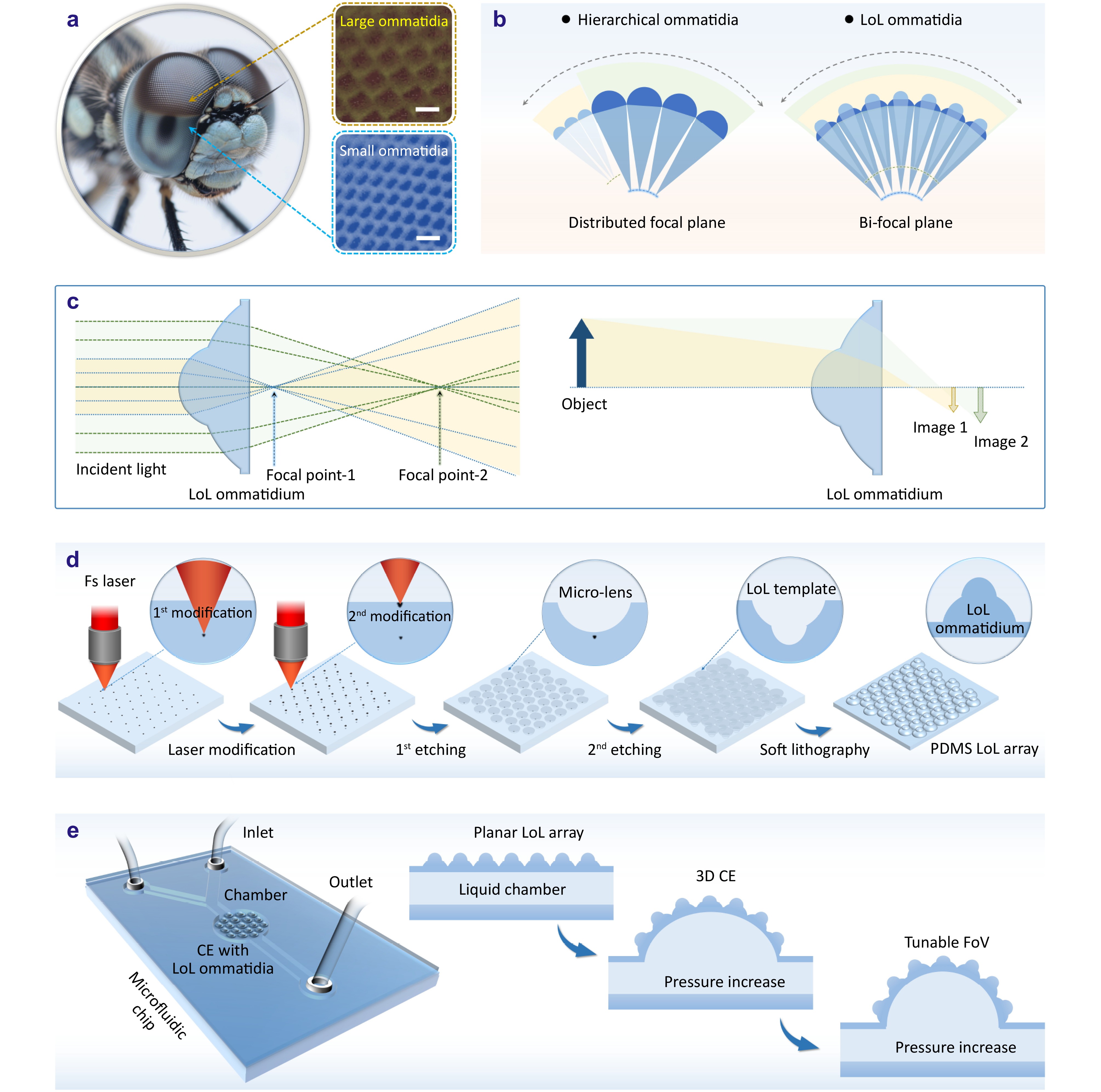
Compound eyes (CEs) offer a unique design paradigm for developing artificial micro-optical systems. However, current bionic CEs still fall significantly short of their insect counterparts in performance, particularly regarding ommatidial spatial arrangement, size distribution, visual field adaptability and environmental perception. Inspired by the CEs of Sympetrum frequens, we developed a tunable bionic CE with bi-focal ommatidia by integrating a flexible lens-on-lens (LoL) array with microfluidics, enabling simultaneous bi-focal imaging.
The polydimethylsiloxane (PDMS) LoL array was fabricated through sequential processing steps, including femtosecond laser dual-modification of quartz glass, two-step wet etching, and soft lithography using the resulting glass template. Integration of this flexible LoL array with a microfluidic chip produced a tunable CE with bi-focal ommatidia, allowing liquid-pressure modulation of CE configurations.
We systematically investigated the optical performance of both LoL ommatidia and the integrated CE, including bi-focal focusing/imaging properties, tunable field-of-view (FOV), large-FOV imaging, and moving target monitoring. This tunable CE with LoL ommatidia demonstrates significant potential for cutting-edge applications.
A 36 × 240 Gbps hybrid mode/wavelength division multiplexing transmitter using lithium niobate on insulator
Mingyu Zhu, Weihan Wang, Ruitao Ma, Aoyun Gao, Chun Gao, Zexu Wang, Fei Huang, Zhenyuan Bao, Dajian Liu, Jiaxuan Gan, Zejie Yu, Huan Li, Weike Zhao, Daoxin Dai
Opto-Electronic Advances
2026-08-25
Light-perception-based interactive control of an underwater digital twin hand
Jinlong Lu, Chao Zhang, Hengchang Nong, Dongying Wang, Hongyu Zhou, Junjie Weng, Yuehua Deng, Yang Yu, Qiang Bian, Jianfa Zhang, Chaofan Zhang, Zhenrong Zhang, Junbo Yang
Opto-Electronic Advances
2026-07-10
Unlocking home-based nocturnal health management: A fiber-optic approach for early detection of cardiorespiratory rhythm disorders
Hanyu Jin, Hao Li, Zhuolin Chen, Liangye Li, Zurui Wang, Kai Zhou, Weijian Hang, Zhipeng Chen, Junfeng Chen, Kai Shen, Jianfeng Wen, Chen Chen, Cunzheng Fan, Zhijun Yan, Feng Wang, Qizhen Sun
Opto-Electronic Advances
2026-07-10
A flexible wireless system for prospective photodynamic therapy applications
Rolan Mansour, Bhavani Yalagala, Vikas Vikas, Nikolas Bruce, Fawziye Tarhini, Georgios N. Arvanitakis, Mohammed Mughal, Jamie Blanche, Ahmad Taha, Jonathan Copper, Muhammad Imran, Karin Williams, Karin Oien, Mahmoud Wagih, Hadi Heidari, Robert Hadfield, David Flynn
Opto-Electronic Advances
2026-07-10
Parallel bright-field and multi-order edge imaging via wide field-of-view trichannel metalens
Xiaotong Li, Yeseul Kim, Youngsun Jeon, Junhwa Seong, Jaekyung Kim, Peng Tang, Shiqi Hu, Harit Keawmuang, Beomha Yang, Dongmin Jeon, Le Dai, Weiyan Li, Xiaodong Cai, Jinhui Shi, Yong-Sang Ryu, Trevon Badloe, Junsuk Rho
Opto-Electronic Advances
2026-07-10