(Peer-Reviewed) Rayleigh-driven ethanol cluster tracking based on non-contact deep optical molecular diagnosis
Geon Mo Kim ¹, Yun Ji Hwang ¹, Chengyi Li ¹, Teajong Hwang ¹, In-Sung Hwang ², James Hone ³, Seong Chan Jun ¹
¹ School of Mechanical Engineering, Yonsei University, 50, Yonsei-ro, Seodaemun-gu, Seoul 03722, Republic of Korea
² Sentech GMI Co. Ltd, Seoul 07548, Republic of Korea
³ Department of Mechanical Engineering, Columbia University, 500 West 120th Street, Mudd 220, New York 10027, USA
Opto-Electronic Advances, 2026-06-08
Abstract
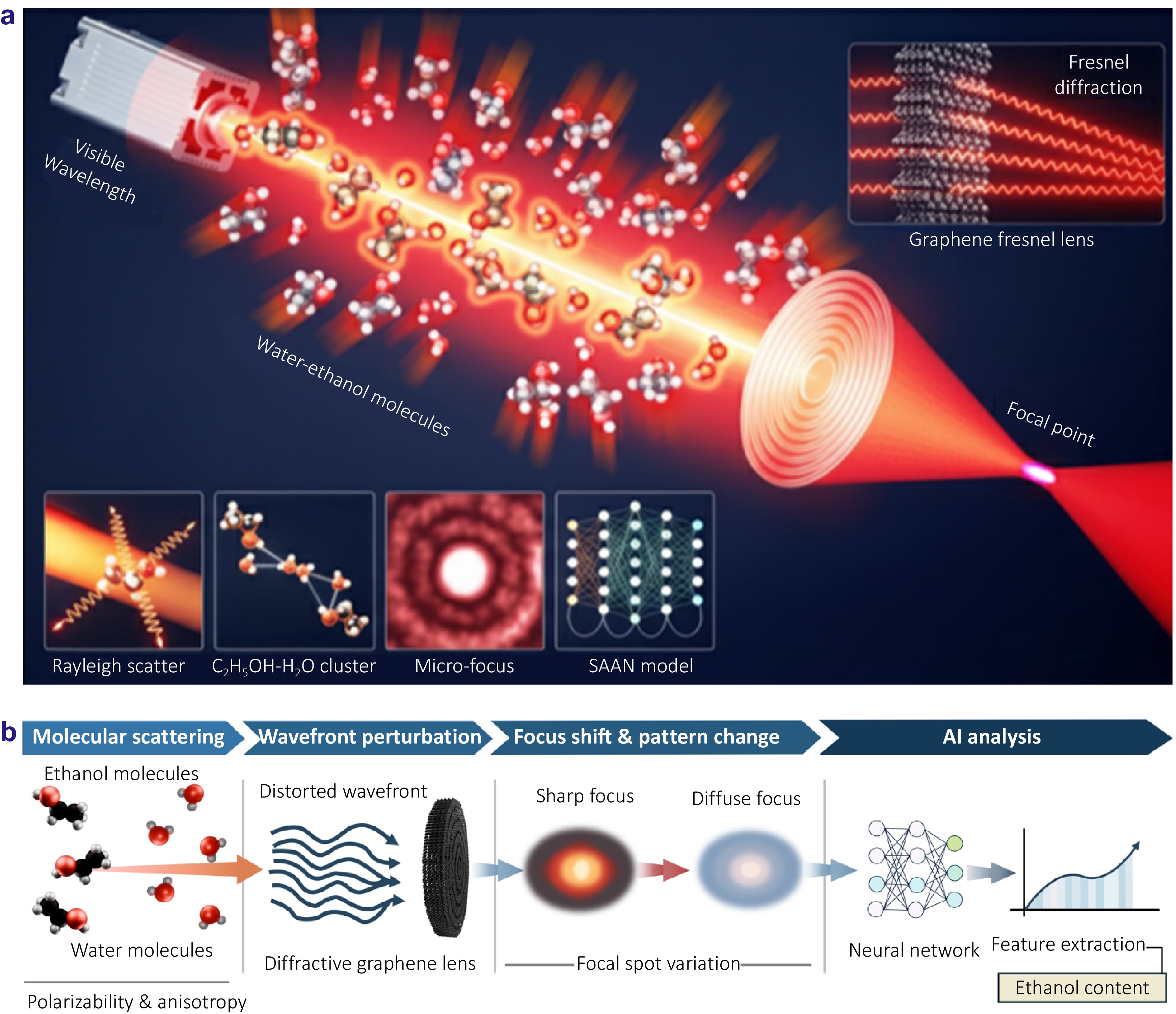
Investigating the composition ratio of ethanol–water molecular clusters in air, which are responsible for anisotropic behavior, is a significant challenge, primarily owing to the difficulty of detecting Rayleigh scattering, an inherently weak signal highly susceptible to external interference. This study overcame these limitations by integrating laser diffraction focusing with artificial neural networks.
We demonstrate a fully non-contact sensing system that circumvents the direct measurement of difficult-to-distinguish Rayleigh scattering signals. Our approach infers ethanol content by utilizing a self-fabricated multi-layered graphene Fresnel lens. An analysis of gaseous ethanol content in the 0.01%–0.1% range revealed that while a wavelength of 405 nm exhibited high sensitivity with up to a 7% intensity change corresponding to ethanol content, a wavelength of 638 nm provided superior stability for deep-learning analysis as its intensity parameter remained fixed. Ultimately, by combining the 638 nm laser with our self-developed self-aware assembly network model, we successfully inferred ethanol content with an R2 of 0.884, even under varied power conditions.
This study creates a new path for recognizing weak Rayleigh scattering signals that were previously difficult to measure and may facilitate the development of rapid and durable sensing systems, such as for the non-invasive diagnosis of gas molecules.
Light-perception-based interactive control of an underwater digital twin hand
Jinlong Lu, Chao Zhang, Hengchang Nong, Dongying Wang, Hongyu Zhou, Junjie Weng, Yuehua Deng, Yang Yu, Qiang Bian, Jianfa Zhang, Chaofan Zhang, Zhenrong Zhang, Junbo Yang
Opto-Electronic Advances
2026-07-10
Unlocking home-based nocturnal health management: A fiber-optic approach for early detection of cardiorespiratory rhythm disorders
Hanyu Jin, Hao Li, Zhuolin Chen, Liangye Li, Zurui Wang, Kai Zhou, Weijian Hang, Zhipeng Chen, Junfeng Chen, Kai Shen, Jianfeng Wen, Chen Chen, Cunzheng Fan, Zhijun Yan, Feng Wang, Qizhen Sun
Opto-Electronic Advances
2026-07-10
A flexible wireless system for prospective photodynamic therapy applications
Rolan Mansour, Bhavani Yalagala, Vikas Vikas, Nikolas Bruce, Fawziye Tarhini, Georgios N. Arvanitakis, Mohammed Mughal, Jamie Blanche, Ahmad Taha, Jonathan Copper, Muhammad Imran, Karin Williams, Karin Oien, Mahmoud Wagih, Hadi Heidari, Robert Hadfield, David Flynn
Opto-Electronic Advances
2026-07-10
Parallel bright-field and multi-order edge imaging via wide field-of-view trichannel metalens
Xiaotong Li, Yeseul Kim, Youngsun Jeon, Junhwa Seong, Jaekyung Kim, Peng Tang, Shiqi Hu, Harit Keawmuang, Beomha Yang, Dongmin Jeon, Le Dai, Weiyan Li, Xiaodong Cai, Jinhui Shi, Yong-Sang Ryu, Trevon Badloe, Junsuk Rho
Opto-Electronic Advances
2026-07-10