(Peer-Reviewed) Emerging optical techniques for sorting and detection of chiral particles
Yuzhi Shi 施宇智 ¹ ² ³ ⁴ ⁵ ⁶ ⁷, Chengfeng Li 李程峰 ⁴ ⁵ ⁶ ⁷, Xiaolei Lin 林晓蕾 ¹ ² ³, Wenwen Xue 薛文文 ¹ ² ³, Chengxing Lai 赖成兴 ⁴ ⁵ ⁶ ⁷, Tao He 何涛 ⁴ ⁵ ⁶ ⁷, Qinghua Song 宋清华 ⁸, Zhanshan Wang 王占山 ⁴ ⁵ ⁶ ⁷, Yulan Wang 王于蓝 ¹ ² ³, Din Ping Tsai 蔡定平 ⁹, Xinbin Cheng 程鑫彬 ⁴ ⁵ ⁶ ⁷, Haidong Zou 邹海东 ¹ ² ³
¹ Shanghai Eye Diseases Prevention & Treatment Center/Shanghai Eye Hospital, School of Medicine, Tongji University, Shanghai 200092, China
中国 上海 上海市眼科医院 同济大学医学院 上海市眼病防治中心
² National Clinical Research Center for Eye Diseases, Shanghai 200080, China
中国 上海 国家眼部疾病临床医学研究中心
³ Shanghai Engineering Center for Precise Diagnosis and Treatment of Eye Diseases, Shanghai 200080, China
中国 上海 上海眼科疾病精准诊疗工程技术研究中心
⁴ Institute of Precision Optical Engineering, School of Physics Science and Engineering, Tongji University, Shanghai 200092, China
中国 上海 同济大学物理科学与工程学院 精密光学工程技术研究所
⁵ MOE Key Laboratory of Advanced Micro-Structured Materials, Shanghai 200092, China
中国 上海 先进微结构材料教育部重点实验室
⁶ Shanghai Institute of Intelligent Science and Technology, Tongji University, Shanghai 200092, China
中国 上海 同济大学工程智能研究院
⁷ Shanghai Frontiers Science Center of Digital Optics, Shanghai 200092, China
中国 上海 上海市数字光学前沿科学研究基地
⁸ Tsinghua Shenzhen International Graduate School, Tsinghua University, Shenzhen 518055, China
中国 深圳 清华大学深圳国际研究生院
⁹ Department of Electrical Engineering, City University of Hong Kong, Kowloon, Hong Kong SAR 999077, China
中国 香港 香港城市大学电机工程系
Opto-Electronic Advances, 2026-06-08
Abstract
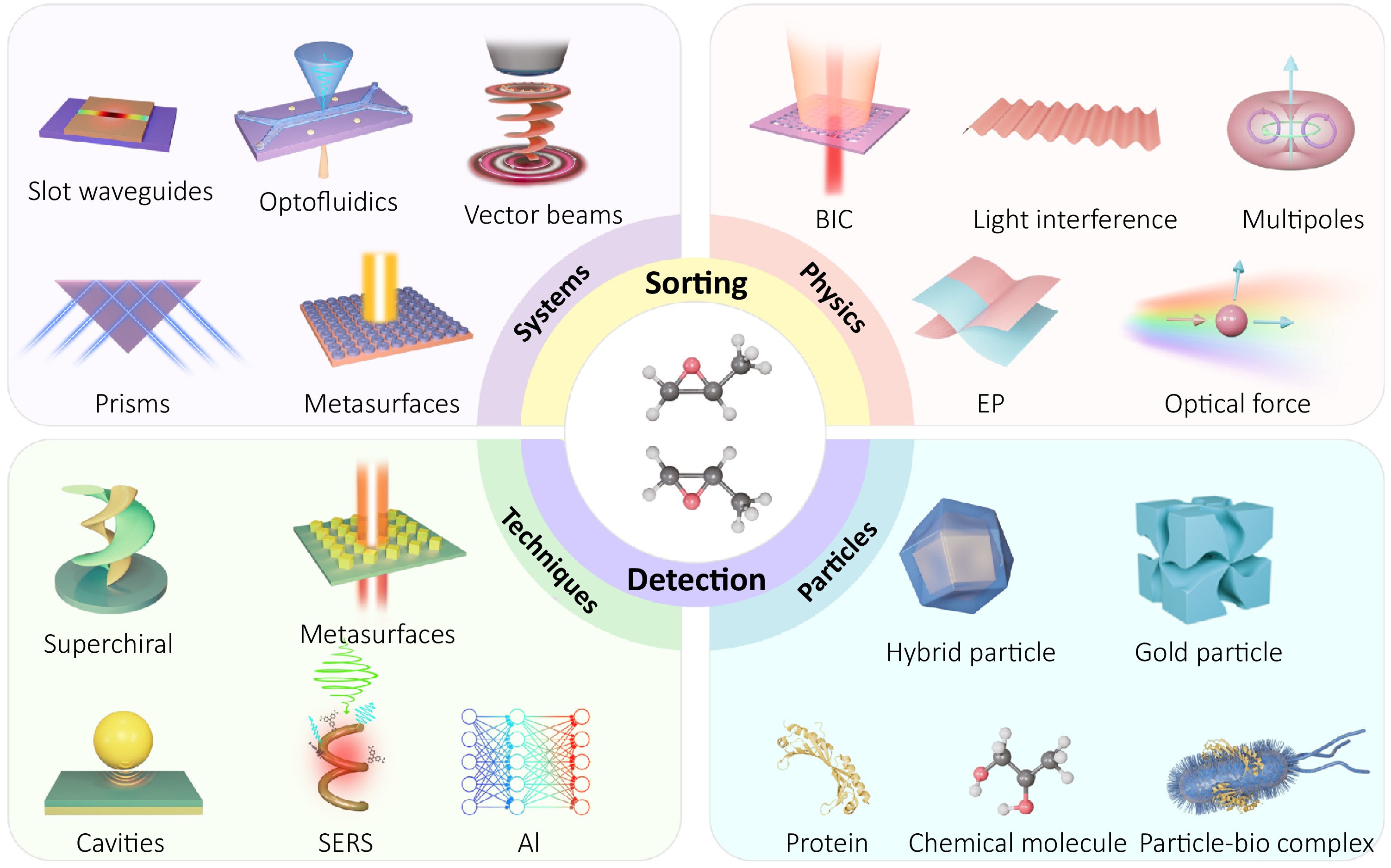
Sorting and detection of enantiomers hold critical importance in biomedical, chemical, and pharmacological sciences due to their fundamental role in molecular interactions and therapeutic efficacy. Over the past two decades, diverse chemical, biophysical, and microfluidic methodologies have been developed for chiral enantiomer sorting and detection.
While these approaches have demonstrated significant capabilities, optical techniques have attracted increasing interest due to their intrinsic advantages, including rapid analysis, minimal sample consumption, and non-invasive operation. This review comprehensively overviews recent advances in optical methods for chiral enantiomer sorting and detection. We focus on emerging optical concepts, including exotic optical forces and engineered light fields, such as bound states in the continuum and metasurfaces, and analyze their operational principles, capabilities, and inherent limitations. Furthermore, we investigate the growing impact of artificial intelligence in reshaping optical sorting and sensing strategies, particularly its role in improving analytical precision and enabling autonomous operation.
The review concludes with a forward-looking perspective, discussing persistent challenges like system scalability and real-world implementation while outlining promising future directions, including integrated lab-on-chip platforms and advanced chiral metamaterials.
Light-perception-based interactive control of an underwater digital twin hand
Jinlong Lu, Chao Zhang, Hengchang Nong, Dongying Wang, Hongyu Zhou, Junjie Weng, Yuehua Deng, Yang Yu, Qiang Bian, Jianfa Zhang, Chaofan Zhang, Zhenrong Zhang, Junbo Yang
Opto-Electronic Advances
2026-07-10
Unlocking home-based nocturnal health management: A fiber-optic approach for early detection of cardiorespiratory rhythm disorders
Hanyu Jin, Hao Li, Zhuolin Chen, Liangye Li, Zurui Wang, Kai Zhou, Weijian Hang, Zhipeng Chen, Junfeng Chen, Kai Shen, Jianfeng Wen, Chen Chen, Cunzheng Fan, Zhijun Yan, Feng Wang, Qizhen Sun
Opto-Electronic Advances
2026-07-10
A flexible wireless system for prospective photodynamic therapy applications
Rolan Mansour, Bhavani Yalagala, Vikas Vikas, Nikolas Bruce, Fawziye Tarhini, Georgios N. Arvanitakis, Mohammed Mughal, Jamie Blanche, Ahmad Taha, Jonathan Copper, Muhammad Imran, Karin Williams, Karin Oien, Mahmoud Wagih, Hadi Heidari, Robert Hadfield, David Flynn
Opto-Electronic Advances
2026-07-10
Parallel bright-field and multi-order edge imaging via wide field-of-view trichannel metalens
Xiaotong Li, Yeseul Kim, Youngsun Jeon, Junhwa Seong, Jaekyung Kim, Peng Tang, Shiqi Hu, Harit Keawmuang, Beomha Yang, Dongmin Jeon, Le Dai, Weiyan Li, Xiaodong Cai, Jinhui Shi, Yong-Sang Ryu, Trevon Badloe, Junsuk Rho
Opto-Electronic Advances
2026-07-10