(Peer-Reviewed) Highly sensitive DUV-SWIR photodetectors by natural flavonoid-derivative isomers through a multisite chelation strategy
Nan Ding 丁楠 ¹, Donggang Li 李东纲 ¹, Mingyu Yao 姚明宇 ¹, Yanqi Liu 刘延琦 ¹, Hailong Liu 刘海龙 ¹, Guoqiang Fang 方国强 ¹, Ge Zhu 朱革 ¹, Xiaodong Li 李小东 ², Wen Xu 徐文 ¹, Bin Dong 董斌 ¹
¹ Key Laboratory of New Energy and Rare Earth Resource Utilization of State Ethnic Affairs Commission, School of Physics and Materials Engineering, Dalian Minzu University, Dalian 116600, China
中国 大连 大连民族大学物理与材料工程学院 国家民委新能源与稀土资源利用重点实验室
² College of Information Engineering, Guizhou University of Traditional Chinese Medicine, Guiyang 550025, China
中国 贵阳 贵州中医药大学信息工程学院
Opto-Electronic Science, 2026-06-17
Abstract
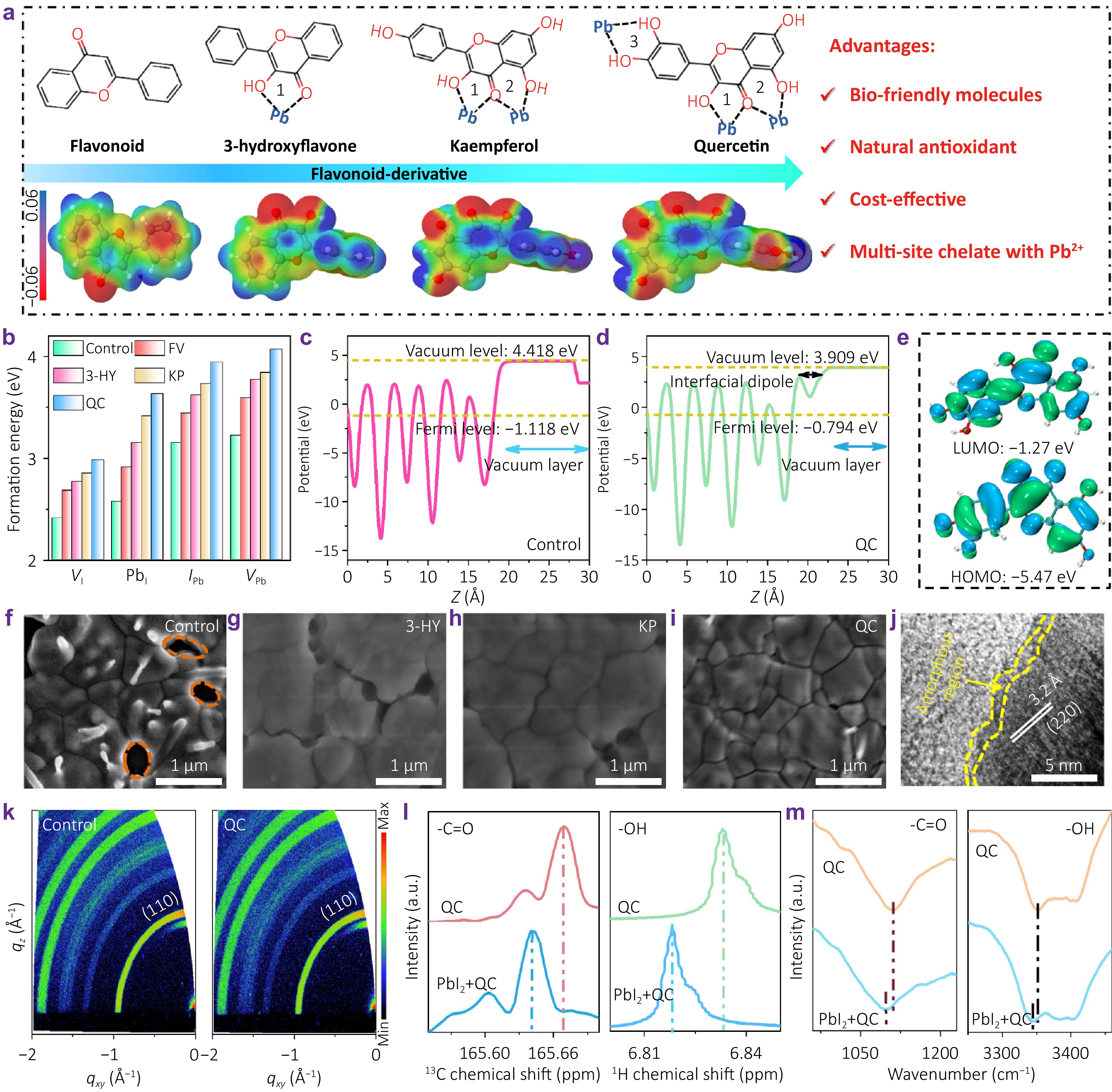
Achieving high crystallization and excellent charge transport in lead halide perovskite is crucial for broadband photodetectors (PDs), but remains a significant challenge. Herein, a series of natural flavonoid-derivative isomers with hydroxy and carbonyl groups are applied to modify perovskite PDs. Unlike the single-point coordination or weak van der Waals interactions commonly observed between organic molecules and perovskite, the multiple functional groups in isomers can form stable chelate ring to "lock" Pb2+, enhancing crystal quality, reducing defects density, and improving stability. Especially, quercetin (QC) modified perovskite achieves the outstanding performance stemming from the coordination of its multisite acidic hydroxyl groups, which creates an optimal stereochemical environment for chelation.
Moreover, the QC treatment imparts more pronounced n-type behavior of perovskite, optimizing the energy alignment and facilitating interfacial charge extraction, thereby improving the sensitivity of PDs. Consequently, a single deep-ultraviolet-to-short-wavelength-infrared PD is fabricated by combining the QC modified perovskite with In0.53Ga0.47As, showing a detectivity of 2.71×10¹³ Jones and an external quantum efficiency of 189.41%. Furthermore, unencapsulated device retains 98.4% of its initial sensitivity after 50000 ON/OFF cycles. Ultimately, the PD array is constructed for high-resolution pixel-level multispectral imaging.
Ultrafast all-optical modulation of wide-bandwidth pulses enabled by silicon-metasurfaces
Kaloyan Georgiev, Khosro Zangeneh Kamali, Anton A. Trifonov, Giulia Crotti, Lyuben Petrov, Stefan Georgiev, Hristo Iliev, Lei Xu, Unai Arregui Leon, Mohsen Rahmani, Giuseppe Della Valle, Ivan Buchvarov, Dragomir Neshev
Opto-Electronic Advances
2026-09-15
Physics-informed neural fields enable blind aberration correction for partially coherent quantitative phase imaging
Shun Zhou, Xingyu Huang, Linpeng Lu, Habib Ullah, Kaiyu Du, Maciej Trusiak, Malgorzata Kujawinska, Yuzhen Zhang, Yao Fan, Qian Chen, Qinrong Zhang, Chao Zuo
Opto-Electronic Science
2026-08-26
Heterogeneously integrated micro-ring with SnS₂ for dual-functional optical modulation and photodetection
Jinyi Du, Lidan Lu, Xu Zhang, Bofei Zhu, Wenbo Bo, Yingjie Xu, Guang Chen, Yanlin He, Guanghui Ren, Xiaoping Lou, Zheng You, Lianqing Zhu
Opto-Electronic Advances
2026-08-25
Hardware-aware lightweight photonic spiking neural network for pattern classification
Shuiying Xiang, Yahui Zhang, Shangxuan Shi, Haowen Zhao, Dianzhuang Zheng, Xingxing Guo, Yanan Han, Ye Tian, Liyue Zhang, Yuechun Shi, Yue Hao
Opto-Electronic Advances
2026-08-25
PhyspeNet: An empirical physics-aware network for adaptive speckle reconstructive spectrometry
Junrui Liang, Min Jiang, Jun Li, Zhongming Huang, Junhong He, Yanting Guo, Yanzhao Ke, Jun Ye, Jiangming Xu, Jinyong Leng, Pu Zhou
Opto-Electronic Advances
2026-08-25
A 36 × 240 Gbps hybrid mode/wavelength division multiplexing transmitter using lithium niobate on insulator
Mingyu Zhu, Weihan Wang, Ruitao Ma, Aoyun Gao, Chun Gao, Zexu Wang, Fei Huang, Zhenyuan Bao, Dajian Liu, Jiaxuan Gan, Zejie Yu, Huan Li, Weike Zhao, Daoxin Dai
Opto-Electronic Advances
2026-08-25