(Peer-Reviewed) Cavity-assisted nonlocal metasurfaces for momentum-space broadband-operational optical vortice generation with maximum efficiency approaching 80%
Keren Wang 王柯人 ¹, Kaili Sun 孙开礼 ², Jing Du ¹, Peijuan Dai ¹, Hao Zhou 周昊 ³, Lujun Huang 黄陆军 ⁴, Zhanghua Han 韩张华 ², Wei Wang 王卫 ¹
¹ College of Physics, Sichuan University, Chengdu 610064, China
中国 成都 四川大学物理学院
² Shandong Provincial Key Laboratory of Optics and Photonic Devices, Center of Light Manipulation and Applications, School of Physics and Electronics, Shandong Normal University, Jinan 250358, China
中国 济南 山东师范大学物理与电子科学学院 光场调控及应用中心 光学与光子器件技术重点实验室
³ College of Electronics and Information Engineering, Sichuan University, Chengdu 610064, China
中国 成都 四川大学电子信息学院
⁴ State Key Laboratory of Precision Spectroscopy, School of Physics, East China Normal University, Shanghai 200241, China
中国 上海 华东师范大学物理与电子科学学院 精密光谱科学与技术国家重点实验室
Opto-Electronic Advances, 2026-07-10
Abstract
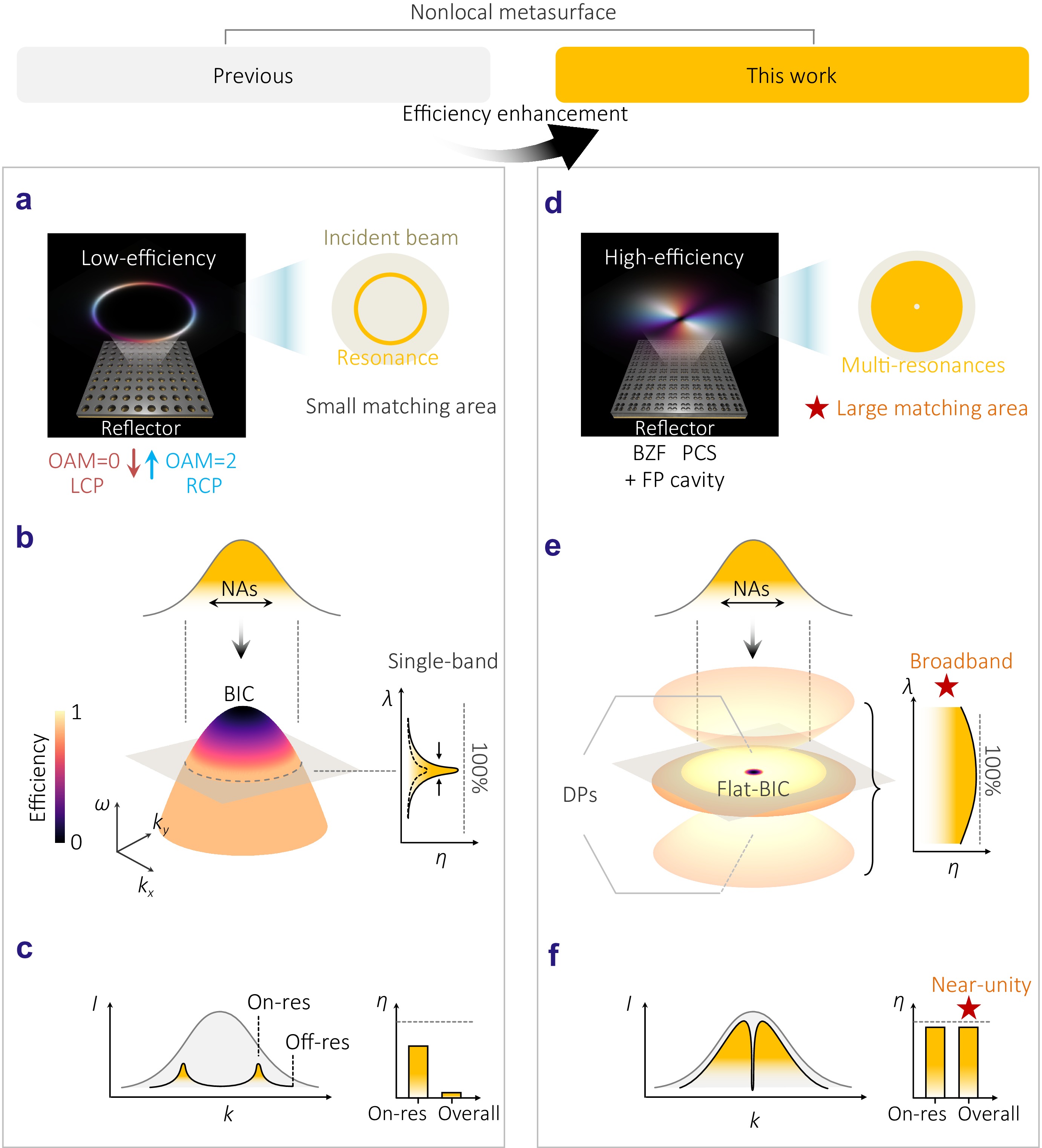
Nonlocal metasurfaces generate optical vortices via momentum-space topological singularities, eliminating the need for complex meta-atom phasing or precise beam alignment. Their utility has been constrained by narrow bandwidth and low efficiency stemming from the steep dispersion of high-Q resonances. Here, we introduce a cavity-assisted reflective nonlocal metasurface that overcomes these limits by hybridizing bound states in the continuum (BICs) with degeneracy points (DPs).
A Fabry-Pérot cavity supplies a single, addressable control for BIC-DP coupling, enabling deterministic tuning of dispersion, radiative Q, and polarization to realize quasi-flat bands with strong scattering. Simulations predict near-unity on-resonance conversion and >90% overall efficiency—3–4× higher and >15× broader than conventional designs. Experiments confirm operation from 1480 to 1600 nm with ~80% peak efficiency and 91.7% OAM purity, while suppressing edge effects and markedly reducing sensitivity to alignment, beam profile, and numerical aperture. Crucially, the device enables broadband, efficient conversion of zero-order Bessel beams into high-quality, OAM-carrying perfect vortex beams—performance not achieved by prior metasurfaces.
These results establish a practical, scalable route to broadband, high-efficiency vortex generation for high-dimensional optical communications, advanced imaging, and quantum photonics.
Unlocking home-based nocturnal health management: A fiber-optic approach for early detection of cardiorespiratory rhythm disorders
Hanyu Jin, Hao Li, Zhuolin Chen, Liangye Li, Zurui Wang, Kai Zhou, Weijian Hang, Zhipeng Chen, Junfeng Chen, Kai Shen, Jianfeng Wen, Chen Chen, Cunzheng Fan, Zhijun Yan, Feng Wang, Qizhen Sun
Opto-Electronic Advances
2026-07-10
A flexible wireless system for prospective photodynamic therapy applications
Rolan Mansour, Bhavani Yalagala, Vikas Vikas, Nikolas Bruce, Fawziye Tarhini, Georgios N. Arvanitakis, Mohammed Mughal, Jamie Blanche, Ahmad Taha, Jonathan Copper, Muhammad Imran, Karin Williams, Karin Oien, Mahmoud Wagih, Hadi Heidari, Robert Hadfield, David Flynn
Opto-Electronic Advances
2026-07-10
Parallel bright-field and multi-order edge imaging via wide field-of-view trichannel metalens
Xiaotong Li, Yeseul Kim, Youngsun Jeon, Junhwa Seong, Jaekyung Kim, Peng Tang, Shiqi Hu, Harit Keawmuang, Beomha Yang, Dongmin Jeon, Le Dai, Weiyan Li, Xiaodong Cai, Jinhui Shi, Yong-Sang Ryu, Trevon Badloe, Junsuk Rho
Opto-Electronic Advances
2026-07-10