(Peer-Reviewed) 3D-printed copper water cooling system assisted fabrication of 10.6-μm high-power CO₂ laser resistance reflectors
Hongfei Jiao ¹ ² ³, Binbin Jiang ¹ ² ³, Xinshang Niu ¹ ² ³, Yifan Wang ¹ ² ³, Dongdong Li ¹ ² ³, Jun Yu ¹ ² ³, Xiaochuan Ji ¹ ² ³, Jingjing Xia ¹ ² ³, Jinlong Zhang ¹ ² ³, Xinbin Cheng ¹ ² ³, Zhanshan Wang ¹ ² ³
¹ MOE Key Laboratory of Advanced Micro-Structured Materials, Tongji University, Shanghai 200092, China
中国 上海 同济大学先进微结构材料教育部重点实验室
² Institute of Precision Optical Engineering, School of Physics Science and Engineering, Tongji University, Shanghai 200092, China
中国 上海 同济大学精密光学工程技术研究所
³ Shanghai Professional Technical Service Platform for Full-Spectrum and High-Performance Optical Thin Film Devices and Applications, Shanghai 200092, China
中国 上海 上海市全光谱高性能光学薄膜器件及应用专业技术服务平台
Opto-Electronic Advances, 2026-09-15
Abstract
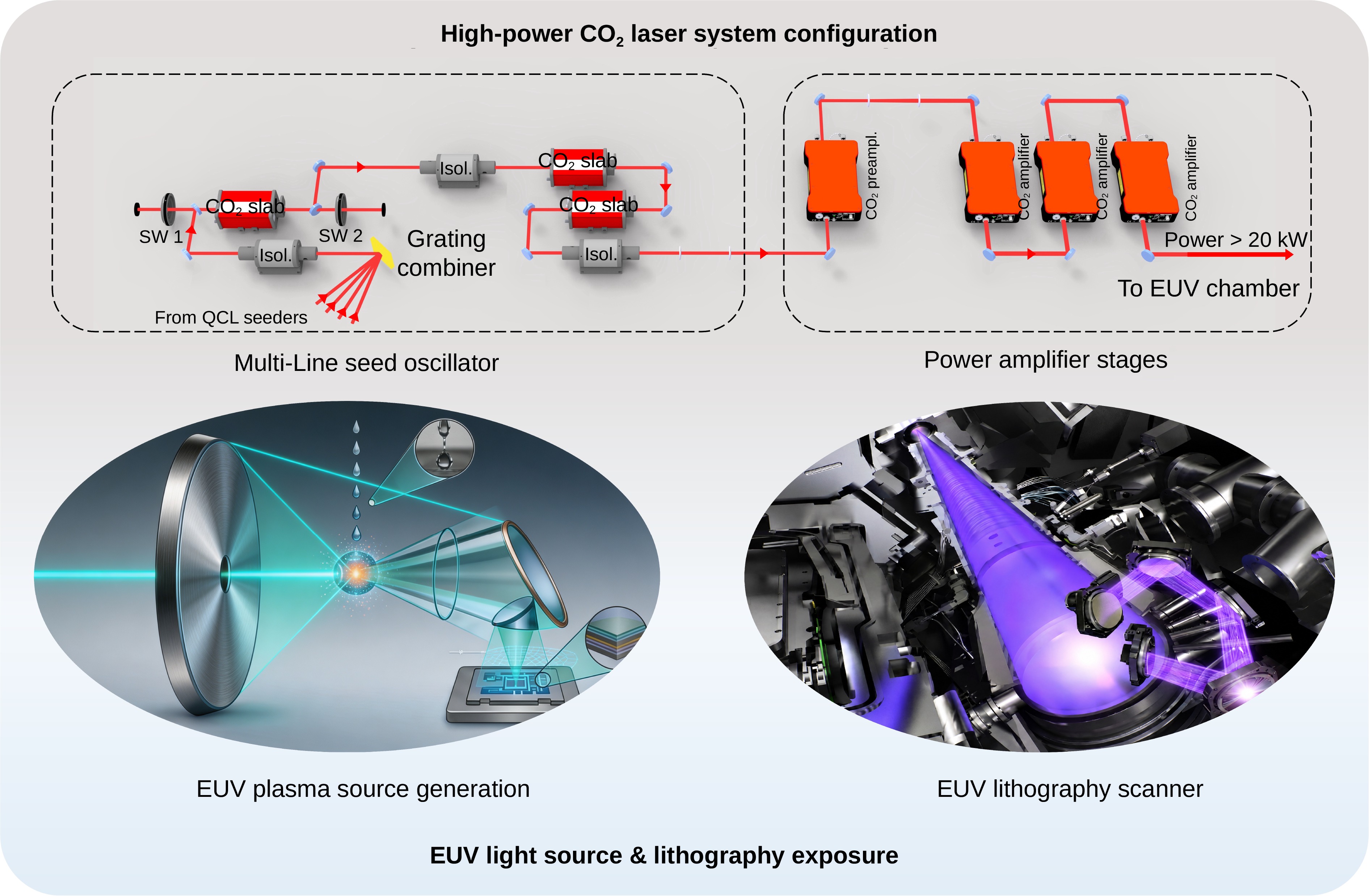
The rapid advance of high-power CO₂ laser systems is urgently calling the innovation of laser beam reflectors with a high laser-induced damage threshold (LIDT) above 10000 W/cm² for their stable operation in extreme conditions. In this work, we integrated a 3D-printed copper water-cooling system (laser powder bed fusion fabricated) with a multilayer coating technique to promote the LIDT of 10.6 μm reflectors, surface modification using electron beam evaporation ion beam assisted deposition (IAD) of Cu films, and 10.6 μm reflective films of 3251 nm in thickness (800 nm-Ge/699 nm-ZnS/779 nm-Ge/863 nm-ZnS/100 nm-Au/10 nm-Cr).
After integration of a water-cooling system, the surface temperature upon of 5093 W/cm² drops 53% (45.00 °C vs. 84.20 °C) and the LIDT increased by 60% (8488 ± 127 to 13581 ± 203 W/cm2), demonstrating a performance enhancement while reflectance of >99.50% at 45°. Cu-modified layer’s high thermal conductivity (401 W/(m·K)) suppresses thermal accumulation, thermal deformation peak-to-valley falls from 12292 nm (1.16 λ) to 3082 nm (0.29 λ). While keeping the reflective multi-layer and just changing of the 1st-layer coating, Cu-modified layer is found to exhibit superior thermal dissipation properties over Ni-modified layer.
This work is instructive regarding for realizing better thermal control of reflectors for high-power laser-containing high-end equipment such as EUV lithography.
Light-perception-based interactive control of an underwater digital twin hand
Jinlong Lu, Chao Zhang, Hengchang Nong, Dongying Wang, Hongyu Zhou, Junjie Weng, Yuehua Deng, Yang Yu, Qiang Bian, Jianfa Zhang, Chaofan Zhang, Zhenrong Zhang, Junbo Yang
Opto-Electronic Advances
2026-07-10
Unlocking home-based nocturnal health management: A fiber-optic approach for early detection of cardiorespiratory rhythm disorders
Hanyu Jin, Hao Li, Zhuolin Chen, Liangye Li, Zurui Wang, Kai Zhou, Weijian Hang, Zhipeng Chen, Junfeng Chen, Kai Shen, Jianfeng Wen, Chen Chen, Cunzheng Fan, Zhijun Yan, Feng Wang, Qizhen Sun
Opto-Electronic Advances
2026-07-10
A flexible wireless system for prospective photodynamic therapy applications
Rolan Mansour, Bhavani Yalagala, Vikas Vikas, Nikolas Bruce, Fawziye Tarhini, Georgios N. Arvanitakis, Mohammed Mughal, Jamie Blanche, Ahmad Taha, Jonathan Copper, Muhammad Imran, Karin Williams, Karin Oien, Mahmoud Wagih, Hadi Heidari, Robert Hadfield, David Flynn
Opto-Electronic Advances
2026-07-10
Parallel bright-field and multi-order edge imaging via wide field-of-view trichannel metalens
Xiaotong Li, Yeseul Kim, Youngsun Jeon, Junhwa Seong, Jaekyung Kim, Peng Tang, Shiqi Hu, Harit Keawmuang, Beomha Yang, Dongmin Jeon, Le Dai, Weiyan Li, Xiaodong Cai, Jinhui Shi, Yong-Sang Ryu, Trevon Badloe, Junsuk Rho
Opto-Electronic Advances
2026-07-10