(Peer-Reviewed) Laser-induced phase transitions in 2D materials: from microscopic mechanisms to device applications
Yao Yao ¹ ² ³, Yinzhou Yan ³
¹ nstitute of Manufacturing Engineering, Huaqiao University, Xiamen 361021, China
中国 厦门 华侨大学制造工程研究院
² State Key Laboratory for High Performance Tools, Xiamen 361021, China
中国 厦门 高性能工具全国重点实验室
³ School of Physics and Optoelectronic Engineering, Beijing University of Technology, Beijing 100124, China
中国 北京 北京工业大学物理与光电工程学院
Opto-Electronic Manufacturing, 2026-09-25
Abstract
Two-dimensional (2D) materials exhibit a rich variety of crystal phases, which impart distinctly different electrical conductivity, optical response, and catalytic activity. This diversity makes phase engineering a core strategy for on-demand property tuning in 2D materials. To date, various phase engineering strategies have been developed, including chemical intercalation, strain engineering, and electrostatic gating.
These approaches offer distinct advantages for specific scenarios, but each is also subject to intrinsic limitations, such as the introduction of extrinsic species, restricted modulation range, or limited compatibility with fabrication processing. Laser-induced phase transition (LIPT) has emerged over the past decade as a complementary route that addresses some of these constraints. Owing to the high temporal resolution, localized energy deposition, and non-equilibrium processing capability, LIPT can drive phase transitions on timescales ranging from femtoseconds to nanoseconds, while the spatial resolution, phase purity, and long-term stability remain active areas of investigation.
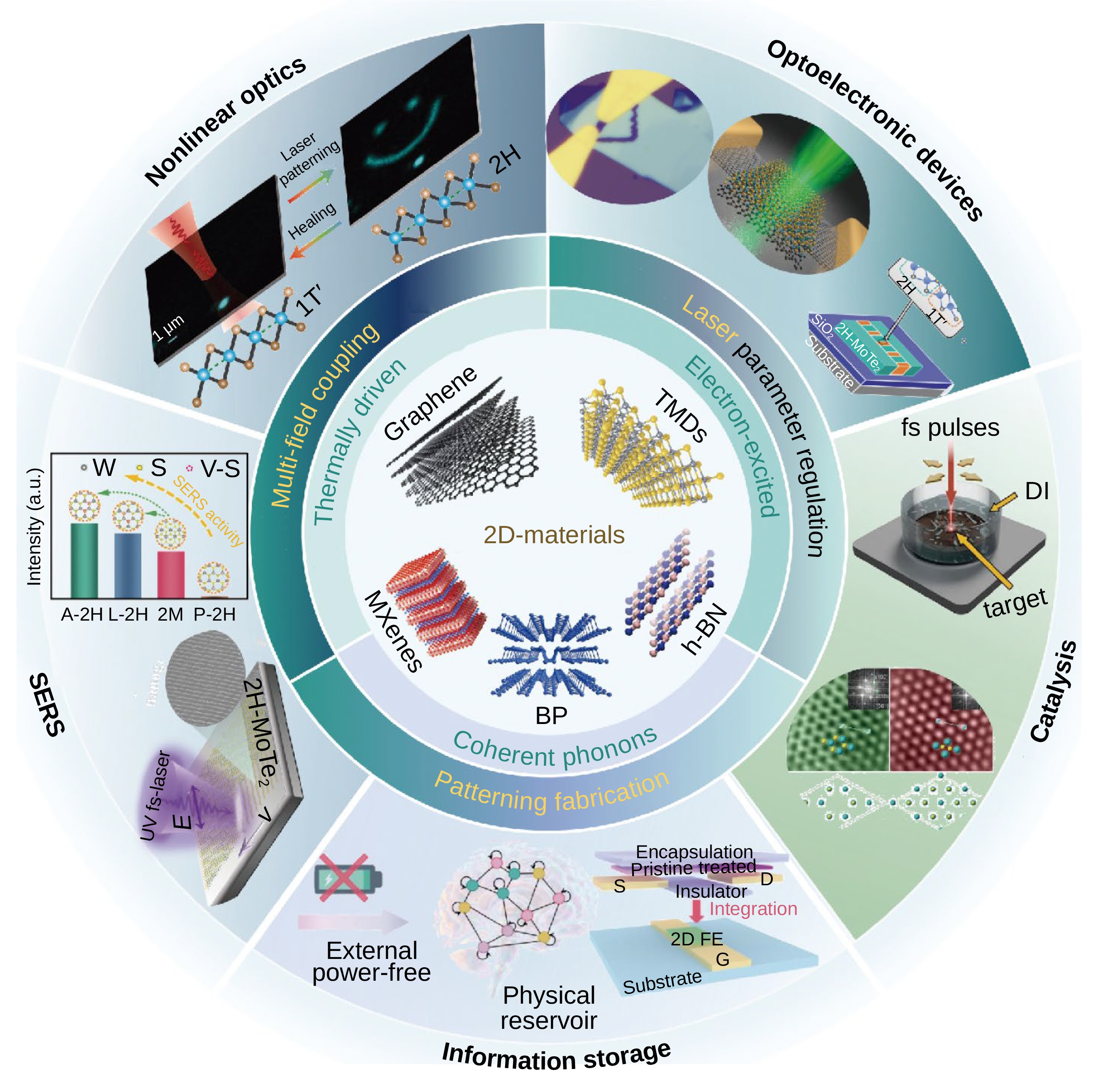
This review systematically summarizes recent advances in LIPT applied to 2D materials. The underlying mechanisms, including thermally driven, electronically excited, and coherent-phonon-mediated transitions, are discussed. The regulation strategies of LIPT in terms of optical field, field assistance, and spatial field are also systematically discussed. Finally, the cutting-edge device applications enabled by LIPT are explored in depth, by which the future developments and applications are prospected.
Ultrafast all-optical modulation of wide-bandwidth pulses enabled by silicon-metasurfaces
Kaloyan Georgiev, Khosro Zangeneh Kamali, Anton A. Trifonov, Giulia Crotti, Lyuben Petrov, Stefan Georgiev, Hristo Iliev, Lei Xu, Unai Arregui Leon, Mohsen Rahmani, Giuseppe Della Valle, Ivan Buchvarov, Dragomir Neshev
Opto-Electronic Advances
2026-09-15
Physics-informed neural fields enable blind aberration correction for partially coherent quantitative phase imaging
Shun Zhou, Xingyu Huang, Linpeng Lu, Habib Ullah, Kaiyu Du, Maciej Trusiak, Malgorzata Kujawinska, Yuzhen Zhang, Yao Fan, Qian Chen, Qinrong Zhang, Chao Zuo
Opto-Electronic Science
2026-08-26
Heterogeneously integrated micro-ring with SnS₂ for dual-functional optical modulation and photodetection
Jinyi Du, Lidan Lu, Xu Zhang, Bofei Zhu, Wenbo Bo, Yingjie Xu, Guang Chen, Yanlin He, Guanghui Ren, Xiaoping Lou, Zheng You, Lianqing Zhu
Opto-Electronic Advances
2026-08-25
Hardware-aware lightweight photonic spiking neural network for pattern classification
Shuiying Xiang, Yahui Zhang, Shangxuan Shi, Haowen Zhao, Dianzhuang Zheng, Xingxing Guo, Yanan Han, Ye Tian, Liyue Zhang, Yuechun Shi, Yue Hao
Opto-Electronic Advances
2026-08-25
PhyspeNet: An empirical physics-aware network for adaptive speckle reconstructive spectrometry
Junrui Liang, Min Jiang, Jun Li, Zhongming Huang, Junhong He, Yanting Guo, Yanzhao Ke, Jun Ye, Jiangming Xu, Jinyong Leng, Pu Zhou
Opto-Electronic Advances
2026-08-25
A 36 × 240 Gbps hybrid mode/wavelength division multiplexing transmitter using lithium niobate on insulator
Mingyu Zhu, Weihan Wang, Ruitao Ma, Aoyun Gao, Chun Gao, Zexu Wang, Fei Huang, Zhenyuan Bao, Dajian Liu, Jiaxuan Gan, Zejie Yu, Huan Li, Weike Zhao, Daoxin Dai
Opto-Electronic Advances
2026-08-25