(Peer-Reviewed) Ultrafast laser direct writing of highly conductive copper micropatterns
Songyan Xue ¹, Chunsan Deng ¹, Mingduo Zhang ¹, Huace Hu ¹, Fayu Chen ¹, Leimin Deng ¹, Jianguo Liu ¹, Hui Gao ¹ ², Wei Xiong ¹ ²
¹ Wuhan National Laboratory for Optoelectronics, School of Optical and Electronic Information, Huazhong University of Science and Technology, Wuhan 430074, China
中国 武汉 华中科技大学光学与电子信息学院 武汉光电国家研究中心
² Optics Valley Laboratory, Hubei 430074, China
中国 武汉 湖北光谷实验室
Opto-Electronic Manufacturing, 2026-09-30
Abstract
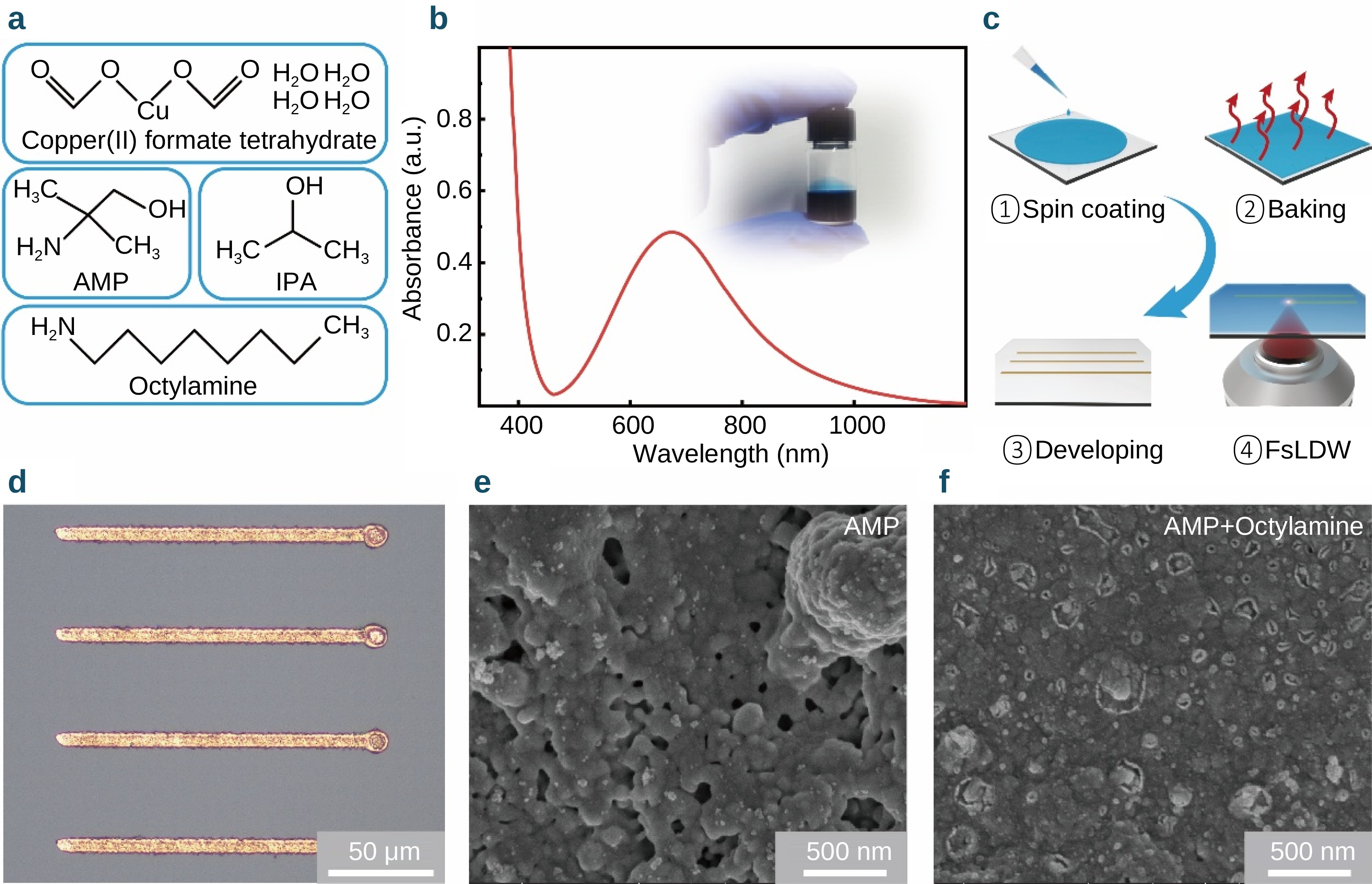
Copper (Cu) interconnects are fundamental to advanced optoelectronic systems. Femtosecond laser direct writing (FsLDW) employing particle-free Cu ion inks provides a compelling “cold processing” approach; however, it frequently results in porous, high-resistivity structures caused by disordered grain growth and solvent-induced micro-explosions.
Here, we report a high-precision FsLDW strategy utilizing a specifically formulated metal-organic complex ink. By decreasing the reduction energy barrier and regulating crystallization via a composite amine complex, combined with a pre-baking step to suppress micro-explosions, we achieve Cu micropatterns with a highly dense surface morphology under ambient conditions. The resulting structures demonstrate a minimum resistivity of 9.34 μΩ·cm (approximately 5.5 times that of bulk Cu) while maintaining sub-10 μm linewidths.
Moreover, this method exhibits broad processing adaptability and substrate compatibility, facilitating reliable metallization on flexible substrates, macroscopic wafers, and curved surfaces. The fabricated Cu interconnects function as stable signal and power transmission pathways within a fully FsLDW-patterned UV photodetector. This study establishes a practical route for deploying high-performance conductive networks in advanced electronic systems.
Ultrafast all-optical modulation of wide-bandwidth pulses enabled by silicon-metasurfaces
Kaloyan Georgiev, Khosro Zangeneh Kamali, Anton A. Trifonov, Giulia Crotti, Lyuben Petrov, Stefan Georgiev, Hristo Iliev, Lei Xu, Unai Arregui Leon, Mohsen Rahmani, Giuseppe Della Valle, Ivan Buchvarov, Dragomir Neshev
Opto-Electronic Advances
2026-09-15
Physics-informed neural fields enable blind aberration correction for partially coherent quantitative phase imaging
Shun Zhou, Xingyu Huang, Linpeng Lu, Habib Ullah, Kaiyu Du, Maciej Trusiak, Malgorzata Kujawinska, Yuzhen Zhang, Yao Fan, Qian Chen, Qinrong Zhang, Chao Zuo
Opto-Electronic Science
2026-08-26
Heterogeneously integrated micro-ring with SnS₂ for dual-functional optical modulation and photodetection
Jinyi Du, Lidan Lu, Xu Zhang, Bofei Zhu, Wenbo Bo, Yingjie Xu, Guang Chen, Yanlin He, Guanghui Ren, Xiaoping Lou, Zheng You, Lianqing Zhu
Opto-Electronic Advances
2026-08-25
Hardware-aware lightweight photonic spiking neural network for pattern classification
Shuiying Xiang, Yahui Zhang, Shangxuan Shi, Haowen Zhao, Dianzhuang Zheng, Xingxing Guo, Yanan Han, Ye Tian, Liyue Zhang, Yuechun Shi, Yue Hao
Opto-Electronic Advances
2026-08-25
PhyspeNet: An empirical physics-aware network for adaptive speckle reconstructive spectrometry
Junrui Liang, Min Jiang, Jun Li, Zhongming Huang, Junhong He, Yanting Guo, Yanzhao Ke, Jun Ye, Jiangming Xu, Jinyong Leng, Pu Zhou
Opto-Electronic Advances
2026-08-25
A 36 × 240 Gbps hybrid mode/wavelength division multiplexing transmitter using lithium niobate on insulator
Mingyu Zhu, Weihan Wang, Ruitao Ma, Aoyun Gao, Chun Gao, Zexu Wang, Fei Huang, Zhenyuan Bao, Dajian Liu, Jiaxuan Gan, Zejie Yu, Huan Li, Weike Zhao, Daoxin Dai
Opto-Electronic Advances
2026-08-25