(Peer-Reviewed) Scalable spatiotemporal interleaving network for high-density integrated photonic convolution
Hudi Liu 刘虎迪, Jingchi Li 李靖驰, Hua Zhong 钟华, Yu He 何宇, Yikai Su 苏翼凯
State Key Laboratory of Photonics and Communications, School of Integrated Circuits, Shanghai Jiao Tong University, Shanghai 200240, China
中国 上海 上海交通大学集成电路学院 光子传输与通信全国重点实验室
Opto-Electronic Science, 2026-07-24
Abstract
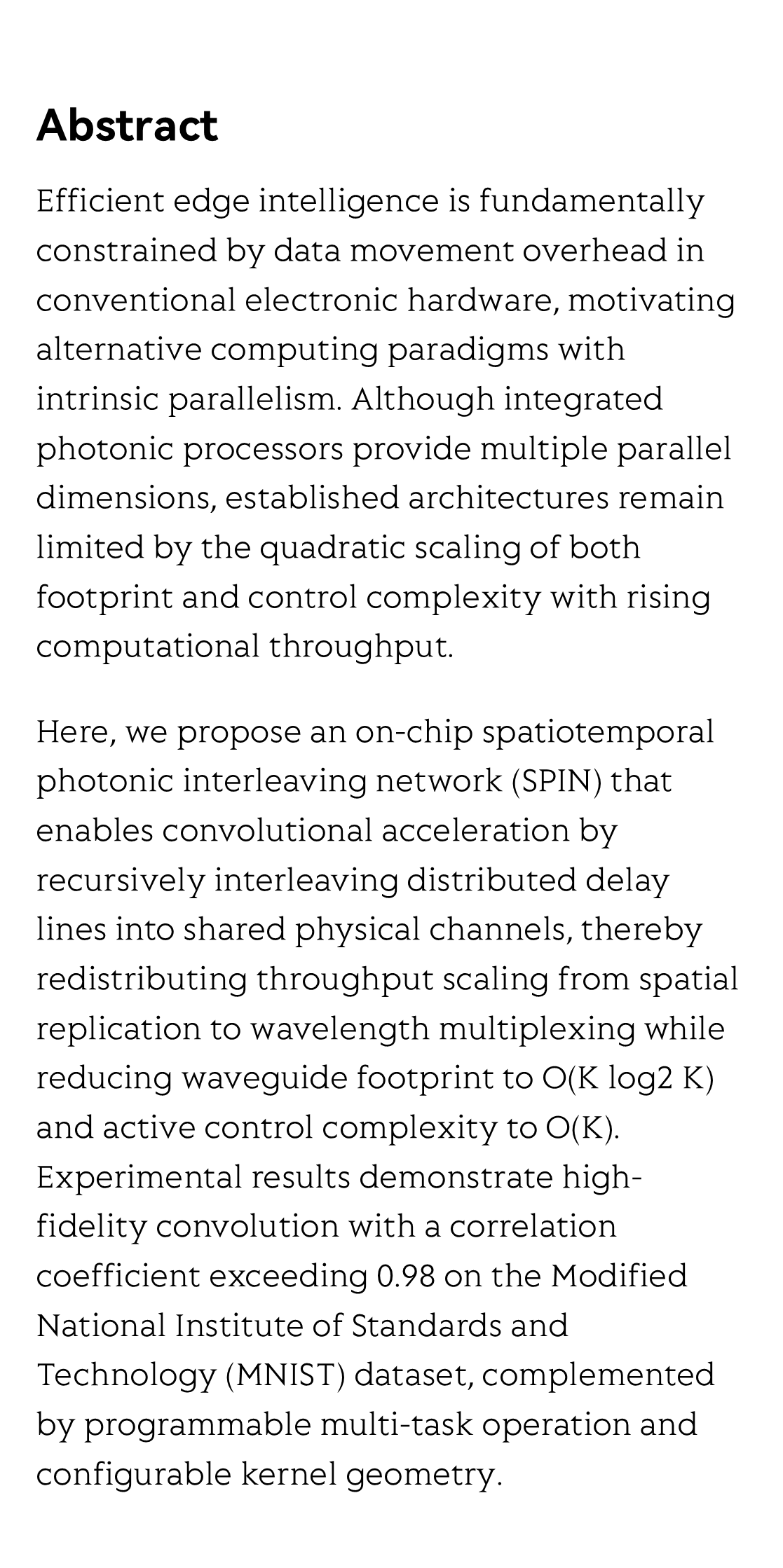
Efficient edge intelligence is fundamentally constrained by data movement overhead in conventional electronic hardware, motivating alternative computing paradigms with intrinsic parallelism. Although integrated photonic processors provide multiple parallel dimensions, established architectures remain limited by the quadratic scaling of both footprint and control complexity with rising computational throughput.
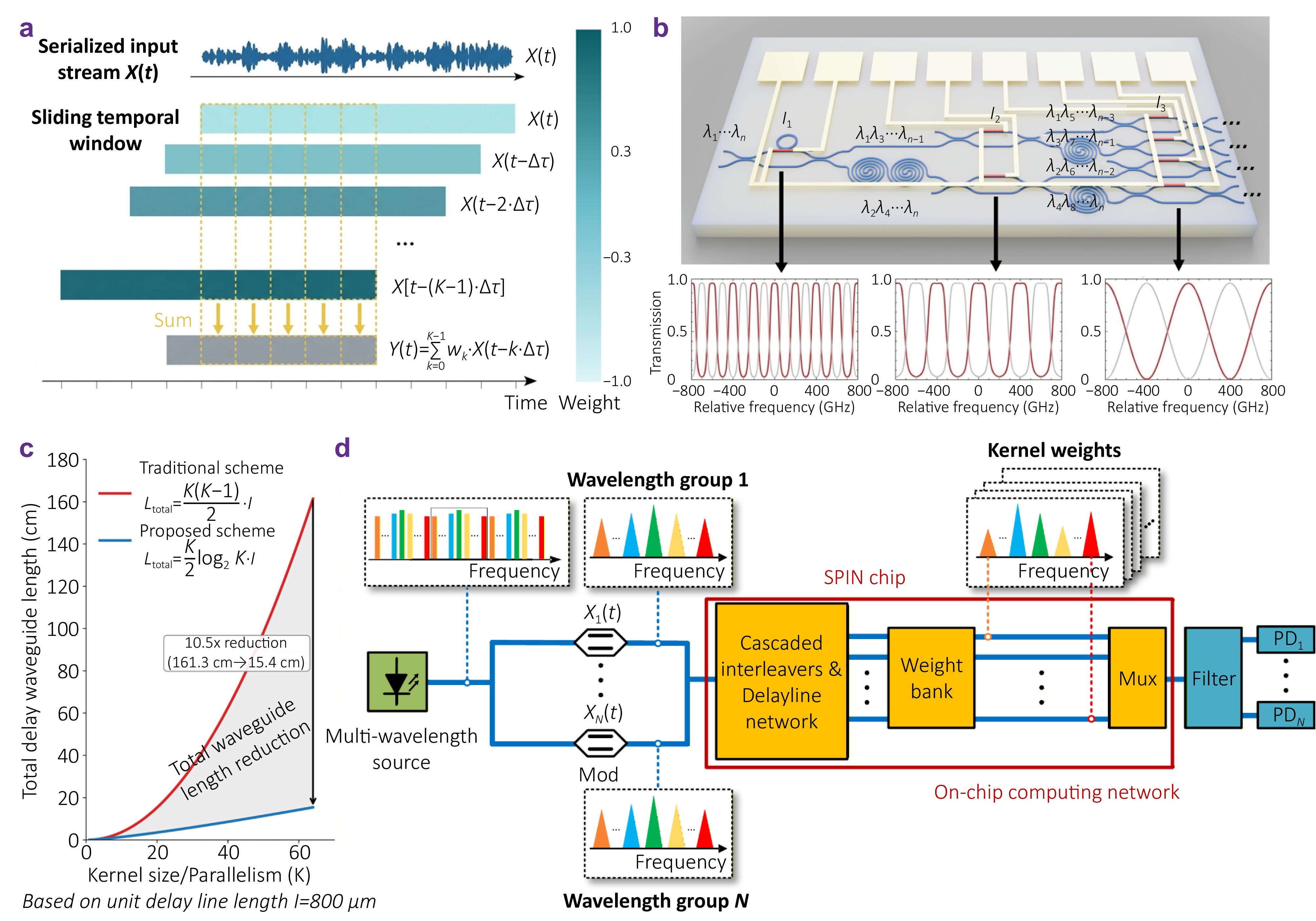
Here, we propose an on-chip spatiotemporal photonic interleaving network (SPIN) that enables convolutional acceleration by recursively interleaving distributed delay lines into shared physical channels, thereby redistributing throughput scaling from spatial replication to wavelength multiplexing while reducing waveguide footprint to O(K log2 K) and active control complexity to O(K). Experimental results demonstrate high-fidelity convolution with a correlation coefficient exceeding 0.98 on the Modified National Institute of Standards and Technology (MNIST) dataset, complemented by programmable multi-task operation and configurable kernel geometry.
The SPIN architecture is capable of supporting a projected single-core throughput of 29.7 TOPS upon full exploitation of the available spectrum. These results validate a structurally scalable and energy-efficient photonic computing framework, advancing the viability of integrated optical accelerators for next-generation edge AI.
Light-perception-based interactive control of an underwater digital twin hand
Jinlong Lu, Chao Zhang, Hengchang Nong, Dongying Wang, Hongyu Zhou, Junjie Weng, Yuehua Deng, Yang Yu, Qiang Bian, Jianfa Zhang, Chaofan Zhang, Zhenrong Zhang, Junbo Yang
Opto-Electronic Advances
2026-07-10
Unlocking home-based nocturnal health management: A fiber-optic approach for early detection of cardiorespiratory rhythm disorders
Hanyu Jin, Hao Li, Zhuolin Chen, Liangye Li, Zurui Wang, Kai Zhou, Weijian Hang, Zhipeng Chen, Junfeng Chen, Kai Shen, Jianfeng Wen, Chen Chen, Cunzheng Fan, Zhijun Yan, Feng Wang, Qizhen Sun
Opto-Electronic Advances
2026-07-10
A flexible wireless system for prospective photodynamic therapy applications
Rolan Mansour, Bhavani Yalagala, Vikas Vikas, Nikolas Bruce, Fawziye Tarhini, Georgios N. Arvanitakis, Mohammed Mughal, Jamie Blanche, Ahmad Taha, Jonathan Copper, Muhammad Imran, Karin Williams, Karin Oien, Mahmoud Wagih, Hadi Heidari, Robert Hadfield, David Flynn
Opto-Electronic Advances
2026-07-10
Parallel bright-field and multi-order edge imaging via wide field-of-view trichannel metalens
Xiaotong Li, Yeseul Kim, Youngsun Jeon, Junhwa Seong, Jaekyung Kim, Peng Tang, Shiqi Hu, Harit Keawmuang, Beomha Yang, Dongmin Jeon, Le Dai, Weiyan Li, Xiaodong Cai, Jinhui Shi, Yong-Sang Ryu, Trevon Badloe, Junsuk Rho
Opto-Electronic Advances
2026-07-10