(Peer-Reviewed) Recent progress on mid-infrared and terahertz dual-comb spectroscopy
Zhuoren Wan 万卓仁 ¹, Min Li 李敏 ², Binbin Liu 刘彬彬 ³ ⁴, Yu Xia 夏宇 ¹, Yuan Chen 陈员 ¹, Xiuxiu Zhang 张秀秀 ¹, Dongxu Zhu 朱东旭 ¹, Yan Dai 戴言 ¹, Sinan Tao 陶思楠 ², Hua Li 黎华 ³ ⁵, Ming Yan 闫明 ¹ ⁵, Heping Zeng 曾和平 ¹ ⁴ ⁶
¹ State Key Laboratory of Precision Spectroscopy, and Hainan Institute, East China Normal University, Shanghai 200062, China
中国 上海 华东师范大学海南研究院 精密光谱科学与技术国家重点实验室
² School of Optical Electrical and Computer Engineering, University of Shanghai for Science and Technology, Shanghai 200093, China
中国 上海 上海理工大学光电信息与计算机工程学院
³ Key Laboratory of Terahertz Solid State Technology Shanghai Institute of Microsystem and Information Technology, Chinese Academy of Sciences, Shanghai 200050, China
中国 上海 中国科学院上海微系统与信息技术研究所 太赫兹固态技术重点实验室
⁴ Chongqing Key Laboratory of Precision Optics, Chongqing Institute of East China Normal University, Chongqing 401121, China
中国 重庆 华东师范大学重庆研究所 精密光学重庆市重点实验室
⁵ Center of Materials Science and Optoelectronics Engineering, University of Chinese Academy of Sciences, Beijing 100049, China
中国 北京 中国科学院大学 材料科学与光电子工程中心
⁶ Jinan Institute of Quantum Technology, Jinan 250101, China
中国 济南 济南量子技术研究所
Opto-Electronic Technology, 2026-09-30
Abstract
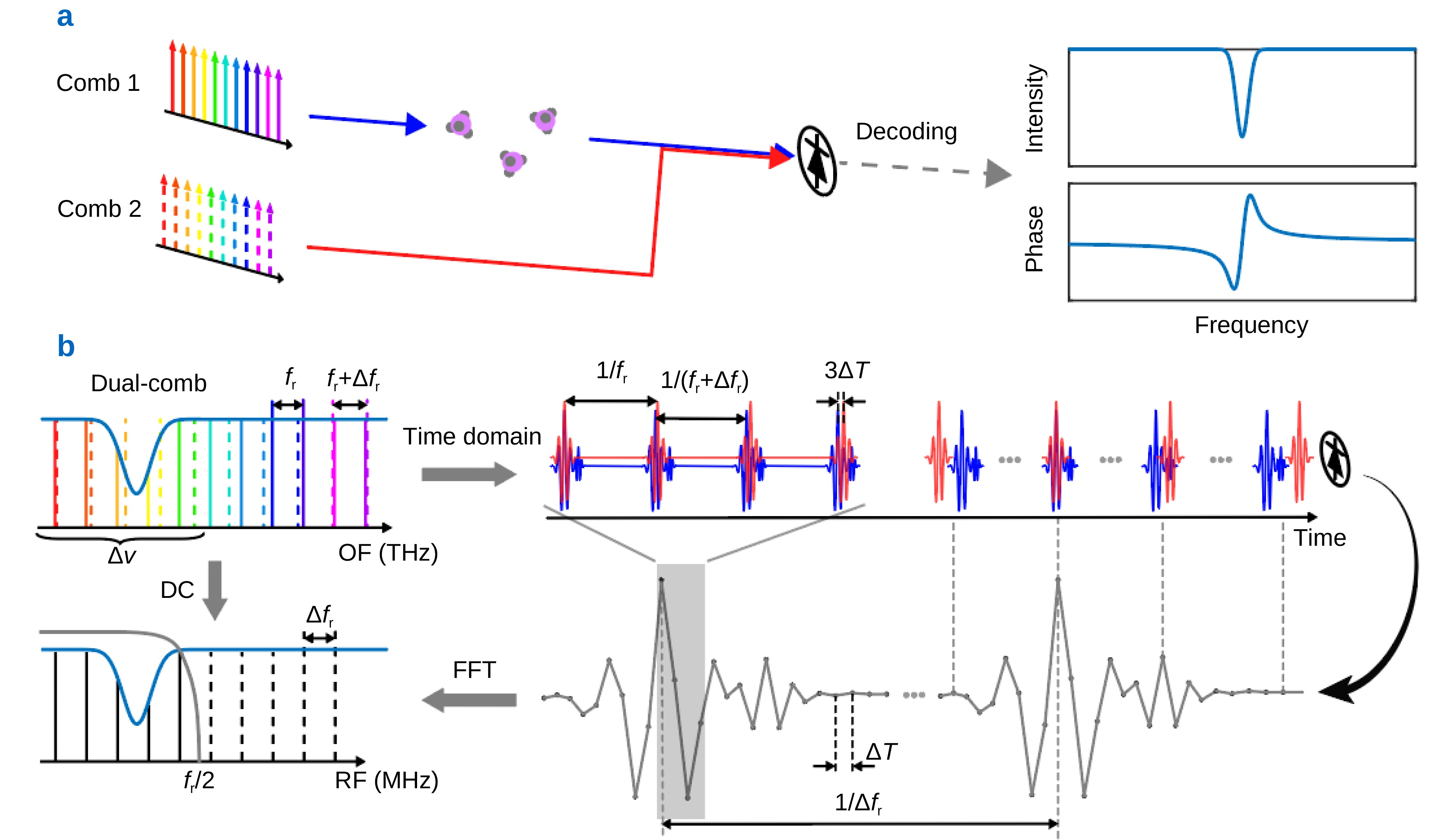
Dual-comb spectroscopy (DCS) has emerged as a revolutionary optical technique, offering exceptional spectral resolution, rapid measurement capability, and inherent frequency accuracy without the need for moving parts. This review provides a comprehensive survey of the principles and technological developments of DCS within the mid-infrared (mid-IR, ~2–20 μm) and terahertz (THz, ~0.1–10 THz) spectral regions.
These regimes are of paramount importance due to the unique molecular fingerprints and low-energy excitations they encompass, spanning areas such as gas-phase chemical analysis, combustion diagnostics, and atmospheric sensing. We systematically outline the primary approaches for generating dual-comb sources in these spectral ranges, including direct generation via quantum cascade lasers, optical parametric oscillation, difference frequency generation, and microresonator-based frequency combs. The performance metrics, trade-offs, and recent innovations for each platform are critically compared.
Finally, we discuss key challenges and emerging directions, including continuous mid-infrared-to-THz spectral coverage, broadband and low-noise detection, beam quality and mode matching, quantum-enhanced sensitivity, and coherence preservation for long-term operation. We conclude by outlining future trends toward integrated, field-deployable, and application-oriented DCS systems capable of broadband molecular fingerprinting, high-speed sensing, and precision spectroscopy.
Ultrafast all-optical biomimetic encoder for spiking neural networks
Qijun Bian, Fangchen Hu, Junlian Jia, Aolong Sun, Sizhe Xing, Boyu Dong, An Yan, Ziwei Li, Jianyang Shi, Nan Chi, Junwen Zhang
Opto-Electronic Science
2026-10-20
Neural holography enabled multi-beam steering for multi-task classifier
Lin Wu, Mian Wu, Zhen Li, Ying Qiu, Zichen Liu, Yongquan Zeng, Guozhen Liang, Hanbing Li, Guoxing Zheng, Zhixue He, Xi Xiao, Qi Jie Wang, Jin Tao, Shaohua Yu
Opto-Electronic Technology
2026-09-30