(Peer-Reviewed) Ultrafast all-optical biomimetic encoder for spiking neural networks
Qijun Bian ¹ ², Fangchen Hu ³, Junlian Jia ¹ ², Aolong Sun ¹ ², Sizhe Xing ¹ ², Boyu Dong ¹ ², An Yan ¹ ², Ziwei Li ¹ ², Jianyang Shi ³, Nan Chi ¹ ², Junwen Zhang ¹ ²
¹ Future Information Innovative College (FIIC), Fudan University, Shanghai 200433, China
中国 上海 复旦大学未来信息创新学院
² Key Laboratory for Information Science of Electromagnetic Waves (MoE), Fudan University, Shanghai 200433, China
中国 上海 复旦大学电磁波信息科学教育部重点实验室
³ Zhangjiang Laboratory, Shanghai 200232, China
中国 上海 张江实验室
Opto-Electronic Science, 2026-10-20
Abstract
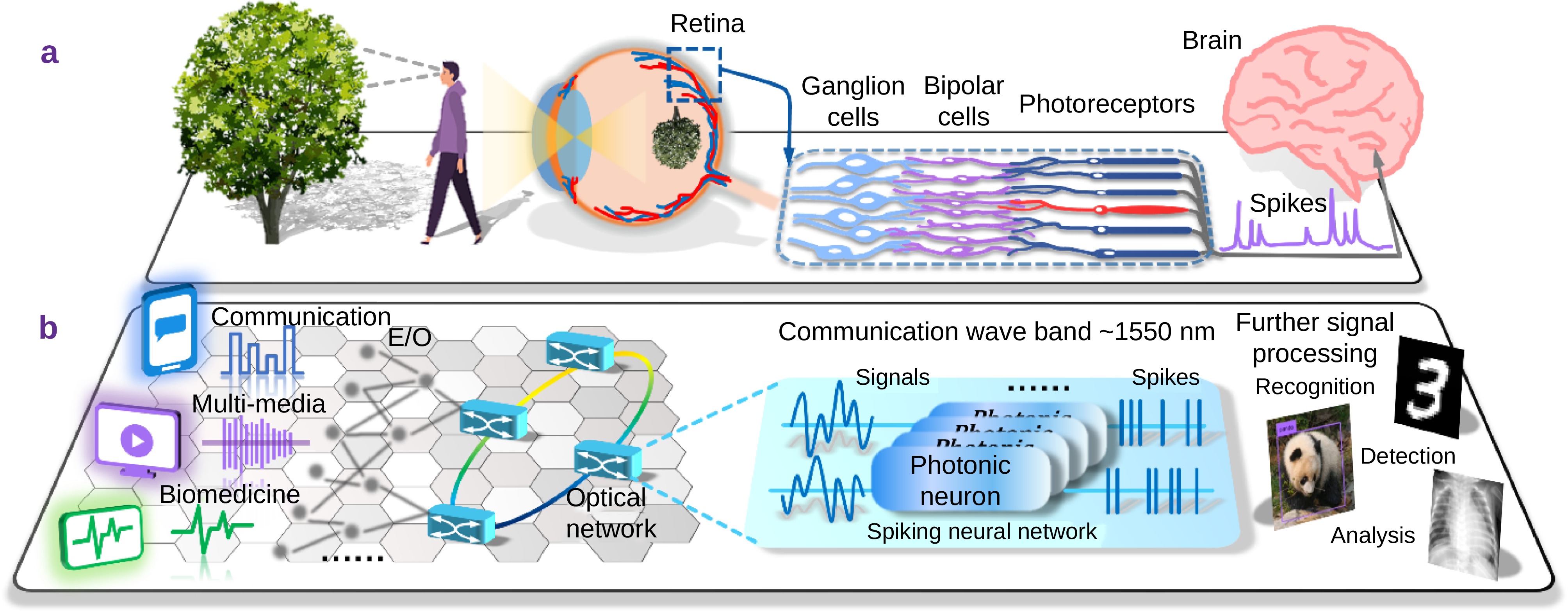
Spiking neural networks (SNNs) represent a brain-inspired computing paradigm with inherent advantages in low latency and energy efficiency, where high-fidelity conversion of analog sensory signals into optical spike trains remains a critical bottleneck for photonic neuromorphic deployment. In this work, we experimentally demonstrate an all-optical biomimetic spike encoder based on optically injected Fabry–Perot (FP) laser neuron, enabling amplitude-to-rate linear encoding with a spike rate beyond 2.0 GHz and an encoding precision of ≈5 bits.
Different from previous FP laser spiking devices that only support binary spike generation, our scheme establishes a robust monotonic mapping between input optical intensity and spike firing rate, and exhibits excellent compatibility with standard 1550 nm fiber-optic communication infrastructure. We validate the encoding performance via handwritten digit recognition on the MNIST dataset using a digital spiking neural network, achieving a classification accuracy over 94.1%. Beyond static image encoding, the proposed encoder is capable of converting continuous physiological and audio signals into well-behaved spike sequences.
We further construct a scalable optical neuromorphic architecture compatible with time- and wavelength-division multiplexing, supporting multi-user physiological signal access and intelligent medical diagnosis including X-ray radiography, ECG arrhythmia analysis, and heart sound classification. This work not only unveils the laser dynamical mechanism of amplitude-rate encoding in injected FP lasers, but also provides a feasible route to integrate photonic spiking encoders with existing fiber-optic networks for scalable, ultrafast, low-power neuromorphic healthcare and communication applications.
Recent progress on mid-infrared and terahertz dual-comb spectroscopy
Zhuoren Wan, Min Li, Binbin Liu, Yu Xia, Yuan Chen, Xiuxiu Zhang, Dongxu Zhu, Yan Dai, Sinan Tao, Hua Li, Ming Yan, Heping Zeng
Opto-Electronic Technology
2026-09-30
Electrically switchable bright-field and interference-synthesized edge-enhanced imaging with a polarization-multiplexed metalens
Xiaotong Li, Junhwa Seong, Yeseul Kim, Kwang-Suk Oh, Shiqi Hu, Le Dai, Harit Keawmuang, Beomha Yang, Minseok Choi, Youngsun Jeon, Cherry Park, Weiyan Li, Tianxu Jia, Han Zhu, Xiaodong Cai, Qi Zheng, Jinhui Shi, Young-Ki Kim, Yuchuan Shao, Trevon Badloe, Junsuk Rho
Opto-Electronic Science
2026-09-20
3D-printed copper water cooling system assisted fabrication of 10.6-μm high-power CO₂ laser resistance reflectors
Hongfei Jiao, Binbin Jiang, Xinshang Niu, Yifan Wang, Dongdong Li, Jun Yu, Xiaochuan Ji, Jingjing Xia, Jinlong Zhang, Xinbin Cheng, Zhanshan Wang
Opto-Electronic Advances
2026-09-15
Ultrafast all-optical modulation of wide-bandwidth pulses enabled by silicon-metasurfaces
Kaloyan Georgiev, Khosro Zangeneh Kamali, Anton A. Trifonov, Giulia Crotti, Lyuben Petrov, Stefan Georgiev, Hristo Iliev, Lei Xu, Unai Arregui Leon, Mohsen Rahmani, Giuseppe Della Valle, Ivan Buchvarov, Dragomir Neshev
Opto-Electronic Advances
2026-09-15
Physics-informed neural fields enable blind aberration correction for partially coherent quantitative phase imaging
Shun Zhou, Xingyu Huang, Linpeng Lu, Habib Ullah, Kaiyu Du, Maciej Trusiak, Malgorzata Kujawinska, Yuzhen Zhang, Yao Fan, Qian Chen, Qinrong Zhang, Chao Zuo
Opto-Electronic Science
2026-08-26