(Peer-Reviewed) Multiphysics optimization framework for high-power fiber amplifiers
Wei Liu ¹ ² ³, Zan Cheng ¹, Pengfei Ma ¹ ² ³, Yisha Chen ¹ ² ³, Huan Yang ¹ ² ³, Zhiyong Pan ¹ ² ³, Zefeng Wang ¹ ² ³, Jinbao Chen ¹ ² ³
¹ College of Advanced Interdisciplinary Studies, National University of Defense Technology, Changsha 410073, China
中国 长沙 国防科技大学前沿交叉学科学院
² Nanhu Laser Laboratory, National University of Defense Technology, Changsha 410073, China
中国 长沙 国防科技大学南湖之光实验室
³ Hunan Provincial Key Laboratory of High Energy Laser Technology, National University of Defense Technology, Changsha 410073, China
中国 长沙 国防科技大学高能激光技术湖南省重点实验室
Opto-Electronic Science, 2026-09-20
Abstract
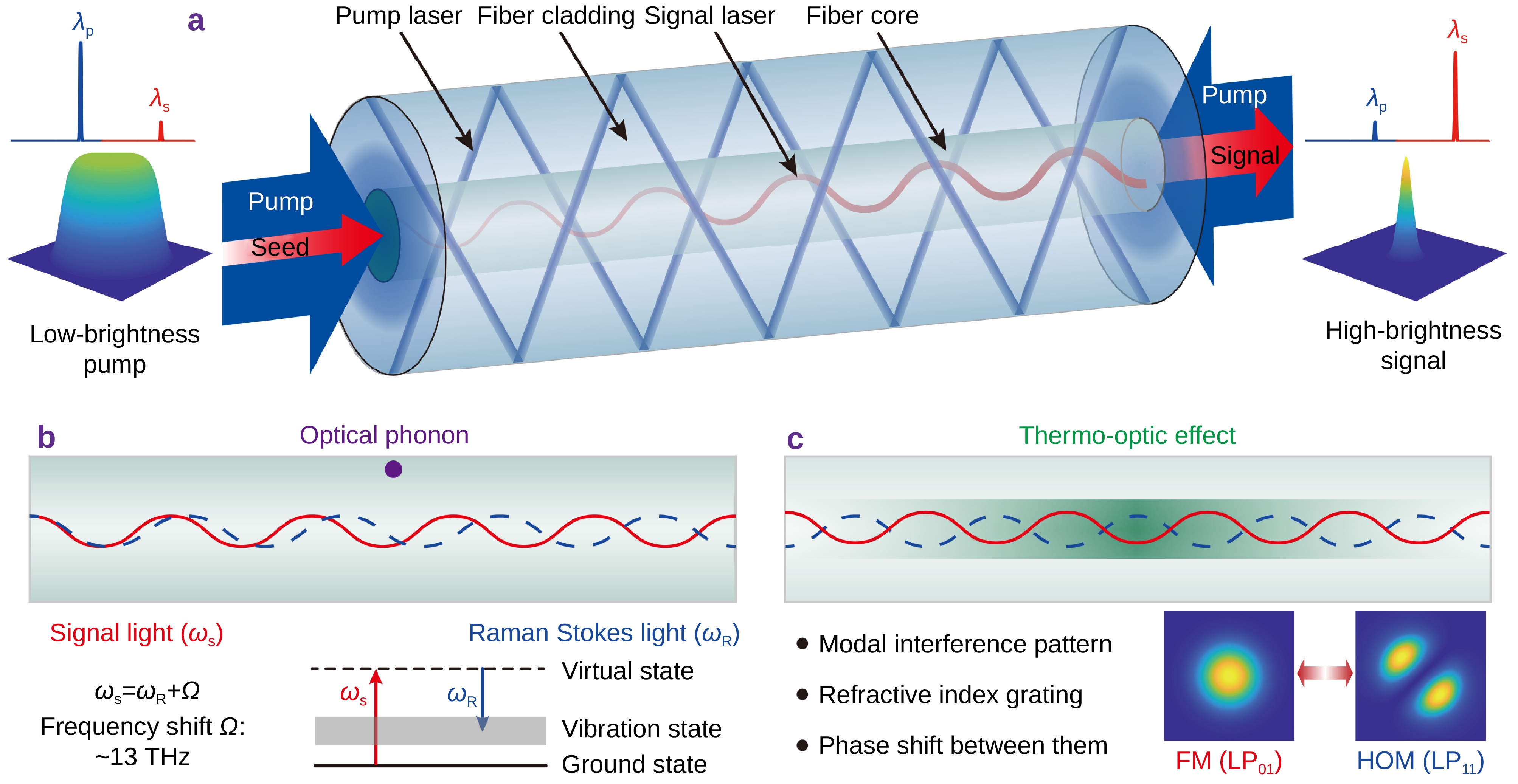
The interplay of nonlinear and thermal dynamics fundamentally constrains the power scalability of fiber lasers. Conventional development cycles rely on heuristic iterations between modeling and experiment, inevitably leading to extensive resource consumption and suboptimal architectures. In this work, we demonstrate a predictive in silico design paradigm for high-power fiber amplifiers by integrating a coupled multiphysics model with a physics-informed, surrogate-assisted optimization algorithm.
This framework enables the efficient co-optimization of macroscopic configurations and internal waveguide parameters, thereby directly identifying the system-level optimum under rigorous physical constraints. Computationally directed by this method, we designed an optimal gain fiber featuring a numerical aperture of 0.0585 and a centrally depressed refractive index profile. Upon physical fabrication and integration into a 0.5-nm-linewidth setup, the amplifier delivered an output power of 7.68 kW with high optical-to-optical efficiency (84%) and excellent beam quality (M2<1.5), setting a new power record for sub-nanometer-linewidth fiber lasers.
This generalizable framework paves the way to unlock previously inaccessible performance regimes in high-power lasers and accelerate the realization of fully functional digital twins for next-generation photonic systems.
A 36 × 240 Gbps hybrid mode/wavelength division multiplexing transmitter using lithium niobate on insulator
Mingyu Zhu, Weihan Wang, Ruitao Ma, Aoyun Gao, Chun Gao, Zexu Wang, Fei Huang, Zhenyuan Bao, Dajian Liu, Jiaxuan Gan, Zejie Yu, Huan Li, Weike Zhao, Daoxin Dai
Opto-Electronic Advances
2026-08-25
Light-perception-based interactive control of an underwater digital twin hand
Jinlong Lu, Chao Zhang, Hengchang Nong, Dongying Wang, Hongyu Zhou, Junjie Weng, Yuehua Deng, Yang Yu, Qiang Bian, Jianfa Zhang, Chaofan Zhang, Zhenrong Zhang, Junbo Yang
Opto-Electronic Advances
2026-07-10
Unlocking home-based nocturnal health management: A fiber-optic approach for early detection of cardiorespiratory rhythm disorders
Hanyu Jin, Hao Li, Zhuolin Chen, Liangye Li, Zurui Wang, Kai Zhou, Weijian Hang, Zhipeng Chen, Junfeng Chen, Kai Shen, Jianfeng Wen, Chen Chen, Cunzheng Fan, Zhijun Yan, Feng Wang, Qizhen Sun
Opto-Electronic Advances
2026-07-10
A flexible wireless system for prospective photodynamic therapy applications
Rolan Mansour, Bhavani Yalagala, Vikas Vikas, Nikolas Bruce, Fawziye Tarhini, Georgios N. Arvanitakis, Mohammed Mughal, Jamie Blanche, Ahmad Taha, Jonathan Copper, Muhammad Imran, Karin Williams, Karin Oien, Mahmoud Wagih, Hadi Heidari, Robert Hadfield, David Flynn
Opto-Electronic Advances
2026-07-10
Parallel bright-field and multi-order edge imaging via wide field-of-view trichannel metalens
Xiaotong Li, Yeseul Kim, Youngsun Jeon, Junhwa Seong, Jaekyung Kim, Peng Tang, Shiqi Hu, Harit Keawmuang, Beomha Yang, Dongmin Jeon, Le Dai, Weiyan Li, Xiaodong Cai, Jinhui Shi, Yong-Sang Ryu, Trevon Badloe, Junsuk Rho
Opto-Electronic Advances
2026-07-10