(Peer-Reviewed) Scaling metasurface design: from reusable unit cells to full-metasurface inverse design
Eunbi Jang ¹, Jiwan Hong ², Ho-Jun Lee ¹, Seokju Choi ³, Hyewon Suk ¹, Chanik Kang ⁴, Sunae So ² ³, Haejun Chung ¹ ⁴ ⁵
¹ Department of Artificial Intelligence Semiconductor, Hanyang University, Seoul 04763, Republic of Korea
² Department of Electro-Mechanical Systems Engineering, Korea University, Sejong 30019, Republic of Korea
³ Department of Control and Instrumentation Engineering, Korea University, Sejong 30019, Republic of Korea
⁴ Department of Artificial Intelligence, Hanyang University, Seoul 04763, Republic of Korea
⁵ Department of Electronic Engineering, Hanyang University, Seoul 04763, Republic of Korea
Opto-Electronic Science, 2026-10-20
Abstract
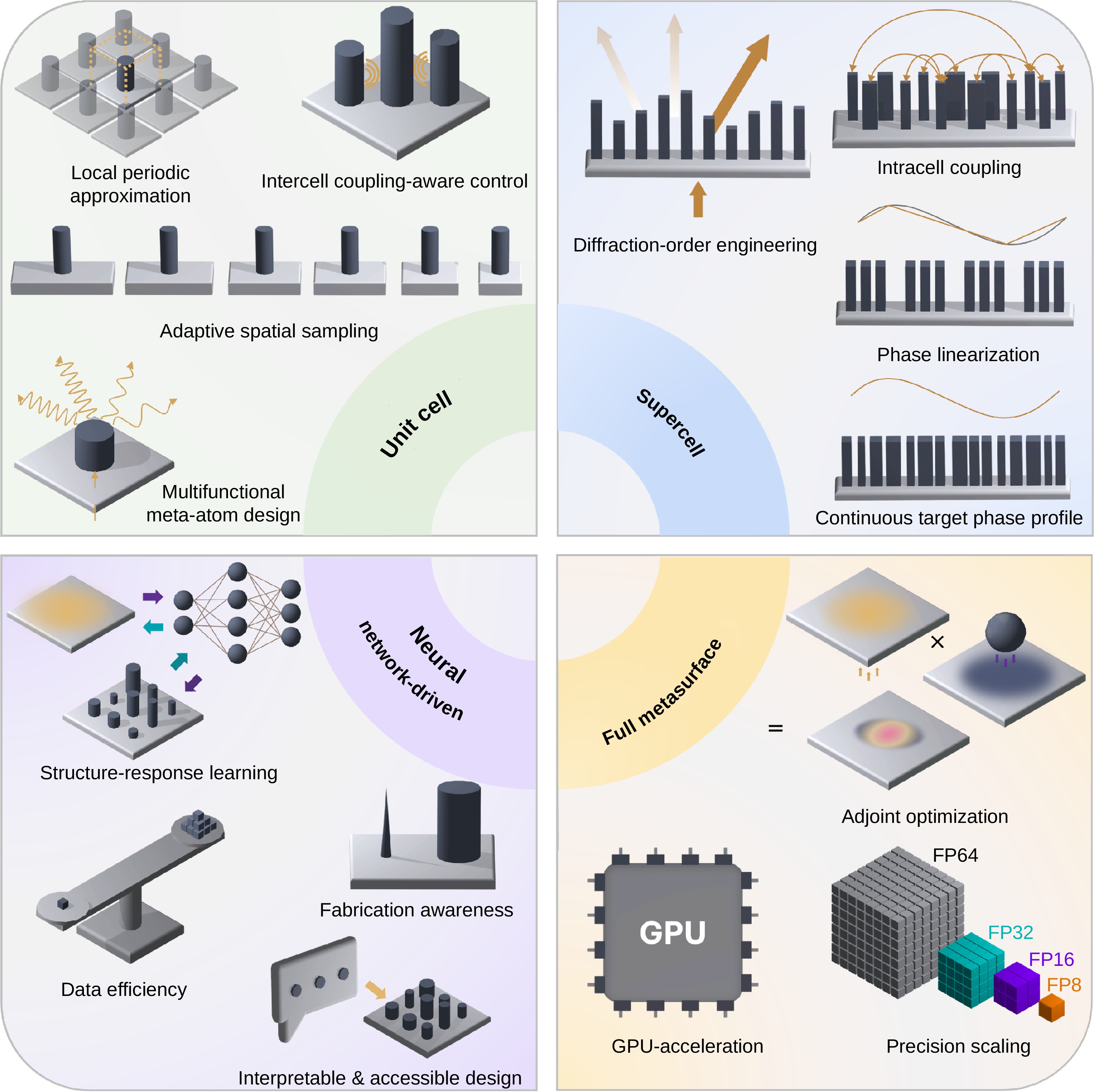
Metasurfaces enable precise control of optical phase, amplitude, and polarization within an ultrathin form factor. Yet many large-area devices are still designed by assembling unit cells characterized under the local periodic approximation, which sometimes neglects important electromagnetic interactions between dissimilar neighboring elements. Full-metasurface inverse design has recently emerged as a powerful alternative because it treats the entire aperture as a coupled electromagnetic system and directly exploits inter-element interactions.
In this review, we organize large-area metasurface design methods according to the spatial extent of the jointly optimized region, progressing from reusable unit cells to supercells and full-metasurface inverse design. We also examine neural-network-based approaches, including surrogate electromagnetic solvers, inverse design networks, and data-efficient and fabrication-aware methods. In addition, we assess whether reusable supercell designs can provide computational savings comparable to those of meta-atom libraries.
Finally, our hardware-aware scaling analysis estimates the memory and runtime required for full-wave full-metasurface optimization across a range of aperture sizes and computing systems. These results clarify the trade-off between electromagnetic accuracy and computational cost and show how advances in computing hardware may expand the practical limits of full-aperture metasurface design.
Recent progress on mid-infrared and terahertz dual-comb spectroscopy
Zhuoren Wan, Min Li, Binbin Liu, Yu Xia, Yuan Chen, Xiuxiu Zhang, Dongxu Zhu, Yan Dai, Sinan Tao, Hua Li, Ming Yan, Heping Zeng
Opto-Electronic Technology
2026-09-30
Electrically switchable bright-field and interference-synthesized edge-enhanced imaging with a polarization-multiplexed metalens
Xiaotong Li, Junhwa Seong, Yeseul Kim, Kwang-Suk Oh, Shiqi Hu, Le Dai, Harit Keawmuang, Beomha Yang, Minseok Choi, Youngsun Jeon, Cherry Park, Weiyan Li, Tianxu Jia, Han Zhu, Xiaodong Cai, Qi Zheng, Jinhui Shi, Young-Ki Kim, Yuchuan Shao, Trevon Badloe, Junsuk Rho
Opto-Electronic Science
2026-09-20
3D-printed copper water cooling system assisted fabrication of 10.6-μm high-power CO₂ laser resistance reflectors
Hongfei Jiao, Binbin Jiang, Xinshang Niu, Yifan Wang, Dongdong Li, Jun Yu, Xiaochuan Ji, Jingjing Xia, Jinlong Zhang, Xinbin Cheng, Zhanshan Wang
Opto-Electronic Advances
2026-09-15
Ultrafast all-optical modulation of wide-bandwidth pulses enabled by silicon-metasurfaces
Kaloyan Georgiev, Khosro Zangeneh Kamali, Anton A. Trifonov, Giulia Crotti, Lyuben Petrov, Stefan Georgiev, Hristo Iliev, Lei Xu, Unai Arregui Leon, Mohsen Rahmani, Giuseppe Della Valle, Ivan Buchvarov, Dragomir Neshev
Opto-Electronic Advances
2026-09-15
Physics-informed neural fields enable blind aberration correction for partially coherent quantitative phase imaging
Shun Zhou, Xingyu Huang, Linpeng Lu, Habib Ullah, Kaiyu Du, Maciej Trusiak, Malgorzata Kujawinska, Yuzhen Zhang, Yao Fan, Qian Chen, Qinrong Zhang, Chao Zuo
Opto-Electronic Science
2026-08-26