(Peer-Reviewed) Physics-informed neural fields enable blind aberration correction for partially coherent quantitative phase imaging
Shun Zhou 周顺 ¹ ² ³, Xingyu Huang 黄星雨 ¹ ² ³, Linpeng Lu 卢林芃 ¹ ² ³, Habib Ullah ¹ ² ³, Kaiyu Du 杜开宇 ¹ ² ³, Maciej Trusiak ⁴, Malgorzata Kujawinska ⁴, Yuzhen Zhang 张玉珍 ³, Yao Fan 范瑶 ¹ ² ³, Qian Chen 陈钱 ³ ⁵, Qinrong Zhang 张沁榕 ⁶, Chao Zuo 左超 ¹ ² ³ ⁵
¹ Smart Computational Imaging Laboratory (SCILab), School of Electronic and Optical Engineering, Nanjing University of Science and Technology, Nanjing 210094, China
中国 南京 南京理工大学电子工程与光电技术学院 智能计算成像实验室
² Smart Computational Imaging Research Institute (SCIRI) of Nanjing University of Science and Technology, Nanjing 210019, China
中国 南京 南京理工大学智能计算成像研究院
³ Jiangsu Key Laboratory of Visual Sensing & Intelligent Perception, Nanjing 210094, China
中国 南京 江苏省视觉传感与智能感知重点实验室
⁴ Institute of Micromechanics and Photonics, Warsaw University of Technology, Warsaw 02-525, Poland
⁵ State Key Laboratory of Extreme Environment Optoelectronic Dynamic Measurement Technology and Instrument, Taiyuan 030051, China
中国 太原 极限环境光电动态测试技术与仪器全国重点实验室
⁶ Department of Biomedical Engineering, City University of Hong Kong, Hong Kong 999077, China
中国 香港 香港城市大学生物医学工程系
Opto-Electronic Science, 2026-08-26
Abstract
Partially coherent quantitative phase imaging (QPI) underpins label-free microscopy and optical metrology, providing stable, speckle-suppressed phase measurement with a brightfield-compatible platform and resolution beyond the coherent diffraction limit. However, its image formation is governed by a high-dimensional bilinear forward model, making linearized analytic inversions such as differential phase contrast (DPC) prone to model mismatch and biased reconstruction under large phase excursions, strong absorption, and optical aberrations.
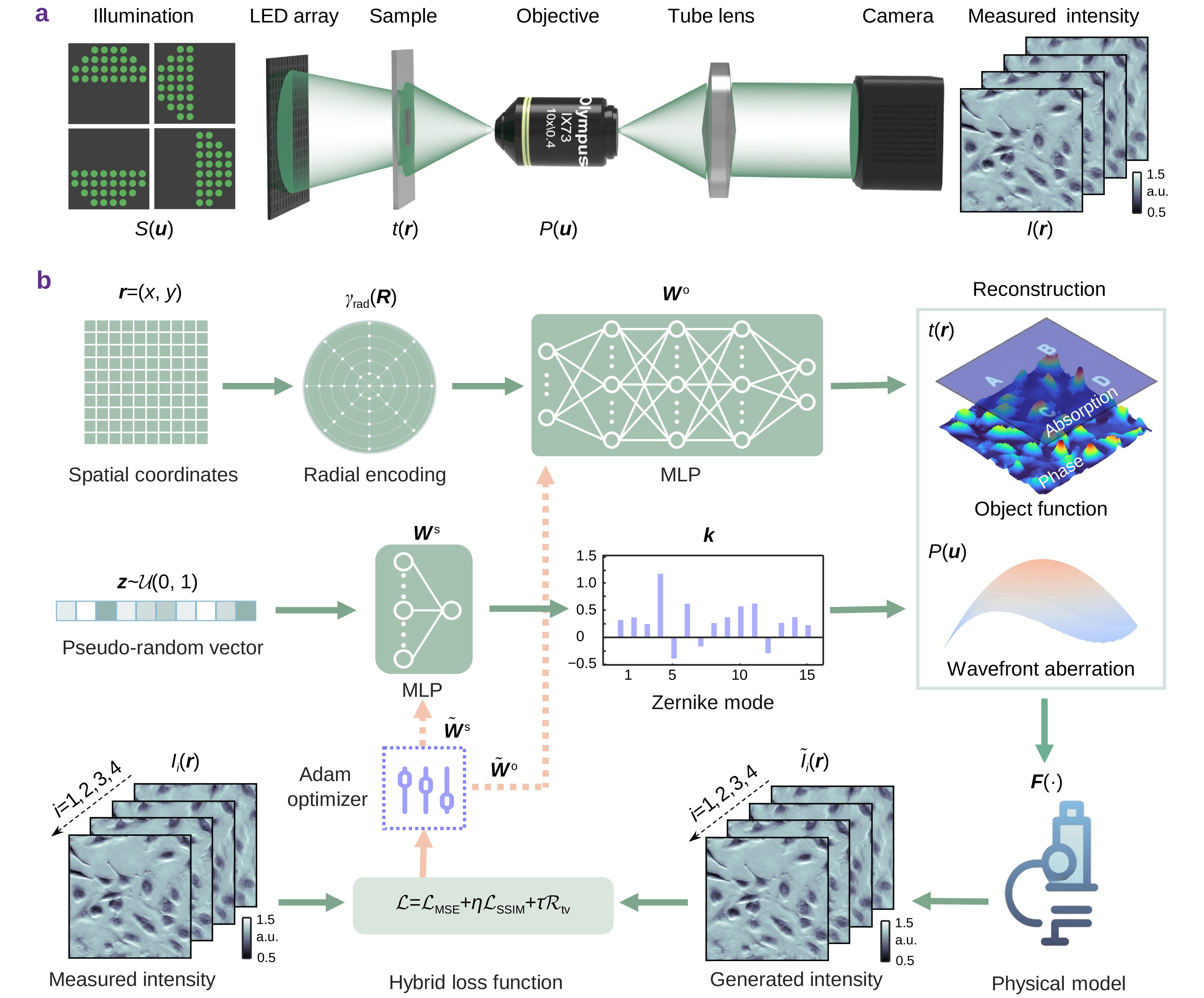
Here, we introduce USDPC, a universal neural-field solver for DPC, that performs physics-constrained, unsupervised inversion of the strict nonlinear intensity-to-phase relationship under partially coherent illumination. USDPC represents the specimen's complex transmittance and pupil aberrations as implicit neural fields and jointly optimizes them via a differentiable bilinear forward operator, enabling accurate phase recovery beyond the weak-object regime while self-calibrating unknown aberrations without additional calibration data or acquisition overhead.
Comprehensive simulations and experimental validations on microlens arrays, resolution targets, stained histological sections, and live HeLa cells demonstrate the effectiveness and universality of USDPC, and highlight physics-informed neural fields as a versatile computational framework for solving challenging nonlinear inverse problems in computational imaging and beyond.
Ultrafast all-optical modulation of wide-bandwidth pulses enabled by silicon-metasurfaces
Kaloyan Georgiev, Khosro Zangeneh Kamali, Anton A. Trifonov, Giulia Crotti, Lyuben Petrov, Stefan Georgiev, Hristo Iliev, Lei Xu, Unai Arregui Leon, Mohsen Rahmani, Giuseppe Della Valle, Ivan Buchvarov, Dragomir Neshev
Opto-Electronic Advances
2026-09-15
Heterogeneously integrated micro-ring with SnS₂ for dual-functional optical modulation and photodetection
Jinyi Du, Lidan Lu, Xu Zhang, Bofei Zhu, Wenbo Bo, Yingjie Xu, Guang Chen, Yanlin He, Guanghui Ren, Xiaoping Lou, Zheng You, Lianqing Zhu
Opto-Electronic Advances
2026-08-25
Hardware-aware lightweight photonic spiking neural network for pattern classification
Shuiying Xiang, Yahui Zhang, Shangxuan Shi, Haowen Zhao, Dianzhuang Zheng, Xingxing Guo, Yanan Han, Ye Tian, Liyue Zhang, Yuechun Shi, Yue Hao
Opto-Electronic Advances
2026-08-25
PhyspeNet: An empirical physics-aware network for adaptive speckle reconstructive spectrometry
Junrui Liang, Min Jiang, Jun Li, Zhongming Huang, Junhong He, Yanting Guo, Yanzhao Ke, Jun Ye, Jiangming Xu, Jinyong Leng, Pu Zhou
Opto-Electronic Advances
2026-08-25
A 36 × 240 Gbps hybrid mode/wavelength division multiplexing transmitter using lithium niobate on insulator
Mingyu Zhu, Weihan Wang, Ruitao Ma, Aoyun Gao, Chun Gao, Zexu Wang, Fei Huang, Zhenyuan Bao, Dajian Liu, Jiaxuan Gan, Zejie Yu, Huan Li, Weike Zhao, Daoxin Dai
Opto-Electronic Advances
2026-08-25