(Peer-Reviewed) Heterogeneously integrated micro-ring with SnS₂ for dual-functional optical modulation and photodetection
Jinyi Du 杜锦翼 ¹, Lidan Lu 鹿利单 ¹, Xu Zhang 张旭 ¹, Bofei Zhu 祝博飞 ², Wenbo Bo 薄文博 ¹, Yingjie Xu 徐英杰 ⁴, Guang Chen 陈光 ¹, Yanlin He 何彦霖 ¹, Guanghui Ren 任光辉 ³, Xiaoping Lou 娄小平 ¹, Zheng You 尤政 ², Lianqing Zhu 祝连庆 ¹
¹ School of Instrumentation Science and Opto-Electronics Engineering, Beijing Information Science and Technology University, Beijing 100192, China
中国 北京 北京信息科技大学仪器科学与光电工程学院
² The Department of precision instrument, Tsinghua University, Beijing 100084, China
中国 北京 清华大学精密仪器系
³ Integrated Photonics and Applications Centre (InPAC), RMIT University, Melbourne, Victoria 3000, Australia
⁴ School of Instrument Science and Opto-Electronics Engineering, Hefei University of Technology, Hefei 230009, China
中国 合肥 合肥工业大学仪器科学与光电工程学院
Opto-Electronic Advances, 2026-08-25
Abstract
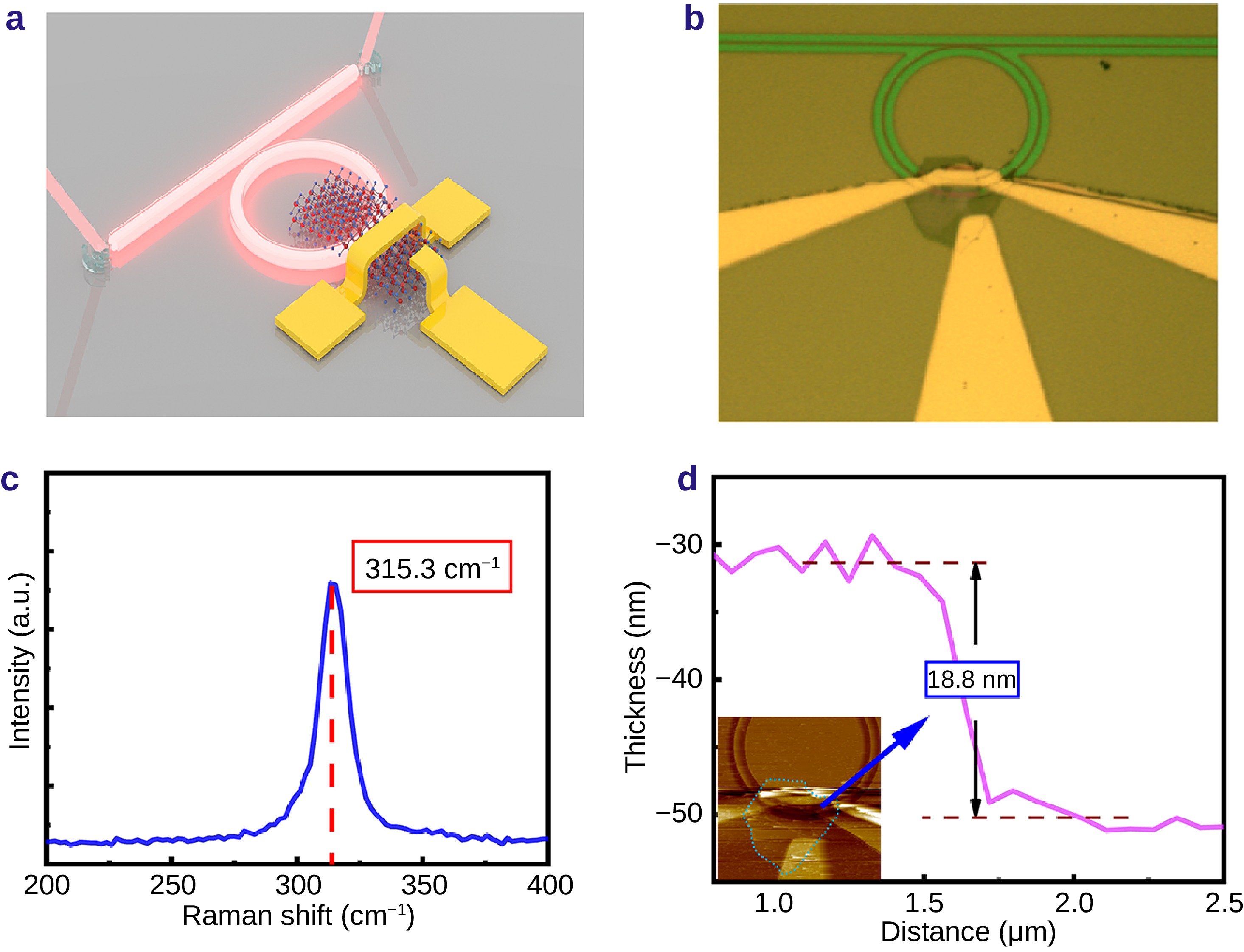
Achieving simultaneous optical modulation and photodetection in a single device represents a key objective for advancing integrated photonics. However, fabricating such dual-functional devices remains challenging due to process complexity, material instability, and weak light–matter interaction. This work demonstrates a dual-functional device through the heterogeneous integration of few-layer SnS₂ onto a silicon-on-insulator (SOI) microring resonator.
Using an electrode-engineered design that eliminates the need for external gate control or heterojunctions, the device achieves simultaneous light modulation and detection. This design not only simplifies fabrication but also maintains independent control ports, enabling real-time monitoring of the optical modulation state and paving the way for integrated feedback in on-chip photonic computing systems.
The modulator achieves a modulation depth of 23 dB, while the photodetector shows a responsivity of 0.38 A/W at −2 V through a hot-carrier-assisted mechanism. This work provides a compact and versatile platform for multifunctional photonic integration, supporting the development of more efficient and reliable on-chip photonic computing.
A 36 × 240 Gbps hybrid mode/wavelength division multiplexing transmitter using lithium niobate on insulator
Mingyu Zhu, Weihan Wang, Ruitao Ma, Aoyun Gao, Chun Gao, Zexu Wang, Fei Huang, Zhenyuan Bao, Dajian Liu, Jiaxuan Gan, Zejie Yu, Huan Li, Weike Zhao, Daoxin Dai
Opto-Electronic Advances
2026-08-25
Light-perception-based interactive control of an underwater digital twin hand
Jinlong Lu, Chao Zhang, Hengchang Nong, Dongying Wang, Hongyu Zhou, Junjie Weng, Yuehua Deng, Yang Yu, Qiang Bian, Jianfa Zhang, Chaofan Zhang, Zhenrong Zhang, Junbo Yang
Opto-Electronic Advances
2026-07-10
Unlocking home-based nocturnal health management: A fiber-optic approach for early detection of cardiorespiratory rhythm disorders
Hanyu Jin, Hao Li, Zhuolin Chen, Liangye Li, Zurui Wang, Kai Zhou, Weijian Hang, Zhipeng Chen, Junfeng Chen, Kai Shen, Jianfeng Wen, Chen Chen, Cunzheng Fan, Zhijun Yan, Feng Wang, Qizhen Sun
Opto-Electronic Advances
2026-07-10
A flexible wireless system for prospective photodynamic therapy applications
Rolan Mansour, Bhavani Yalagala, Vikas Vikas, Nikolas Bruce, Fawziye Tarhini, Georgios N. Arvanitakis, Mohammed Mughal, Jamie Blanche, Ahmad Taha, Jonathan Copper, Muhammad Imran, Karin Williams, Karin Oien, Mahmoud Wagih, Hadi Heidari, Robert Hadfield, David Flynn
Opto-Electronic Advances
2026-07-10
Parallel bright-field and multi-order edge imaging via wide field-of-view trichannel metalens
Xiaotong Li, Yeseul Kim, Youngsun Jeon, Junhwa Seong, Jaekyung Kim, Peng Tang, Shiqi Hu, Harit Keawmuang, Beomha Yang, Dongmin Jeon, Le Dai, Weiyan Li, Xiaodong Cai, Jinhui Shi, Yong-Sang Ryu, Trevon Badloe, Junsuk Rho
Opto-Electronic Advances
2026-07-10