(Peer-Reviewed) Integrated optical transceivers: architectures, key technologies, and applications
Peng Yan 严鹏 ¹ ² ³, Yunhao Zhang 张云皓 ¹ ² ³, Yuansheng Tao 陶源盛 ⁴, Lei Wang 王磊 ², Haowen Shu 舒浩文 ³ ⁵, Xingjun Wang 王兴军 ¹ ² ³ ⁵
¹ Peking University Shenzhen Graduate School, Peking University, Shenzhen 518055, China
中国 深圳 北京大学深圳研究生院
² Peng Cheng Laboratory, Shenzhen 518055, China
中国 深圳 鹏城实验室
³ State Key Laboratory of Photonics and Communications, School of Electronics, Peking University, Beijing 100871, China
中国 北京 北京大学电子学院 光子传输与通信全国重点实验室
⁴ Department of Electrical Engineering & State Key Laboratory of Terahertz and Millimeter Waves, City University of Hong Kong, Hong Kong 999077, China
中国 香港 香港城市大学电机工程系 太赫兹及毫米波全国重点实验室
⁵ Frontiers Science Center for Nano-optoelectronics, Peking University, Beijing 100871, China
中国 北京 北京大学纳光电子前沿科学中心
Opto-Electronic Technology, 2026-06-28
Abstract
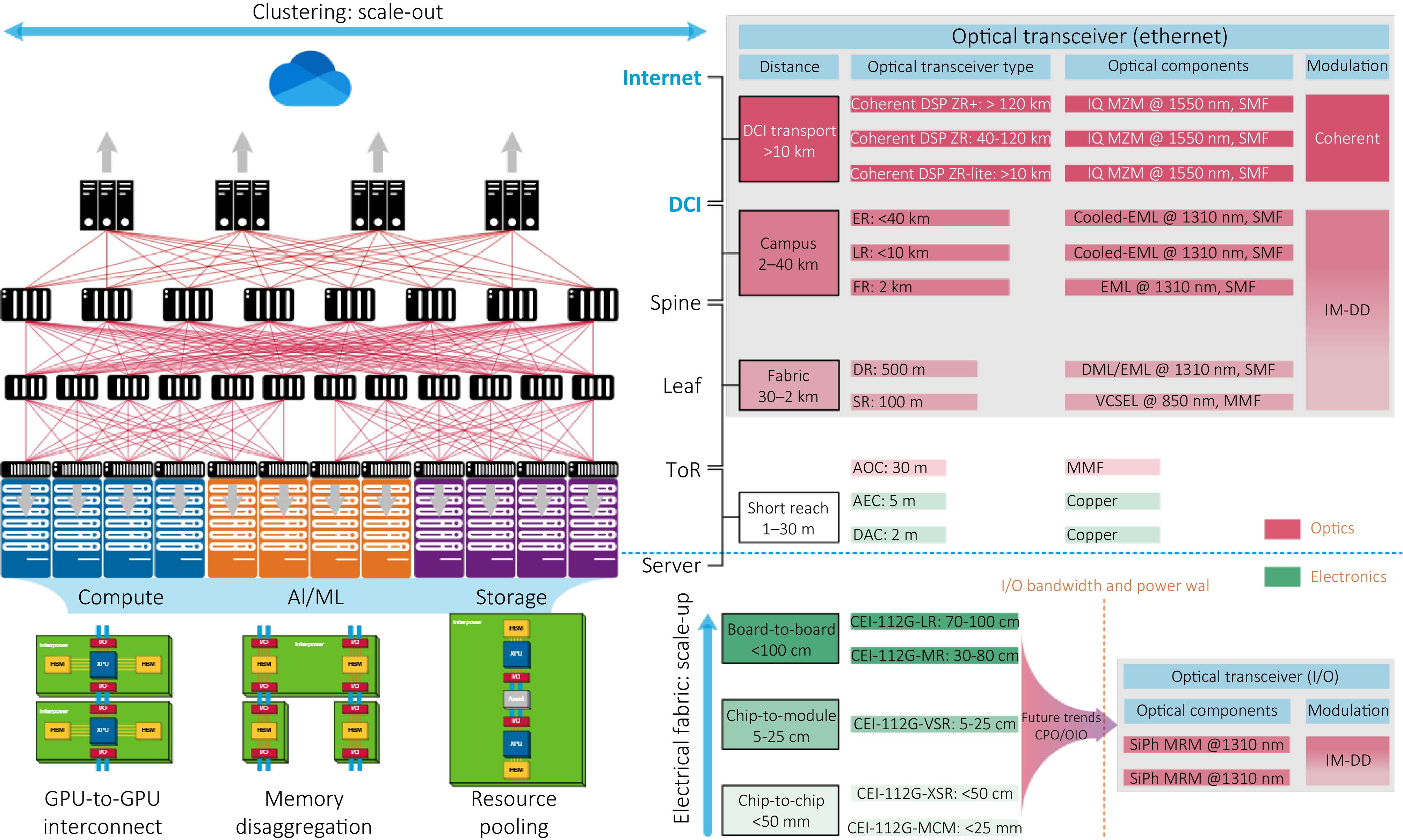
As electrical I/O approaches inherent bottlenecks in reach, energy efficiency, and bandwidth density, integrated optical transceivers are becoming critical enablers for scaling data center and accelerator interconnects. In this review, we systematically explore their development through three aspects: transceiver architectures, key enabling technologies, and target applications.
At the architectural level, we outline the entire integration-driven progression trend of optical transceivers, from pluggable modules to co-packaged optics and chiplet-based engines. Regrading key implemented technologies, we survey various commonly employed optical transmitter solutions, in which the key modulation components are severally vertical-cavity surface-emitting laser (VCSEL), electro-absorption modulated laser (EML), Mach-Zehnder modulator (MZM) and microring modulators; optical receiver schemes based on single and balanced photodetectors; as well as the associated electronic CMOS/SiGe driver and transimpedance amplifier (TIA) circuits. Currently, optical transceivers already serve as essential components in data center and high-performance computing (HPC) fabrics, high-bandwidth memory and accelerator links.
They could also support other emerging computing, sensing, and communication applications in near future, including short-reach free-space links, IoT/edge systems, autonomous vehicles, and quantum communication. Moving forward, next-generation optical transceivers are increasingly progressing toward much higher energy efficiency, bandwidth density, and scalability, driven by the new advancements in architectural design, powerful cell devices and chiplet packaging.
Ultrafast all-optical modulation of wide-bandwidth pulses enabled by silicon-metasurfaces
Kaloyan Georgiev, Khosro Zangeneh Kamali, Anton A. Trifonov, Giulia Crotti, Lyuben Petrov, Stefan Georgiev, Hristo Iliev, Lei Xu, Unai Arregui Leon, Mohsen Rahmani, Giuseppe Della Valle, Ivan Buchvarov, Dragomir Neshev
Opto-Electronic Advances
2026-09-15
Physics-informed neural fields enable blind aberration correction for partially coherent quantitative phase imaging
Shun Zhou, Xingyu Huang, Linpeng Lu, Habib Ullah, Kaiyu Du, Maciej Trusiak, Malgorzata Kujawinska, Yuzhen Zhang, Yao Fan, Qian Chen, Qinrong Zhang, Chao Zuo
Opto-Electronic Science
2026-08-26
Heterogeneously integrated micro-ring with SnS₂ for dual-functional optical modulation and photodetection
Jinyi Du, Lidan Lu, Xu Zhang, Bofei Zhu, Wenbo Bo, Yingjie Xu, Guang Chen, Yanlin He, Guanghui Ren, Xiaoping Lou, Zheng You, Lianqing Zhu
Opto-Electronic Advances
2026-08-25
Hardware-aware lightweight photonic spiking neural network for pattern classification
Shuiying Xiang, Yahui Zhang, Shangxuan Shi, Haowen Zhao, Dianzhuang Zheng, Xingxing Guo, Yanan Han, Ye Tian, Liyue Zhang, Yuechun Shi, Yue Hao
Opto-Electronic Advances
2026-08-25
PhyspeNet: An empirical physics-aware network for adaptive speckle reconstructive spectrometry
Junrui Liang, Min Jiang, Jun Li, Zhongming Huang, Junhong He, Yanting Guo, Yanzhao Ke, Jun Ye, Jiangming Xu, Jinyong Leng, Pu Zhou
Opto-Electronic Advances
2026-08-25
A 36 × 240 Gbps hybrid mode/wavelength division multiplexing transmitter using lithium niobate on insulator
Mingyu Zhu, Weihan Wang, Ruitao Ma, Aoyun Gao, Chun Gao, Zexu Wang, Fei Huang, Zhenyuan Bao, Dajian Liu, Jiaxuan Gan, Zejie Yu, Huan Li, Weike Zhao, Daoxin Dai
Opto-Electronic Advances
2026-08-25