(Peer-Reviewed) Hardware-aware lightweight photonic spiking neural network for pattern classification
Shuiying Xiang 项水英 ¹, Yahui Zhang 张雅慧 ¹, Shangxuan Shi 石尚轩 ¹, Haowen Zhao 赵浩文 ¹, Dianzhuang Zheng 郑殿壮 ¹, Xingxing Guo 郭星星 ¹, Yanan Han 韩亚楠 ¹, Ye Tian 田野 ¹, Liyue Zhang 张力月 ², Yuechun Shi 施跃春 ³, Yue Hao 郝跃 ¹
¹ State Key Laboratory of Integrated Service Networks, State Key Discipline Laboratory of Wide Bandgap Semiconductor Technology, Xidian University, Xi'an 710071, China
中国 西安 西安电子科技大学综合业务网理论及关键技术国家重点实验室 宽带隙半导体技术国家重点学科实验室
² Key Laboratory of Photonic-Electronic Integration and Communication-Sensing Convergence (Ministry of Education), Southwest Jiaotong University, Chengdu 611756, China
中国 成都 西南交通大学光电融合集成与通信感知教育部重点实验室
³ Yongjiang laboratory, No. 1792 Cihai South Road, Ningbo 315202, China
中国 宁波 甬江实验室
Opto-Electronic Advances, 2026-08-25
Abstract
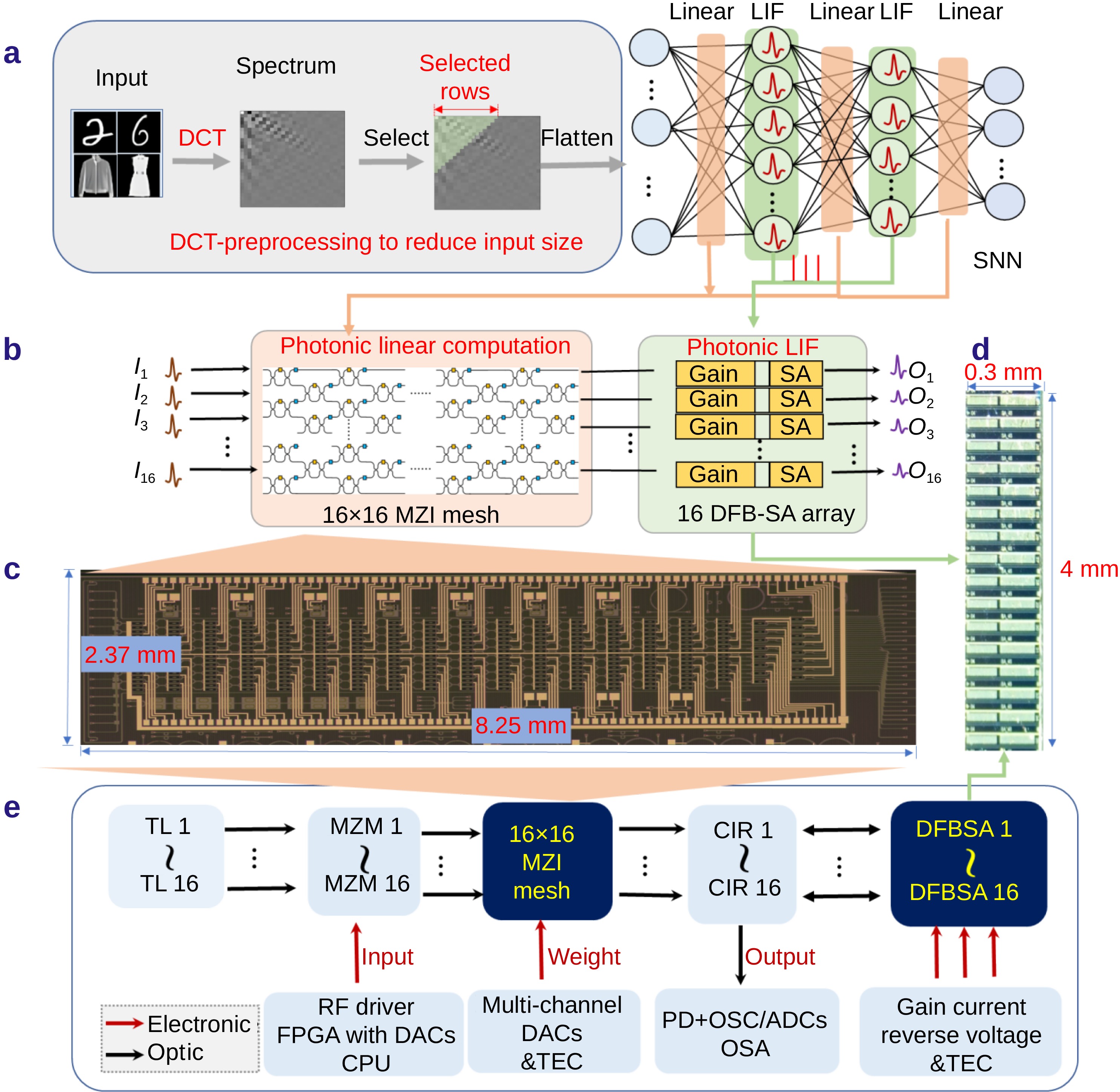
There exists a significant scale gap between photonic neural network integrated chips and neural networks, which hinders the deployment and application of photonic neural network. Here, we propose hardware-aware lightweight spiking neural networks (SNNs) architecture tailored to our photonic neuromorphic chips, and conduct hardware-software collaborative computing for solving pattern classification tasks.
We employed a simplified Mach-Zehnder interferometer (MZI) mesh for performing linear computation, and 16-channel distributed feedback lasers with saturable absorber (DFB-SA) array for performing nonlinear spike activation. Both photonic neuromorphic chips based on the MZI mesh and DFB-SA array were designed, optimized and fabricated. Furthermore, we propose a lightweight SNN with discrete cosine transform to reduce input dimension and match the input/output ports number of the photonic neuromorphic chips. We demonstrated an end-to-end inference of an entire layer of the lightweight photonic SNN.
The hardware-software collaborative inference accuracy is 90% and 80.5% for MNIST and Fashion-MNIST datasets, respectively. The energy efficiency is 1.39 TOPS/W for the MZI mesh, and is 987.65 GOPS/W for the DFB-SA array. The lightweight architecture and experimental demonstration address the challenge of scale mismatch between the photonic chip and SNN, paving the way for the hardware deployment of photonic SNNs.
A 36 × 240 Gbps hybrid mode/wavelength division multiplexing transmitter using lithium niobate on insulator
Mingyu Zhu, Weihan Wang, Ruitao Ma, Aoyun Gao, Chun Gao, Zexu Wang, Fei Huang, Zhenyuan Bao, Dajian Liu, Jiaxuan Gan, Zejie Yu, Huan Li, Weike Zhao, Daoxin Dai
Opto-Electronic Advances
2026-08-25
Light-perception-based interactive control of an underwater digital twin hand
Jinlong Lu, Chao Zhang, Hengchang Nong, Dongying Wang, Hongyu Zhou, Junjie Weng, Yuehua Deng, Yang Yu, Qiang Bian, Jianfa Zhang, Chaofan Zhang, Zhenrong Zhang, Junbo Yang
Opto-Electronic Advances
2026-07-10
Unlocking home-based nocturnal health management: A fiber-optic approach for early detection of cardiorespiratory rhythm disorders
Hanyu Jin, Hao Li, Zhuolin Chen, Liangye Li, Zurui Wang, Kai Zhou, Weijian Hang, Zhipeng Chen, Junfeng Chen, Kai Shen, Jianfeng Wen, Chen Chen, Cunzheng Fan, Zhijun Yan, Feng Wang, Qizhen Sun
Opto-Electronic Advances
2026-07-10
A flexible wireless system for prospective photodynamic therapy applications
Rolan Mansour, Bhavani Yalagala, Vikas Vikas, Nikolas Bruce, Fawziye Tarhini, Georgios N. Arvanitakis, Mohammed Mughal, Jamie Blanche, Ahmad Taha, Jonathan Copper, Muhammad Imran, Karin Williams, Karin Oien, Mahmoud Wagih, Hadi Heidari, Robert Hadfield, David Flynn
Opto-Electronic Advances
2026-07-10
Parallel bright-field and multi-order edge imaging via wide field-of-view trichannel metalens
Xiaotong Li, Yeseul Kim, Youngsun Jeon, Junhwa Seong, Jaekyung Kim, Peng Tang, Shiqi Hu, Harit Keawmuang, Beomha Yang, Dongmin Jeon, Le Dai, Weiyan Li, Xiaodong Cai, Jinhui Shi, Yong-Sang Ryu, Trevon Badloe, Junsuk Rho
Opto-Electronic Advances
2026-07-10