(Peer-Reviewed) A 36 × 240 Gbps hybrid mode/wavelength division multiplexing transmitter using lithium niobate on insulator
Mingyu Zhu 朱明愚 ¹, Weihan Wang 王维涵 ¹, Ruitao Ma 马睿韬 ¹, Aoyun Gao 高奥运 ¹, Chun Gao 高淳 ¹, Zexu Wang 王泽旭 ¹, Fei Huang 黄飞 ¹, Zhenyuan Bao 包正源 ¹, Dajian Liu 刘大建 ¹ ², Jiaxuan Gan 甘嘉轩 ¹, Zejie Yu 俞泽杰 ¹ ³, Huan Li 李欢 ¹ ³, Weike Zhao 赵伟科 ¹, Daoxin Dai 戴道锌 ¹ ³ ⁴
¹ State Key Laboratory of Extreme Photonics and Instrumentation, College of Optical Science and Engineering, Zhejiang University, Hangzhou 310058, China
中国 杭州 浙江大学光电科学与工程学院 极端光学技术与仪器全国重点实验室
² ZJU-Hangzhou Global Scientific and Technological Innovation Center, Zhejiang University, Hangzhou 311215, China
中国 杭州 浙江大学 浙江大学杭州国际科创中心
³ Jiaxing Key Laboratory of Photonic Sensing & Intelligent Imaging, Intelligent Optics & Photonics Research Center, Jiaxing Research Institute, Zhejiang University, Jiaxing 314000, China
中国 嘉兴 浙江大学嘉兴研究院 智能光电创新中心 嘉兴市光电感知与智能成像重点实验室
⁴ China Jiliang University, Hangzhou 310018, China
中国 杭州 中国计量学院
Opto-Electronic Advances, 2026-08-25
Abstract
In the era of big data and artificial intelligence, the explosive growth of data capacity has driven unprecedented demands for high-capacity and high-speed optical communication systems. The traditional single-mode and single-wavelength transmission technologies can no longer meet the requirements of massive data transmission, thereby continuously driving the industry to explore more efficient multiplexing schemes.
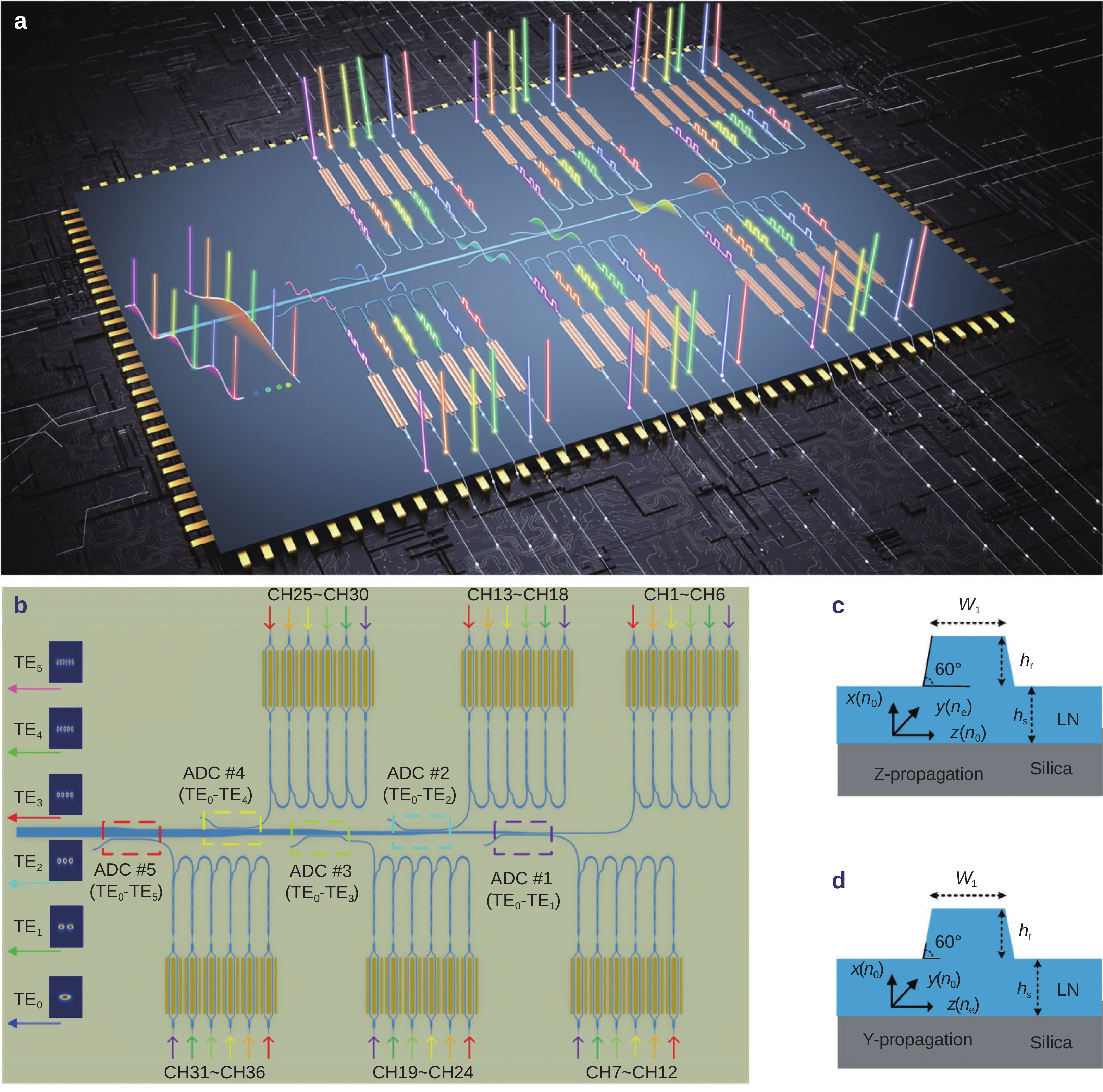
Here, a hybrid 6-mode × 6-wavelength division multiplexing transmitter based on lithium niobate-on-insulator (LNOI) is proposed as a groundbreaking solution for next-generation optical communication. The transmitter innovatively combines six different waveguide modes (TE0–TE5 modes) with six wavelengths spaced 3.2 nm apart, enabling the dense multiplexing of 36 independent channels within a compact optical bandwidth and achieving a capacity of 36 × 240 Gbps. The 3.2 nm channel spacing (approximately 400 GHz at 1550 nm) complies with the ITU-T grid standards, ensuring compatibility with existing optical network infrastructures.
Meanwhile, the mode division multiplexing component utilizes multi-mode waveguides to fully leverage the spatial degrees of freedom in optical transmission, thereby significantly enhancing the spectral efficiency of the system compared to traditional single-mode solutions. This hybrid mode/wavelength division multiplexing architecture exhibits excellent applicability in next-generation data center interconnections and long-haul optical transmission networks.
Light-perception-based interactive control of an underwater digital twin hand
Jinlong Lu, Chao Zhang, Hengchang Nong, Dongying Wang, Hongyu Zhou, Junjie Weng, Yuehua Deng, Yang Yu, Qiang Bian, Jianfa Zhang, Chaofan Zhang, Zhenrong Zhang, Junbo Yang
Opto-Electronic Advances
2026-07-10
Unlocking home-based nocturnal health management: A fiber-optic approach for early detection of cardiorespiratory rhythm disorders
Hanyu Jin, Hao Li, Zhuolin Chen, Liangye Li, Zurui Wang, Kai Zhou, Weijian Hang, Zhipeng Chen, Junfeng Chen, Kai Shen, Jianfeng Wen, Chen Chen, Cunzheng Fan, Zhijun Yan, Feng Wang, Qizhen Sun
Opto-Electronic Advances
2026-07-10
A flexible wireless system for prospective photodynamic therapy applications
Rolan Mansour, Bhavani Yalagala, Vikas Vikas, Nikolas Bruce, Fawziye Tarhini, Georgios N. Arvanitakis, Mohammed Mughal, Jamie Blanche, Ahmad Taha, Jonathan Copper, Muhammad Imran, Karin Williams, Karin Oien, Mahmoud Wagih, Hadi Heidari, Robert Hadfield, David Flynn
Opto-Electronic Advances
2026-07-10
Parallel bright-field and multi-order edge imaging via wide field-of-view trichannel metalens
Xiaotong Li, Yeseul Kim, Youngsun Jeon, Junhwa Seong, Jaekyung Kim, Peng Tang, Shiqi Hu, Harit Keawmuang, Beomha Yang, Dongmin Jeon, Le Dai, Weiyan Li, Xiaodong Cai, Jinhui Shi, Yong-Sang Ryu, Trevon Badloe, Junsuk Rho
Opto-Electronic Advances
2026-07-10