(Peer-Reviewed) Triplet exciton harvesting via TADF in hafnium chlorides array scintillator screen enables ultrahigh-resolution X-ray imaging
Jun'an Lai 赖俊安 ¹ ², Yi Ye 叶意 ³, Xu Liu 刘旭 ¹, Sijun Cao 曹思骏 ², Shiji Zhou 周世纪 ², Wenxia Zhang 周世纪 ⁴, Kang An 安康 ², Peng He 何鹏 ², Tingming Jiang 姜庭明 ², Xiaosheng Tang 唐孝生 ² ⁴, Rui Zhou 周锐 ⁵ ⁶, Dong Zhang 张冬 ¹
¹ Department of Radiology, Xinqiao Hospital, Army Medical University, Chongqing 400037, China
中国 重庆 第三军医大学新桥医院放射科
² Key Laboratory of Optoelectronic Technology & Systems (Ministry of Education), College of Optoelectronic Engineering, Chongqing University, Chongqing 400044, China
中国 重庆 重庆大学光电工程学院 光电技术及系统教育部重点实验室
³ Emergency Department of the Affiliated Hospital/College of Clinical Medicine, Guizhou Medical University, Guiyang 550000, China
中国 贵阳 贵州医科大学附属医院 / 临床医学院 急诊医学科
⁴ College of Optoelectronic Engineering, Chongqing University of Posts and Telecommunications, Chongqing 400065, China
中国 重庆 重庆邮电大学光电工程学院
⁵ Institute of Optics and Electronics, Chinese Academy of Sciences, Chengdu 610209, China
中国 成都 中国科学院光电技术研究所
⁶ Pen-Tung Sah Institute of Micro-Nano Science and Technology, Xiamen University, Xiamen 361005, China
中国 厦门 厦门大学 萨本栋微米纳米科学技术研究院
Opto-Electronic Advances, 2026-06-08
Abstract
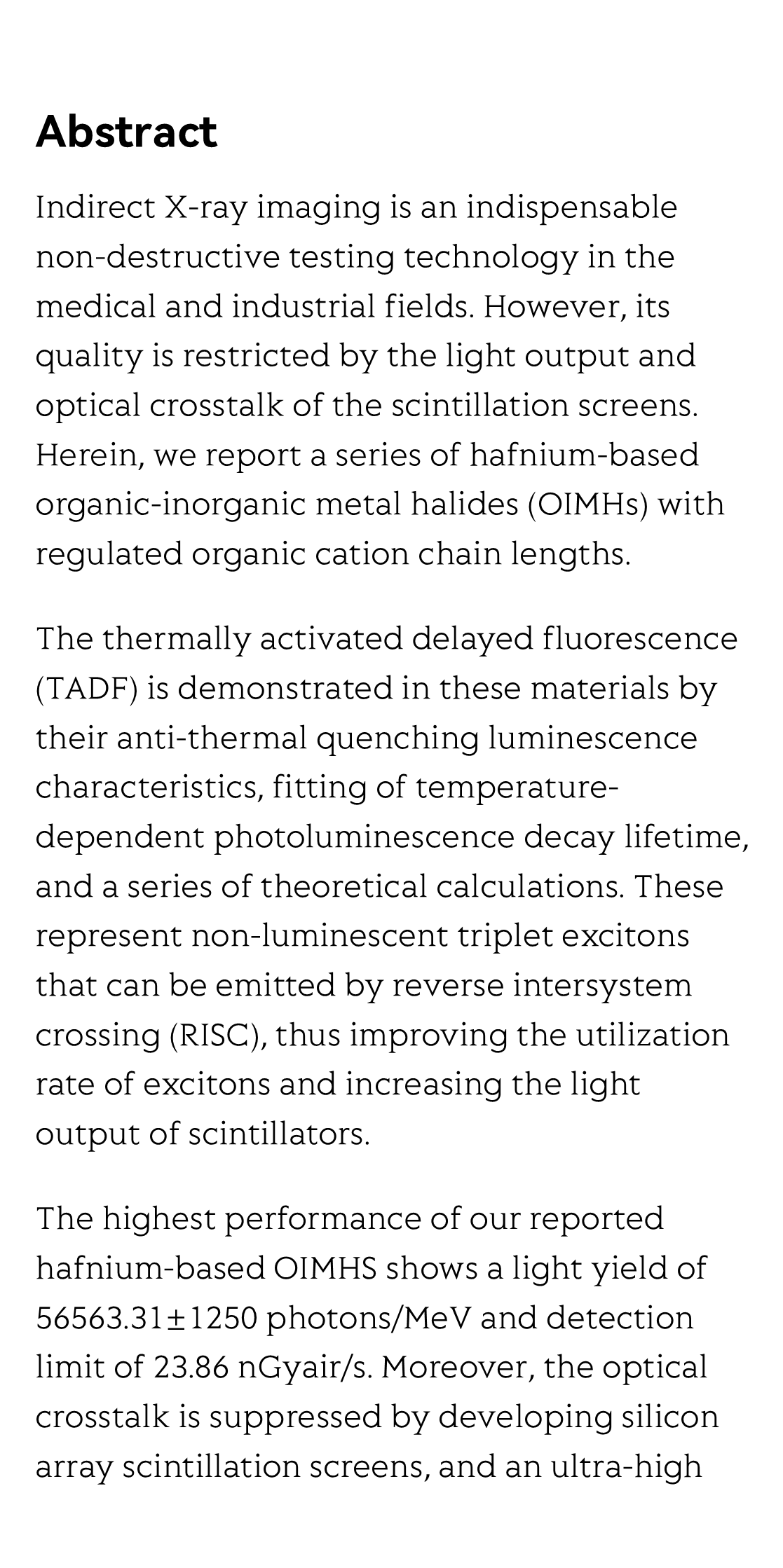
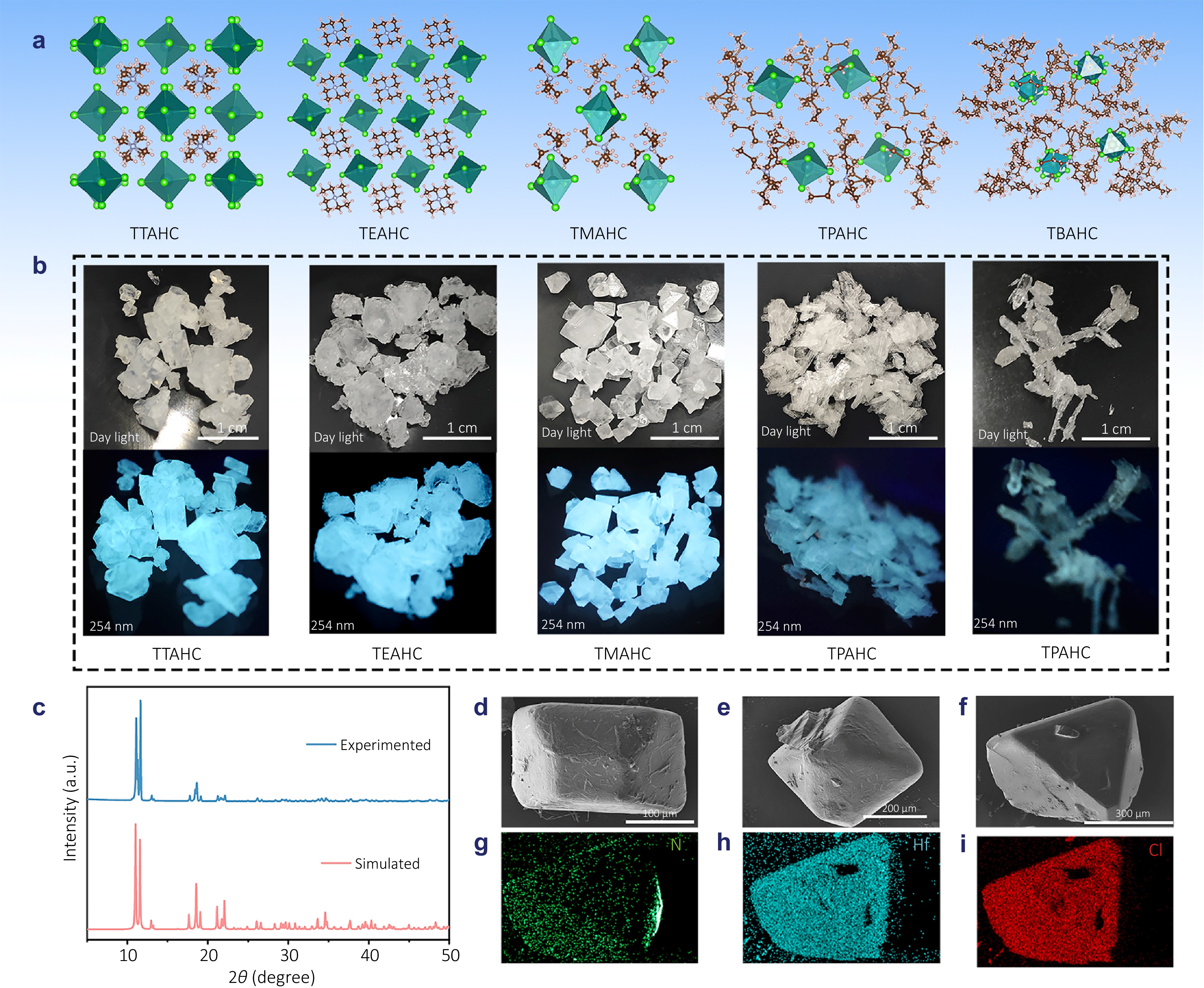
Indirect X-ray imaging is an indispensable non-destructive testing technology in the medical and industrial fields. However, its quality is restricted by the light output and optical crosstalk of the scintillation screens. Herein, we report a series of hafnium-based organic-inorganic metal halides (OIMHs) with regulated organic cation chain lengths.
The thermally activated delayed fluorescence (TADF) is demonstrated in these materials by their anti-thermal quenching luminescence characteristics, fitting of temperature-dependent photoluminescence decay lifetime, and a series of theoretical calculations. These represent non-luminescent triplet excitons that can be emitted by reverse intersystem crossing (RISC), thus improving the utilization rate of excitons and increasing the light output of scintillators.
The highest performance of our reported hafnium-based OIMHS shows a light yield of 56563.31±1250 photons/MeV and detection limit of 23.86 nGyair/s. Moreover, the optical crosstalk is suppressed by developing silicon array scintillation screens, and an ultra-high spatial resolution of 31.41 lp/mm is achieved. These results offer insights into the luminescent mechanism of hafnium-based OIMHs and initiate a new paradigm for exciton-optical co-management for high-quality X-ray imaging.
Light-perception-based interactive control of an underwater digital twin hand
Jinlong Lu, Chao Zhang, Hengchang Nong, Dongying Wang, Hongyu Zhou, Junjie Weng, Yuehua Deng, Yang Yu, Qiang Bian, Jianfa Zhang, Chaofan Zhang, Zhenrong Zhang, Junbo Yang
Opto-Electronic Advances
2026-07-10
Unlocking home-based nocturnal health management: A fiber-optic approach for early detection of cardiorespiratory rhythm disorders
Hanyu Jin, Hao Li, Zhuolin Chen, Liangye Li, Zurui Wang, Kai Zhou, Weijian Hang, Zhipeng Chen, Junfeng Chen, Kai Shen, Jianfeng Wen, Chen Chen, Cunzheng Fan, Zhijun Yan, Feng Wang, Qizhen Sun
Opto-Electronic Advances
2026-07-10
A flexible wireless system for prospective photodynamic therapy applications
Rolan Mansour, Bhavani Yalagala, Vikas Vikas, Nikolas Bruce, Fawziye Tarhini, Georgios N. Arvanitakis, Mohammed Mughal, Jamie Blanche, Ahmad Taha, Jonathan Copper, Muhammad Imran, Karin Williams, Karin Oien, Mahmoud Wagih, Hadi Heidari, Robert Hadfield, David Flynn
Opto-Electronic Advances
2026-07-10
Parallel bright-field and multi-order edge imaging via wide field-of-view trichannel metalens
Xiaotong Li, Yeseul Kim, Youngsun Jeon, Junhwa Seong, Jaekyung Kim, Peng Tang, Shiqi Hu, Harit Keawmuang, Beomha Yang, Dongmin Jeon, Le Dai, Weiyan Li, Xiaodong Cai, Jinhui Shi, Yong-Sang Ryu, Trevon Badloe, Junsuk Rho
Opto-Electronic Advances
2026-07-10