(Peer-Reviewed) AI-enabled electromagnetic metasurfaces for wireless communication and invisibility cloak
Fan Zhang ¹ ² ³, Jiwei Zhao 赵纪伟 ¹ ² ³, Huan Lu 鲁焕 ¹ ² ³, Guixi Mei ¹ ² ³, Ruikai Hu ⁴, Bin Zheng 郑斌 ¹ ² ³, Hongsheng Chen 陈红胜 ¹ ² ³
¹ State Key Laboratory of Reliability Technology for Electronic Components, ZJU-Hangzhou Global Scientific and Technological Innovation Center, Zhejiang University, Hangzhou 310027, China
中国 杭州 浙江大学杭州国际科创中心 电子元器件可靠性技术全国重点实验室
² The Electromagnetics Academy at Zhejiang University, College of Information Science and Electronic Engineering, Zhejiang University, Hangzhou 310027, China
中国 杭州 浙江大学信息与电子工程学院 浙江大学国际电磁科学院
³ Zhejiang Key Lab. of Intelligent Electromagnetic Control and Advanced Electronic Integration, Jinhua Institute of Zhejiang University, Zhejiang University, Jinhua 321099, China
中国 金华 浙江大学金华研究院 全省电磁智能感控与先进电子集成重点实验室
⁴ ZJU-UIUC Institute, Zhejiang University, Haining 314400, China
中国 海宁 浙江大学伊利诺伊大学厄巴纳香槟校区联合学院
Opto-Electronic Technology, 2026-06-28
Abstract
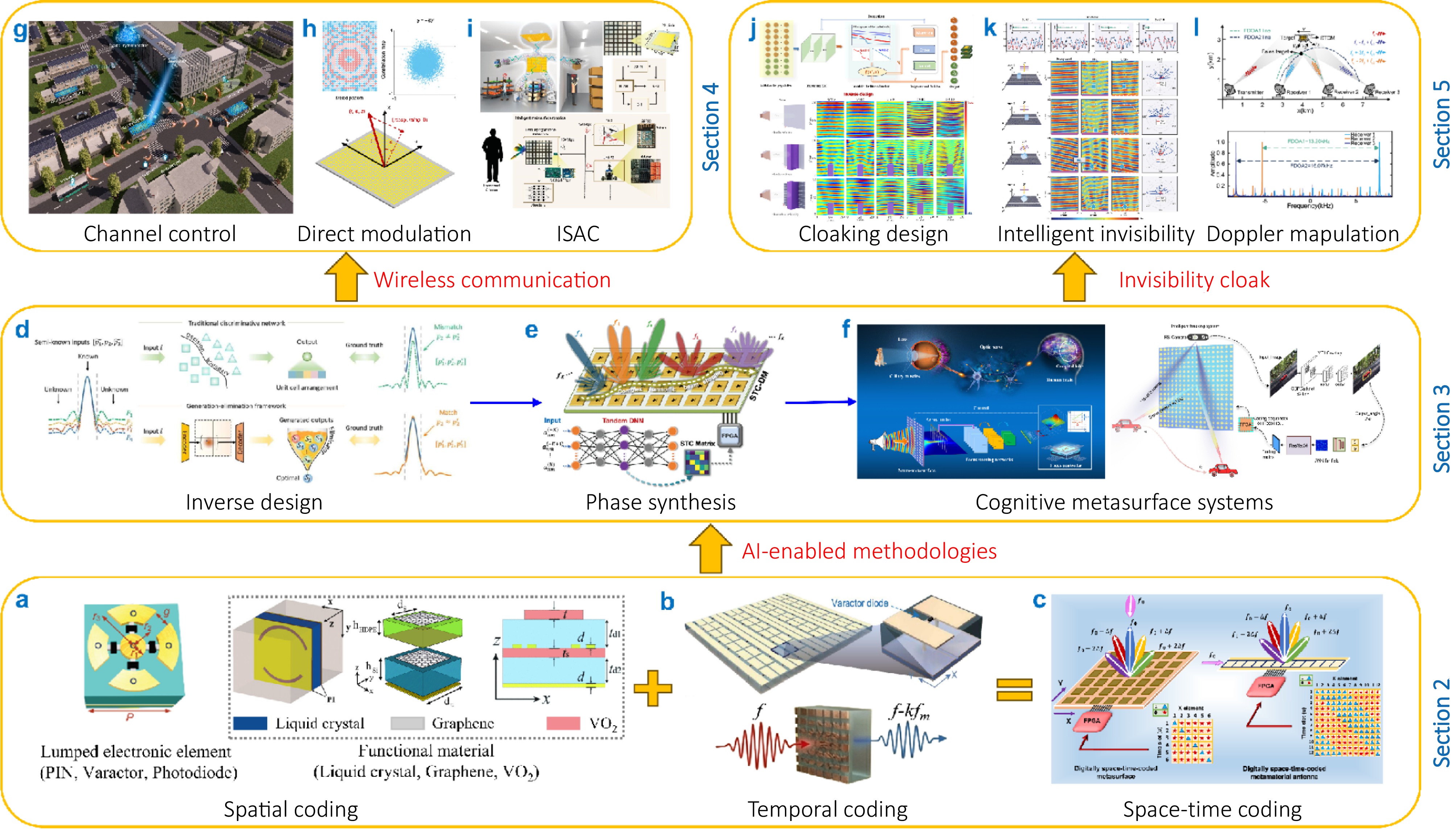
Programmable metasurfaces have evolved into dynamic electromagnetic (EM) interfaces capable of manipulating wavefronts across spatial, temporal, spectral, and information domains. This review summarizes recent advances in programmable metasurfaces and their integration with artificial intelligence (AI).
We first introduce the fundamental coding mechanisms, including spatial coding, temporal modulation, and space-time coding (STC), which provide the physical basis for multidimensional EM control. We then review AI-enabled methodologies for metasurfaces, covering inverse design, large-scale and STC metasurface synthesis, and closed-loop systems integrating sensing, learning, and real-time EM control. Representative system-level applications are discussed in two directions.
For wireless communication, programmable metasurfaces enable radio-environment orchestration, direct information modulation, and integrated sensing and communication. For stealth-oriented applications, they support AI-assisted cloaking design, adaptive invisibility, and EM signature regulation, including Doppler-signature manipulation. Finally, we discuss key challenges in data efficiency, physical consistency, experimental validation, hardware scalability, energy consumption, and closed-loop deployment.
This review presents programmable metasurfaces as a unifying platform concept for intelligent EM systems, while recognizing that current system-level demonstrations remain more mature in the microwave and millimeter-wave regimes.
Ultrafast all-optical modulation of wide-bandwidth pulses enabled by silicon-metasurfaces
Kaloyan Georgiev, Khosro Zangeneh Kamali, Anton A. Trifonov, Giulia Crotti, Lyuben Petrov, Stefan Georgiev, Hristo Iliev, Lei Xu, Unai Arregui Leon, Mohsen Rahmani, Giuseppe Della Valle, Ivan Buchvarov, Dragomir Neshev
Opto-Electronic Advances
2026-09-15
Physics-informed neural fields enable blind aberration correction for partially coherent quantitative phase imaging
Shun Zhou, Xingyu Huang, Linpeng Lu, Habib Ullah, Kaiyu Du, Maciej Trusiak, Malgorzata Kujawinska, Yuzhen Zhang, Yao Fan, Qian Chen, Qinrong Zhang, Chao Zuo
Opto-Electronic Science
2026-08-26
Heterogeneously integrated micro-ring with SnS₂ for dual-functional optical modulation and photodetection
Jinyi Du, Lidan Lu, Xu Zhang, Bofei Zhu, Wenbo Bo, Yingjie Xu, Guang Chen, Yanlin He, Guanghui Ren, Xiaoping Lou, Zheng You, Lianqing Zhu
Opto-Electronic Advances
2026-08-25
Hardware-aware lightweight photonic spiking neural network for pattern classification
Shuiying Xiang, Yahui Zhang, Shangxuan Shi, Haowen Zhao, Dianzhuang Zheng, Xingxing Guo, Yanan Han, Ye Tian, Liyue Zhang, Yuechun Shi, Yue Hao
Opto-Electronic Advances
2026-08-25
PhyspeNet: An empirical physics-aware network for adaptive speckle reconstructive spectrometry
Junrui Liang, Min Jiang, Jun Li, Zhongming Huang, Junhong He, Yanting Guo, Yanzhao Ke, Jun Ye, Jiangming Xu, Jinyong Leng, Pu Zhou
Opto-Electronic Advances
2026-08-25
A 36 × 240 Gbps hybrid mode/wavelength division multiplexing transmitter using lithium niobate on insulator
Mingyu Zhu, Weihan Wang, Ruitao Ma, Aoyun Gao, Chun Gao, Zexu Wang, Fei Huang, Zhenyuan Bao, Dajian Liu, Jiaxuan Gan, Zejie Yu, Huan Li, Weike Zhao, Daoxin Dai
Opto-Electronic Advances
2026-08-25