(Peer-Reviewed) Programmable directional photonic spiking neuron based on a non-Hermitian silicon microresonator
Stefano Biasi, Bülent Aslan, Stefano Gretter, Davide Olivieri, Alessandro Foradori, Riccardo Franchi, Lorenzo Pavesi
Nanoscience Laboratory, Department of Physics, University of Trento, Trento 38123, Italy
Opto-Electronic Science, 2026-08-26
Abstract
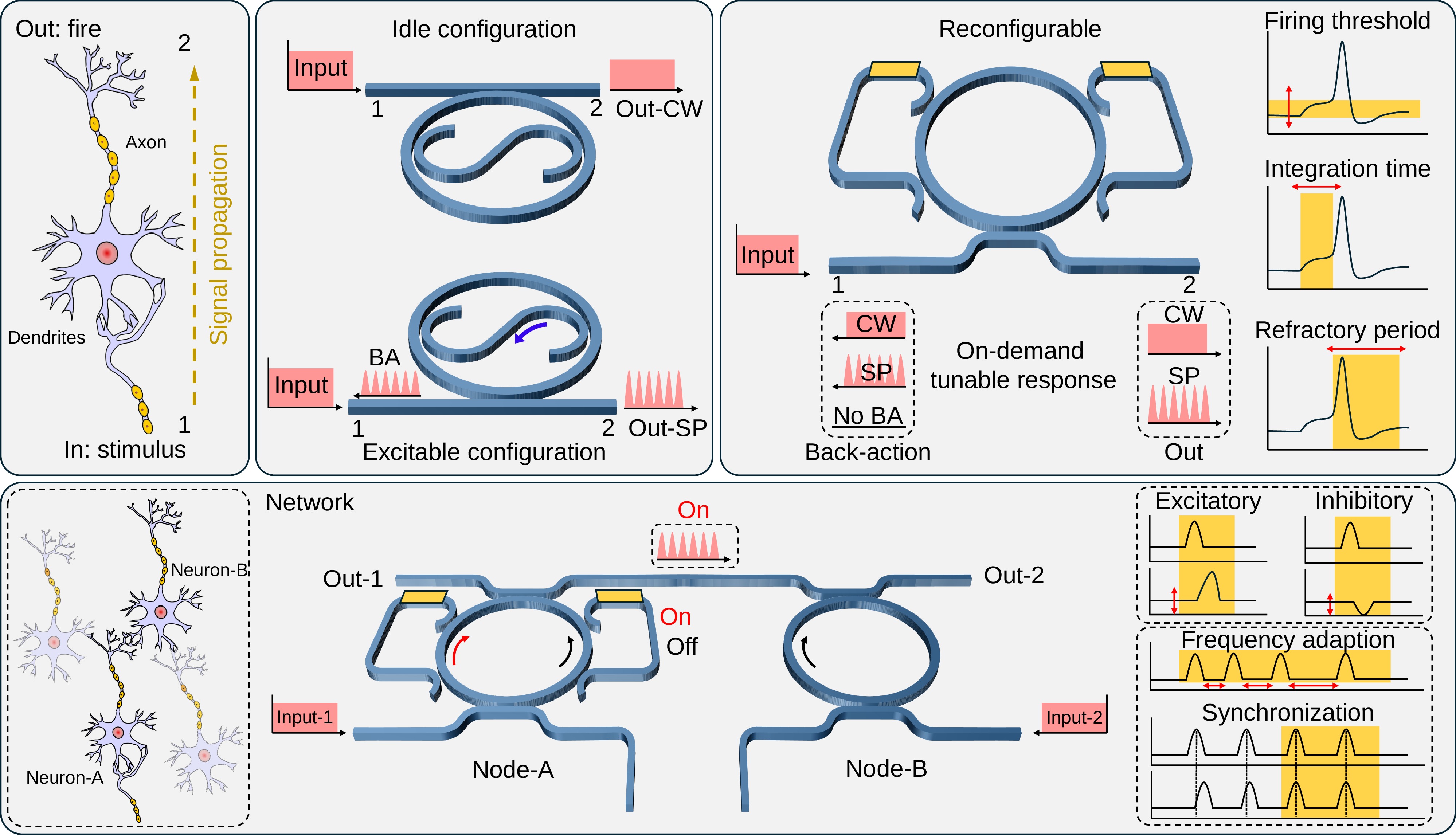
Traditional computing architectures are increasingly constrained by the “Von Neumann bottleneck”, motivating energy-efficient, brain-inspired neuromorphic systems. Silicon photonic microresonators can emulate key neuronal dynamics such as spiking and excitability. However, in reciprocal microresonators, forward spike emission and backward signals are intrinsically linked, limiting independent control of directionality, feedback and inter-node back-action.
Here, we overcome this limitation by exploiting engineered intermodal coupling in non-Hermitian photonic resonators to realize directional excitability in all-optical neurons. First, we show that Taiji microresonators exhibit direction-dependent self-pulsing thresholds, enabling a single device to act as a spiking neuron in one direction while remaining quiescent in the opposite. Then, we introduce the dynamically reconfigurable unified microresonator (DRUM), which enables electrical control of intermodal coupling amplitude and phase. This allows independent control of forward spike emission and backward signals, suppression or enhancement of back-propagation, and active tuning of neuronal properties. We experimentally demonstrate directional spiking asymmetry alongside tunability of temporal integration and refractory period, establishing DRUM as a programmable photonic spiking neuron.
Finally, network-level simulations show that controlled back-action can mediate synaptic-like behavior, including inhibition and synchronization. These results identify reconfigurable non-Hermitian silicon microresonators as promising building blocks for photonic spiking nodes with programmable directionality, back-action, and temporal response.
Ultrafast all-optical modulation of wide-bandwidth pulses enabled by silicon-metasurfaces
Kaloyan Georgiev, Khosro Zangeneh Kamali, Anton A. Trifonov, Giulia Crotti, Lyuben Petrov, Stefan Georgiev, Hristo Iliev, Lei Xu, Unai Arregui Leon, Mohsen Rahmani, Giuseppe Della Valle, Ivan Buchvarov, Dragomir Neshev
Opto-Electronic Advances
2026-09-15
Physics-informed neural fields enable blind aberration correction for partially coherent quantitative phase imaging
Shun Zhou, Xingyu Huang, Linpeng Lu, Habib Ullah, Kaiyu Du, Maciej Trusiak, Malgorzata Kujawinska, Yuzhen Zhang, Yao Fan, Qian Chen, Qinrong Zhang, Chao Zuo
Opto-Electronic Science
2026-08-26
Heterogeneously integrated micro-ring with SnS₂ for dual-functional optical modulation and photodetection
Jinyi Du, Lidan Lu, Xu Zhang, Bofei Zhu, Wenbo Bo, Yingjie Xu, Guang Chen, Yanlin He, Guanghui Ren, Xiaoping Lou, Zheng You, Lianqing Zhu
Opto-Electronic Advances
2026-08-25
Hardware-aware lightweight photonic spiking neural network for pattern classification
Shuiying Xiang, Yahui Zhang, Shangxuan Shi, Haowen Zhao, Dianzhuang Zheng, Xingxing Guo, Yanan Han, Ye Tian, Liyue Zhang, Yuechun Shi, Yue Hao
Opto-Electronic Advances
2026-08-25
PhyspeNet: An empirical physics-aware network for adaptive speckle reconstructive spectrometry
Junrui Liang, Min Jiang, Jun Li, Zhongming Huang, Junhong He, Yanting Guo, Yanzhao Ke, Jun Ye, Jiangming Xu, Jinyong Leng, Pu Zhou
Opto-Electronic Advances
2026-08-25
A 36 × 240 Gbps hybrid mode/wavelength division multiplexing transmitter using lithium niobate on insulator
Mingyu Zhu, Weihan Wang, Ruitao Ma, Aoyun Gao, Chun Gao, Zexu Wang, Fei Huang, Zhenyuan Bao, Dajian Liu, Jiaxuan Gan, Zejie Yu, Huan Li, Weike Zhao, Daoxin Dai
Opto-Electronic Advances
2026-08-25