(Peer-Reviewed) Instantaneous UAV tracking using single-photon LiDAR via photon-event-driven suppression of temporal-averaging bias
Dongfang Guo 郭东芳 ¹, Jianfeng Sun 孙剑峰 ¹ ², Xin Zhou 周鑫 ¹ ² ³, Chen Shen 沈忱 ⁴, Sheng Chen 陈盛 ¹ ², Sining Li 李思宁 ¹, Yanchen Qu 曲彦臣 ¹
¹ National Key Laboratory of Laser Spatial Information, Harbin Institute of Technology, Harbin, 150000, China
中国 哈尔滨 哈尔滨工业大学 激光空间信息全国重点实验室
² Zhengzhou Research Institute, Harbin Institute of Technology, Zhengzhou, 450000, China
中国 哈尔滨 哈尔滨工业大学 郑州高等研究院
³ Research Center for Space Optical Engineering, Harbin Institute of Technology, Harbin, 150000, China
中国 哈尔滨 哈尔滨工业大学空间光学工程研究中心
⁴ School of Electrical and Electronic Engineering, Nanyang Technological University, Jurong West, 639798, Singapore
Opto-Electronic Technology, 2026-06-28
Abstract
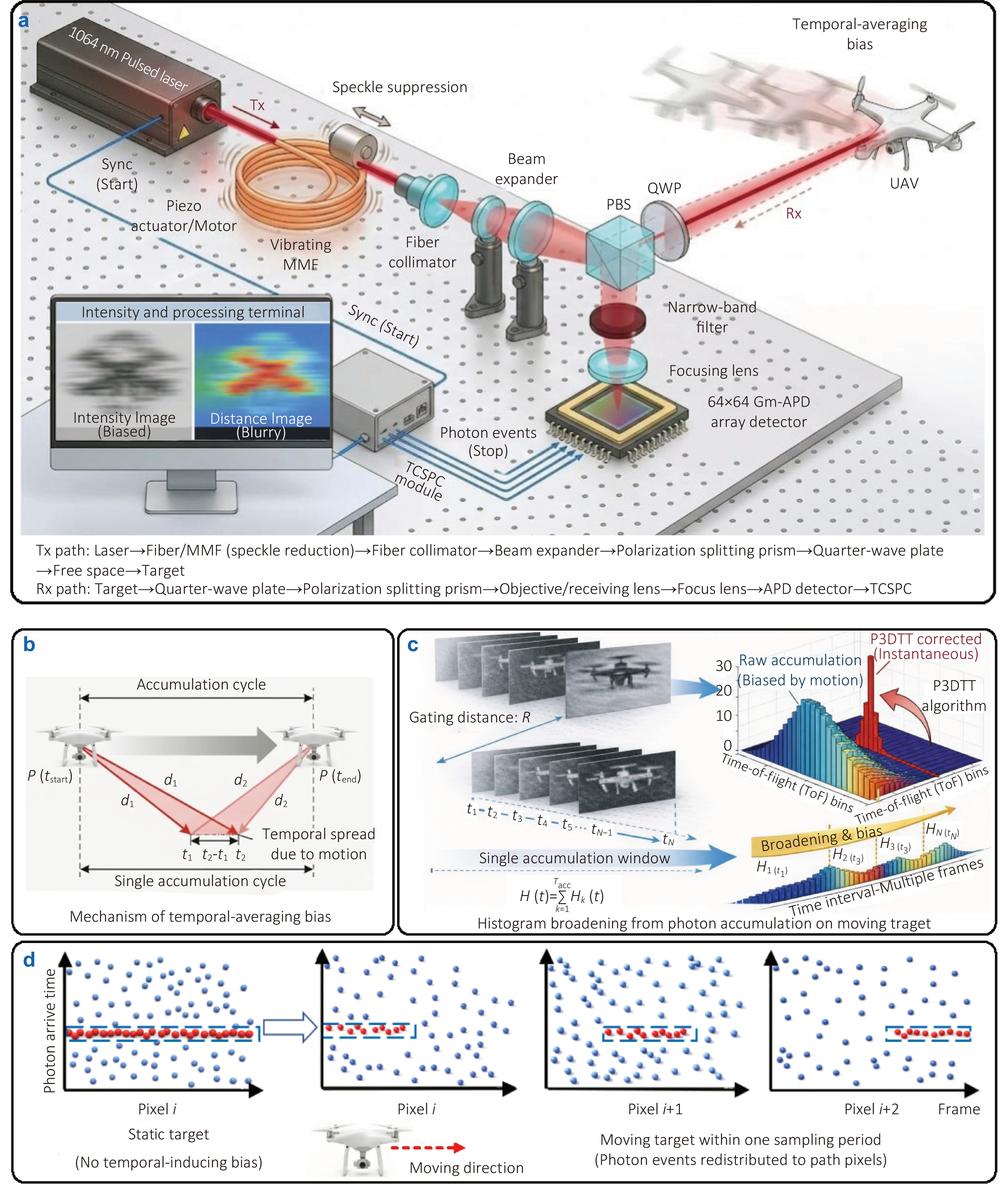
Single-photon LiDAR offers photon-level sensitivity for long-range detection, yet its application to dynamic targets like low-altitude Unmanned Aerial Vehicle (UAV) is bottlenecked by motion-induced temporal-averaging bias. When target motion exceeds spatial resolution within a sampling interval, conventional multi-frame accumulation blurs the instantaneous spatial and temporal coordinates. Here, we introduce a photon-aware three-dimensional dynamic tracking framework (P3DTT) that suppresses this bias by transitioning to a multi-dimensional, photon-event-driven observation space.
By integrating spatio-temporal-frame photon-event statistical modeling with a Random Sample Consensus-based iterative fitting scheme, P3DTT extracts instantaneous, unbiased target positions under extreme photon starvation. Monte Carlo simulations demonstrate accurate 3D-position correction and tracking of target moving up to 188.8 m/s at 2 km under 0.2184 photons per pixel and a Signal-to-Noise Ratio (SNR) of −8.37 dB. The photon-arrival time fitting error is reduced from 4.71 ns to 0.33 ns (about 14-fold improvement), while the 3D tracking error reached 0.16 m. Field experiments conducted with the custom-developed Geiger-mode avalanche photodiode (Gm-APD) single-photon LiDAR demonstrate reliable UAV tracking at 2.5 km under only 0.2731 photons per pixel and an SNR of −7.68 dB. P3DTT consistently recovered unbiased instantaneous 3D-position, achieving tracking errors below 0.43 m.
This work establishes a new computational paradigm, pushing single-photon LiDAR beyond integral imaging towards instantaneous perception for low altitude monitoring.
Ultrafast all-optical modulation of wide-bandwidth pulses enabled by silicon-metasurfaces
Kaloyan Georgiev, Khosro Zangeneh Kamali, Anton A. Trifonov, Giulia Crotti, Lyuben Petrov, Stefan Georgiev, Hristo Iliev, Lei Xu, Unai Arregui Leon, Mohsen Rahmani, Giuseppe Della Valle, Ivan Buchvarov, Dragomir Neshev
Opto-Electronic Advances
2026-09-15
Physics-informed neural fields enable blind aberration correction for partially coherent quantitative phase imaging
Shun Zhou, Xingyu Huang, Linpeng Lu, Habib Ullah, Kaiyu Du, Maciej Trusiak, Malgorzata Kujawinska, Yuzhen Zhang, Yao Fan, Qian Chen, Qinrong Zhang, Chao Zuo
Opto-Electronic Science
2026-08-26
Heterogeneously integrated micro-ring with SnS₂ for dual-functional optical modulation and photodetection
Jinyi Du, Lidan Lu, Xu Zhang, Bofei Zhu, Wenbo Bo, Yingjie Xu, Guang Chen, Yanlin He, Guanghui Ren, Xiaoping Lou, Zheng You, Lianqing Zhu
Opto-Electronic Advances
2026-08-25
Hardware-aware lightweight photonic spiking neural network for pattern classification
Shuiying Xiang, Yahui Zhang, Shangxuan Shi, Haowen Zhao, Dianzhuang Zheng, Xingxing Guo, Yanan Han, Ye Tian, Liyue Zhang, Yuechun Shi, Yue Hao
Opto-Electronic Advances
2026-08-25
PhyspeNet: An empirical physics-aware network for adaptive speckle reconstructive spectrometry
Junrui Liang, Min Jiang, Jun Li, Zhongming Huang, Junhong He, Yanting Guo, Yanzhao Ke, Jun Ye, Jiangming Xu, Jinyong Leng, Pu Zhou
Opto-Electronic Advances
2026-08-25
A 36 × 240 Gbps hybrid mode/wavelength division multiplexing transmitter using lithium niobate on insulator
Mingyu Zhu, Weihan Wang, Ruitao Ma, Aoyun Gao, Chun Gao, Zexu Wang, Fei Huang, Zhenyuan Bao, Dajian Liu, Jiaxuan Gan, Zejie Yu, Huan Li, Weike Zhao, Daoxin Dai
Opto-Electronic Advances
2026-08-25