(Peer-Reviewed) Scattering media as random micro-phase-pinhole arrays for incoherent information transmission
Xuyu Zhang 张栩瑜 ¹ ², Haoran Li 李浩然 ³, Tianting Zhong 仲天庭 ³, Dawei Zhang 张大伟 ¹, Songlin Zhuang 庄松林 ¹, Shensheng Han 韩申生 ² ⁴, Puxiang Lai 赖溥祥 ³ ⁵ ⁶, Honglin Liu 刘红林 ² ⁴
¹ School of Optical-Electrical and Computer Engineering, University of Shanghai for Science and Technology, Shanghai 200093, China
中国 上海 上海理工大学光电信息与计算机工程学院
² Wangzhijiang Innovation Center for Laser, Aerospace Laser Technology and System Department, Shanghai Institute of Optics and Fine Mechanics, Chinese Academy of Sciences, Shanghai 201800, China
中国 上海 中国科学院上海光学精密机械研究所 空天激光技术与系统部 王之江激光创新中心
³ Department of Biomedical Engineering, The Hong Kong Polytechnic University, Hong Kong SAR 999077, China
中国 香港 香港理工大学生物医学工程学系
⁴ Center of Materials Science and Optoelectronics Engineering, University of Chinese Academy of Science, Beijing 100049, China
中国 北京 中国科学院大学材料科学与光电技术学院
⁵ Hong Kong Polytechnic University Shenzhen Research Institute, Shenzhen 518000, China
中国 深圳 香港理工大学深圳研究院
⁶ Photonics Research Institute, The Hong Kong Polytechnic University, Hong Kong SAR 999077, China
中国 香港 香港理工大学光子技术研究院
Opto-Electronic Technology, 2026-06-28
Abstract
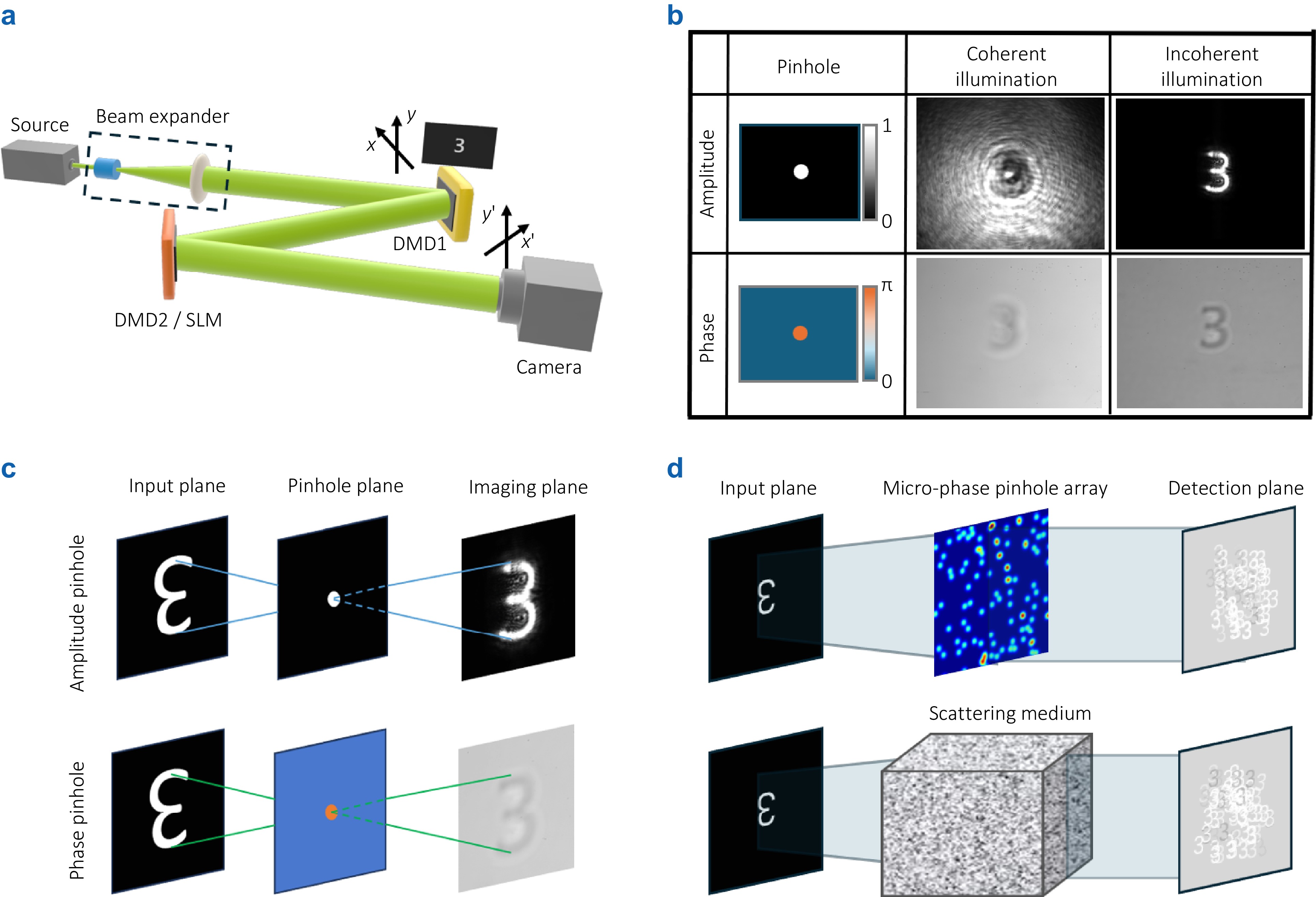
Imaging through an optically thick scattering medium remains a formidable challenge, typically addressed by treating the medium as a stochastic "black box" that scrambles information into random speckle patterns. Here, we present a fundamental shift in this perspective: under incoherent illumination, the scattering medium functions as a random array of micro-phase-pinholes, serving as discrete channels for information transmission.
By proposing and validating a micro-phase-pinhole model, we reveal that individual microchannels possess distinct transmission capacities that govern imaging quality. Crucially, we demonstrate that specific, randomly distributed combinations of these phase pinholes can spontaneously generate high-fidelity images directly within the speckle field. Guided by this fundamental physical interpretation, we develop a feature fusion algorithm that extracts and integrates high-quality information from selective channel combinations within a single speckle pattern.
This work reveals the underlying physical principles of incoherent information delivery through scattering media. Transition from the "black box" view to a deterministic channel model is a strong conceptual leap, offering a novel pathway to overcome thickness limitation in imaging through scattering media.
Ultrafast all-optical modulation of wide-bandwidth pulses enabled by silicon-metasurfaces
Kaloyan Georgiev, Khosro Zangeneh Kamali, Anton A. Trifonov, Giulia Crotti, Lyuben Petrov, Stefan Georgiev, Hristo Iliev, Lei Xu, Unai Arregui Leon, Mohsen Rahmani, Giuseppe Della Valle, Ivan Buchvarov, Dragomir Neshev
Opto-Electronic Advances
2026-09-15
Physics-informed neural fields enable blind aberration correction for partially coherent quantitative phase imaging
Shun Zhou, Xingyu Huang, Linpeng Lu, Habib Ullah, Kaiyu Du, Maciej Trusiak, Malgorzata Kujawinska, Yuzhen Zhang, Yao Fan, Qian Chen, Qinrong Zhang, Chao Zuo
Opto-Electronic Science
2026-08-26
Heterogeneously integrated micro-ring with SnS₂ for dual-functional optical modulation and photodetection
Jinyi Du, Lidan Lu, Xu Zhang, Bofei Zhu, Wenbo Bo, Yingjie Xu, Guang Chen, Yanlin He, Guanghui Ren, Xiaoping Lou, Zheng You, Lianqing Zhu
Opto-Electronic Advances
2026-08-25
Hardware-aware lightweight photonic spiking neural network for pattern classification
Shuiying Xiang, Yahui Zhang, Shangxuan Shi, Haowen Zhao, Dianzhuang Zheng, Xingxing Guo, Yanan Han, Ye Tian, Liyue Zhang, Yuechun Shi, Yue Hao
Opto-Electronic Advances
2026-08-25
PhyspeNet: An empirical physics-aware network for adaptive speckle reconstructive spectrometry
Junrui Liang, Min Jiang, Jun Li, Zhongming Huang, Junhong He, Yanting Guo, Yanzhao Ke, Jun Ye, Jiangming Xu, Jinyong Leng, Pu Zhou
Opto-Electronic Advances
2026-08-25
A 36 × 240 Gbps hybrid mode/wavelength division multiplexing transmitter using lithium niobate on insulator
Mingyu Zhu, Weihan Wang, Ruitao Ma, Aoyun Gao, Chun Gao, Zexu Wang, Fei Huang, Zhenyuan Bao, Dajian Liu, Jiaxuan Gan, Zejie Yu, Huan Li, Weike Zhao, Daoxin Dai
Opto-Electronic Advances
2026-08-25