(Peer-Reviewed) Phonon-assisted absorption photoconductive switch
Zhao Wang 王钊 ¹, Lixin Zhang 张利欣 ¹, Lu Cheng 程璐 ¹, Danwen Zhang 张丹文 ¹, Yu Lu 卢煜 ¹, Naiji Zhang 张乃霁 ¹, Xin Zhang 张鑫 ¹, Duanyang Chen 陈端阳 ², Zhan Sui 隋展 ³, Hongji Qi 齐红基 ⁴ ⁵, Wei Zheng 郑伟 ¹
¹ School of Materials, Sun Yat-sen University, Shenzhen 518107, China
中国 深圳 中山大学材料学院
² Hangzhou Fujia Gallium Technology Company Limited, Hangzhou 311400, China
中国 杭州 杭州富加镓业科技有限公司
³ Shanghai Institute of Laser Plasma, China Academy of Engineering Physics, Shanghai 201899, China
中国 上海 中国工程物理研究院上海激光等离子体研究所
⁴ Advanced Laser and Optoelectronic Functional Materials Department, Shanghai Institute of Optics and Fine Mechanics, Chinese Academy of Sciences, Shanghai 201800, China
中国 上海 中国科学院上海光学精密机械研究所先进激光与光电功能材料部
⁵ Shanghai Key Laboratory of Wide and Ultra-Wide Bandgap Semiconductor Materials, Shanghai 201306, China
中国 上海 上海市宽禁带与超宽禁带半导体材料重点实验室
Opto-Electronic Science, 2026-05-25
Abstract
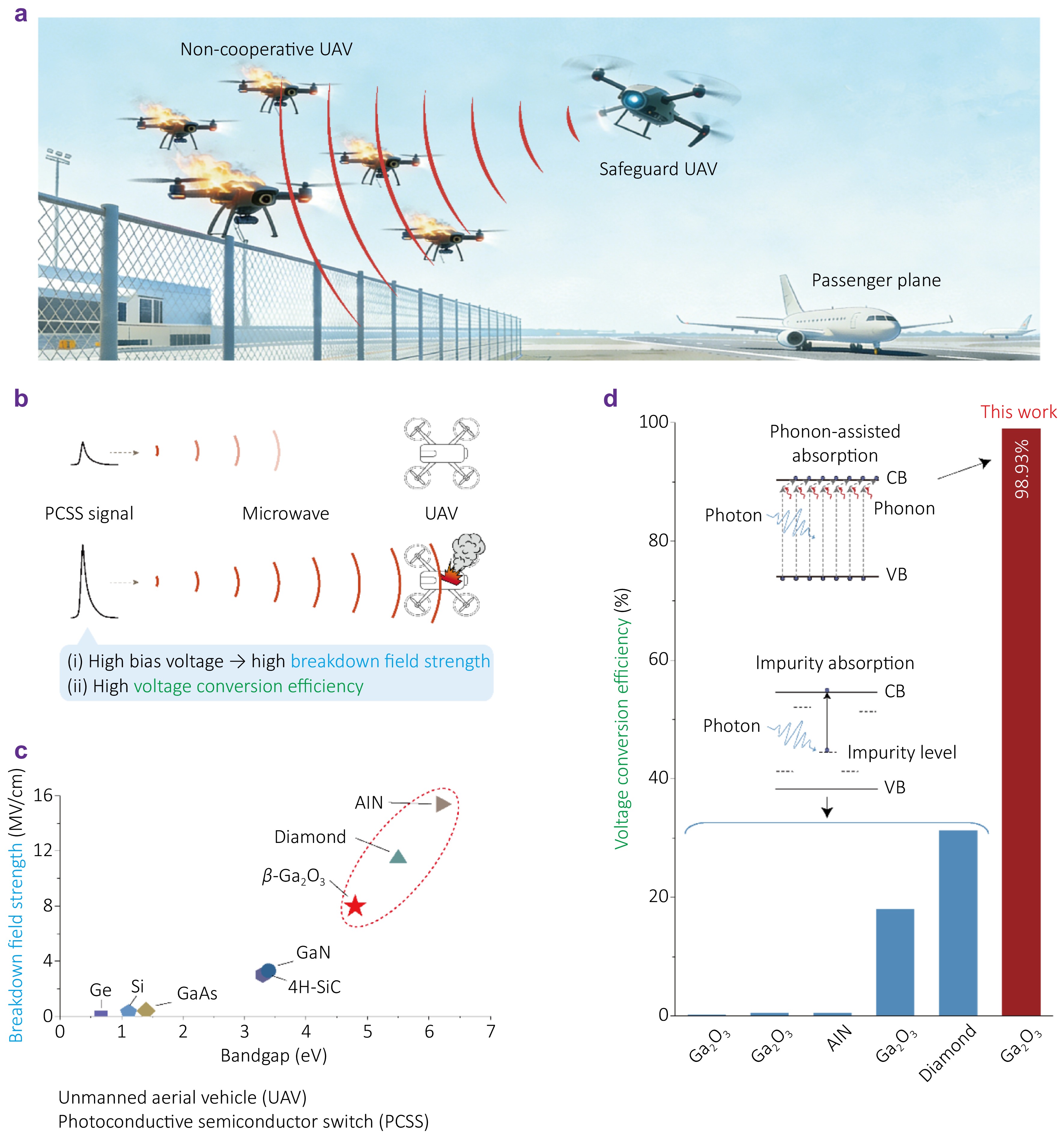
High-power microwave technology shows great promise for applications in low-altitude security systems such as countering non-cooperative unmanned aerial vehicles. However, conventional high-power photoconductive semiconductor switches (PCSSs) based on impurity absorption intrinsically fail to achieve high voltage conversion efficiency across different operating voltages, limiting their overall performance.
Here, we propose a novel PCSS based on phonon-assisted absorption, which fundamentally breaks the efficiency bottleneck and enables voltage conversion efficiency close to the theoretical limit. Using gallium oxide (Ga2O3), we successfully fabricate this phonon-assisted Ga2O3 PCSS, demonstrating a voltage conversion efficiency of 90.25% at an excitation laser energy of 1.98 mJ and a bias voltage of 600 V, as well as a conversion efficiency of 98.93% and a maximum output power density of 17.7 MW/cm2 at a bias voltage of 4000 V.
This work provides a new principle and technical route for designing and fabricating high-performance high-power photoconductive switches, significantly advancing the development of high-efficiency, high-power microwave systems.
Ultrafast all-optical modulation of wide-bandwidth pulses enabled by silicon-metasurfaces
Kaloyan Georgiev, Khosro Zangeneh Kamali, Anton A. Trifonov, Giulia Crotti, Lyuben Petrov, Stefan Georgiev, Hristo Iliev, Lei Xu, Unai Arregui Leon, Mohsen Rahmani, Giuseppe Della Valle, Ivan Buchvarov, Dragomir Neshev
Opto-Electronic Advances
2026-09-15
Physics-informed neural fields enable blind aberration correction for partially coherent quantitative phase imaging
Shun Zhou, Xingyu Huang, Linpeng Lu, Habib Ullah, Kaiyu Du, Maciej Trusiak, Malgorzata Kujawinska, Yuzhen Zhang, Yao Fan, Qian Chen, Qinrong Zhang, Chao Zuo
Opto-Electronic Science
2026-08-26
Heterogeneously integrated micro-ring with SnS₂ for dual-functional optical modulation and photodetection
Jinyi Du, Lidan Lu, Xu Zhang, Bofei Zhu, Wenbo Bo, Yingjie Xu, Guang Chen, Yanlin He, Guanghui Ren, Xiaoping Lou, Zheng You, Lianqing Zhu
Opto-Electronic Advances
2026-08-25
Hardware-aware lightweight photonic spiking neural network for pattern classification
Shuiying Xiang, Yahui Zhang, Shangxuan Shi, Haowen Zhao, Dianzhuang Zheng, Xingxing Guo, Yanan Han, Ye Tian, Liyue Zhang, Yuechun Shi, Yue Hao
Opto-Electronic Advances
2026-08-25
PhyspeNet: An empirical physics-aware network for adaptive speckle reconstructive spectrometry
Junrui Liang, Min Jiang, Jun Li, Zhongming Huang, Junhong He, Yanting Guo, Yanzhao Ke, Jun Ye, Jiangming Xu, Jinyong Leng, Pu Zhou
Opto-Electronic Advances
2026-08-25
A 36 × 240 Gbps hybrid mode/wavelength division multiplexing transmitter using lithium niobate on insulator
Mingyu Zhu, Weihan Wang, Ruitao Ma, Aoyun Gao, Chun Gao, Zexu Wang, Fei Huang, Zhenyuan Bao, Dajian Liu, Jiaxuan Gan, Zejie Yu, Huan Li, Weike Zhao, Daoxin Dai
Opto-Electronic Advances
2026-08-25