(Peer-Reviewed) Ppt-level volatile organic compounds detection via microsecond-pulse-enhanced mid-infrared photoacoustic
Senyu Wang 王森宇 ¹ ³, Liang Zhao 赵亮 ¹, Hongyu Luo 罗鸿禹 ¹, Xiangyu Zhao 赵翔宇 ¹, Jianfeng Li 李剑峰 ¹ ², Wei Wang 王伟 ¹, Hao Lei 雷浩 ¹, Mingrui Jiang 姜明瑞 ¹, Jinlong Wan 万金龙 ¹, Binxing Zhao 赵斌兴 ¹, Bincheng Li 李斌成 ¹, Yong Liu 刘永 ¹
¹ School of Optoelectronic Science and Engineering, University of Electronic Science and Technology of China, Chengdu 610054, China
中国 成都 电子科技大学光电科学与工程学院
² Tianfu Jiangxi Laboratory, Chengdu 641419, China
中国 成都 天府绛溪实验室
³ Institute for Photon Science and Technology, School of Science, The University of Tokyo, Tokyo 113-0033, Japan
Opto-Electronic Science, 2026-04-23
Abstract
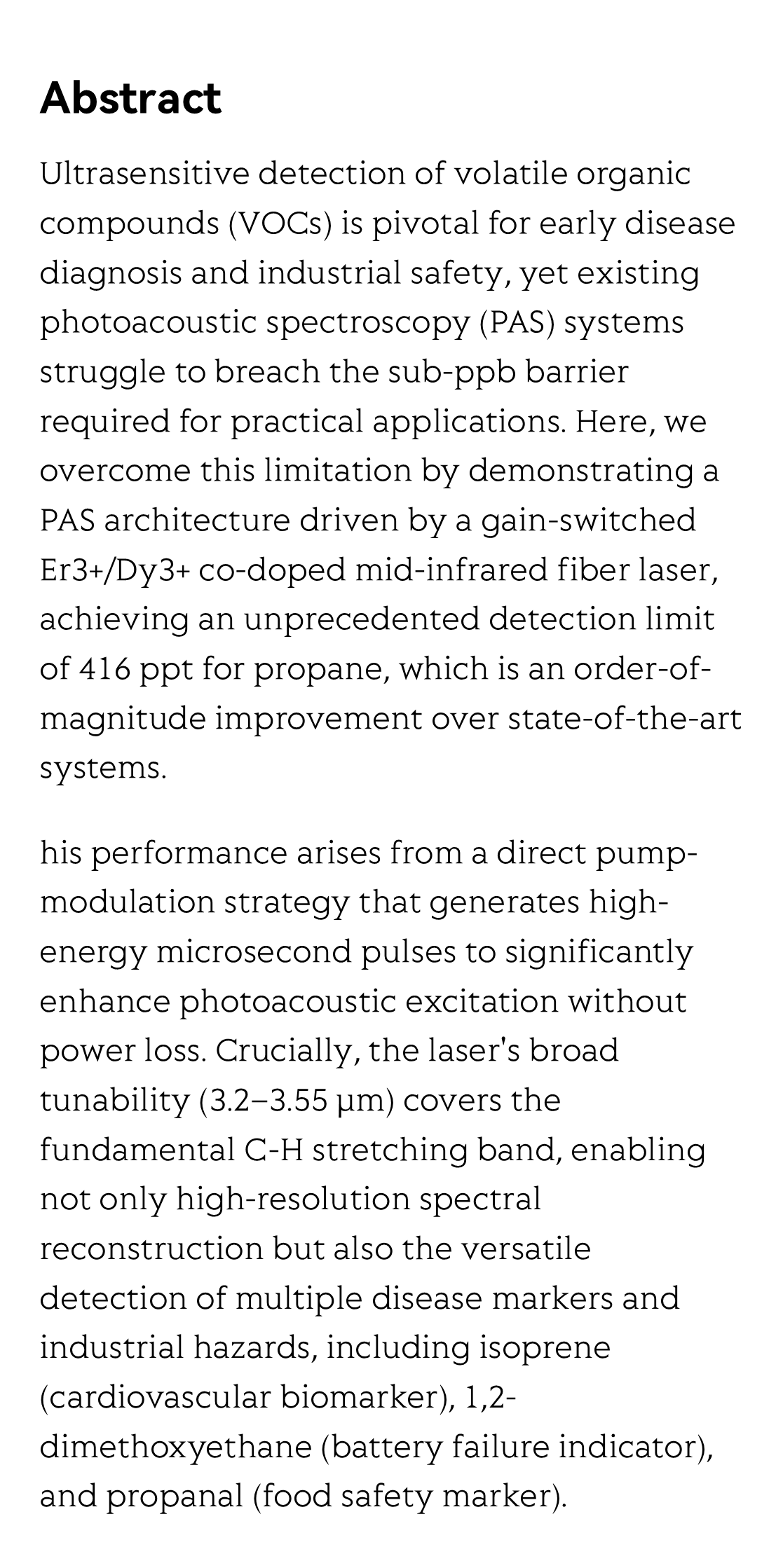
Ultrasensitive detection of volatile organic compounds (VOCs) is pivotal for early disease diagnosis and industrial safety, yet existing photoacoustic spectroscopy (PAS) systems struggle to breach the sub-ppb barrier required for practical applications. Here, we overcome this limitation by demonstrating a PAS architecture driven by a gain-switched Er3+/Dy3+ co-doped mid-infrared fiber laser, achieving an unprecedented detection limit of 416 ppt for propane, which is an order-of-magnitude improvement over state-of-the-art systems.
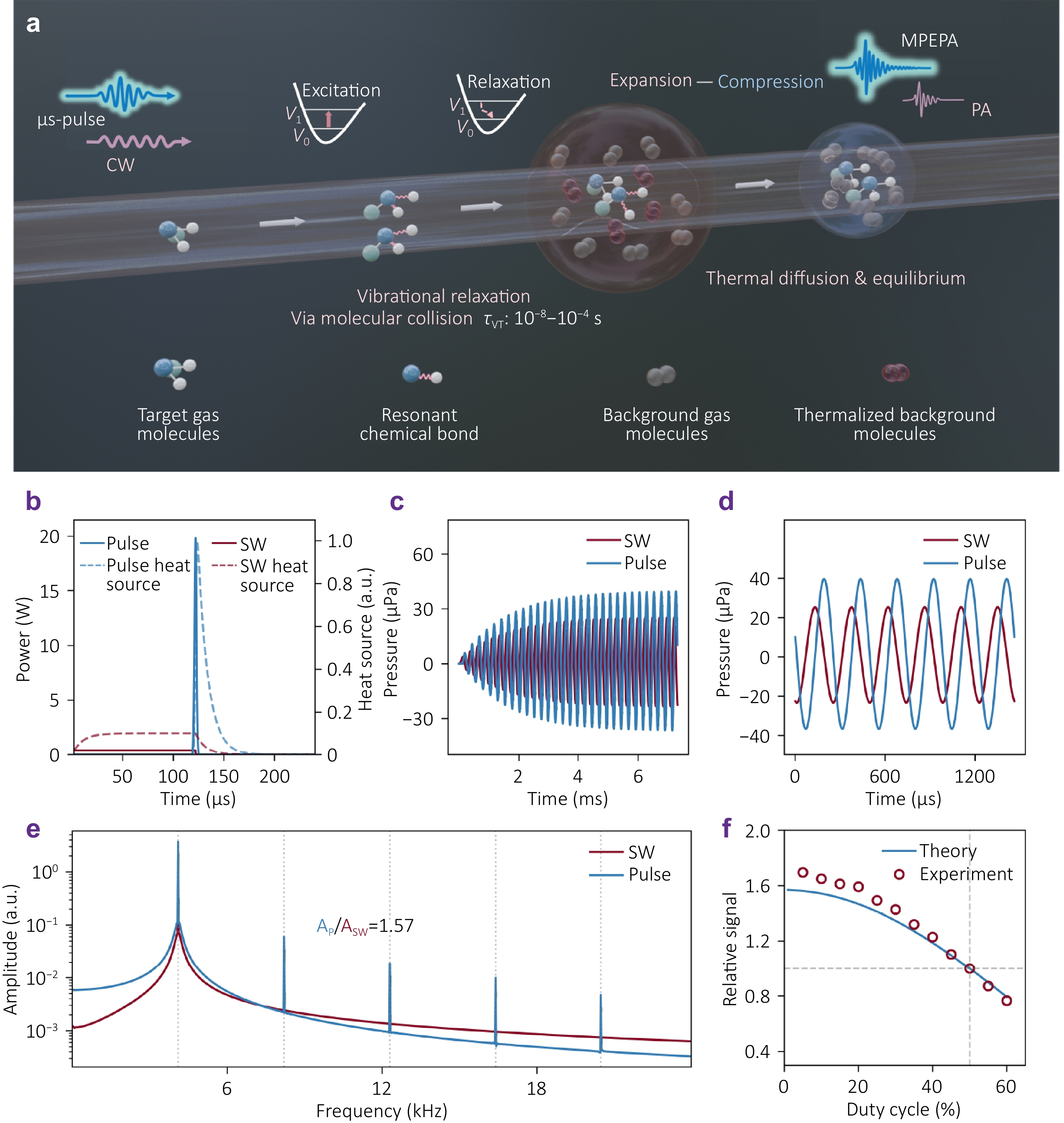
This performance arises from a direct pump-modulation strategy that generates high-energy microsecond pulses to significantly enhance photoacoustic excitation without power loss. Crucially, the laser's broad tunability (3.2–3.55 μm) covers the fundamental C-H stretching band, enabling not only high-resolution spectral reconstruction but also the versatile detection of multiple disease markers and industrial hazards, including isoprene (cardiovascular biomarker), 1,2-dimethoxyethane (battery failure indicator), and propanal (food safety marker).
By delivering clinical-grade sensitivity in a compact, robust fiber-based format, this work establishes a transformative pathway toward deployable, high-performance gas sensing solutions.
Ultrafast all-optical modulation of wide-bandwidth pulses enabled by silicon-metasurfaces
Kaloyan Georgiev, Khosro Zangeneh Kamali, Anton A. Trifonov, Giulia Crotti, Lyuben Petrov, Stefan Georgiev, Hristo Iliev, Lei Xu, Unai Arregui Leon, Mohsen Rahmani, Giuseppe Della Valle, Ivan Buchvarov, Dragomir Neshev
Opto-Electronic Advances
2026-09-15
Physics-informed neural fields enable blind aberration correction for partially coherent quantitative phase imaging
Shun Zhou, Xingyu Huang, Linpeng Lu, Habib Ullah, Kaiyu Du, Maciej Trusiak, Malgorzata Kujawinska, Yuzhen Zhang, Yao Fan, Qian Chen, Qinrong Zhang, Chao Zuo
Opto-Electronic Science
2026-08-26
Heterogeneously integrated micro-ring with SnS₂ for dual-functional optical modulation and photodetection
Jinyi Du, Lidan Lu, Xu Zhang, Bofei Zhu, Wenbo Bo, Yingjie Xu, Guang Chen, Yanlin He, Guanghui Ren, Xiaoping Lou, Zheng You, Lianqing Zhu
Opto-Electronic Advances
2026-08-25
Hardware-aware lightweight photonic spiking neural network for pattern classification
Shuiying Xiang, Yahui Zhang, Shangxuan Shi, Haowen Zhao, Dianzhuang Zheng, Xingxing Guo, Yanan Han, Ye Tian, Liyue Zhang, Yuechun Shi, Yue Hao
Opto-Electronic Advances
2026-08-25
PhyspeNet: An empirical physics-aware network for adaptive speckle reconstructive spectrometry
Junrui Liang, Min Jiang, Jun Li, Zhongming Huang, Junhong He, Yanting Guo, Yanzhao Ke, Jun Ye, Jiangming Xu, Jinyong Leng, Pu Zhou
Opto-Electronic Advances
2026-08-25
A 36 × 240 Gbps hybrid mode/wavelength division multiplexing transmitter using lithium niobate on insulator
Mingyu Zhu, Weihan Wang, Ruitao Ma, Aoyun Gao, Chun Gao, Zexu Wang, Fei Huang, Zhenyuan Bao, Dajian Liu, Jiaxuan Gan, Zejie Yu, Huan Li, Weike Zhao, Daoxin Dai
Opto-Electronic Advances
2026-08-25