(Peer-Reviewed) Photonic spiking reinforcement learning for intelligent routing
Shuiying Xiang 项水英 ¹, Yonghang Chen 陈永航 ¹, Ling Zheng 郑凌 ¹ ², Zhicong Tu 涂志聪 ¹, Xintao Zeng 曾鑫涛 ¹, Mengting Yu 余梦婷 ¹, Shuai Wang 王帅 ¹, Yahui Zhang 张雅慧 ¹, Xingxing Guo 郭星星 ¹, Weitao Pan 潘伟涛 ¹, Yue Hao 郝跃 ¹
¹ State Key Laboratory of Integrated Service Networks, Xidian University, Xi'an 710071, China
中国 西安 西安电子科技大学综合业务网理论及关键技术国家重点实验室
² School of Communication and Information Engineering, Xi'an University of Posts and Telecommunications, Xi'an 710121, China
中国 西安 西安邮电大学通信与信息工程学院
Opto-Electronic Science, 2026-05-25
Abstract
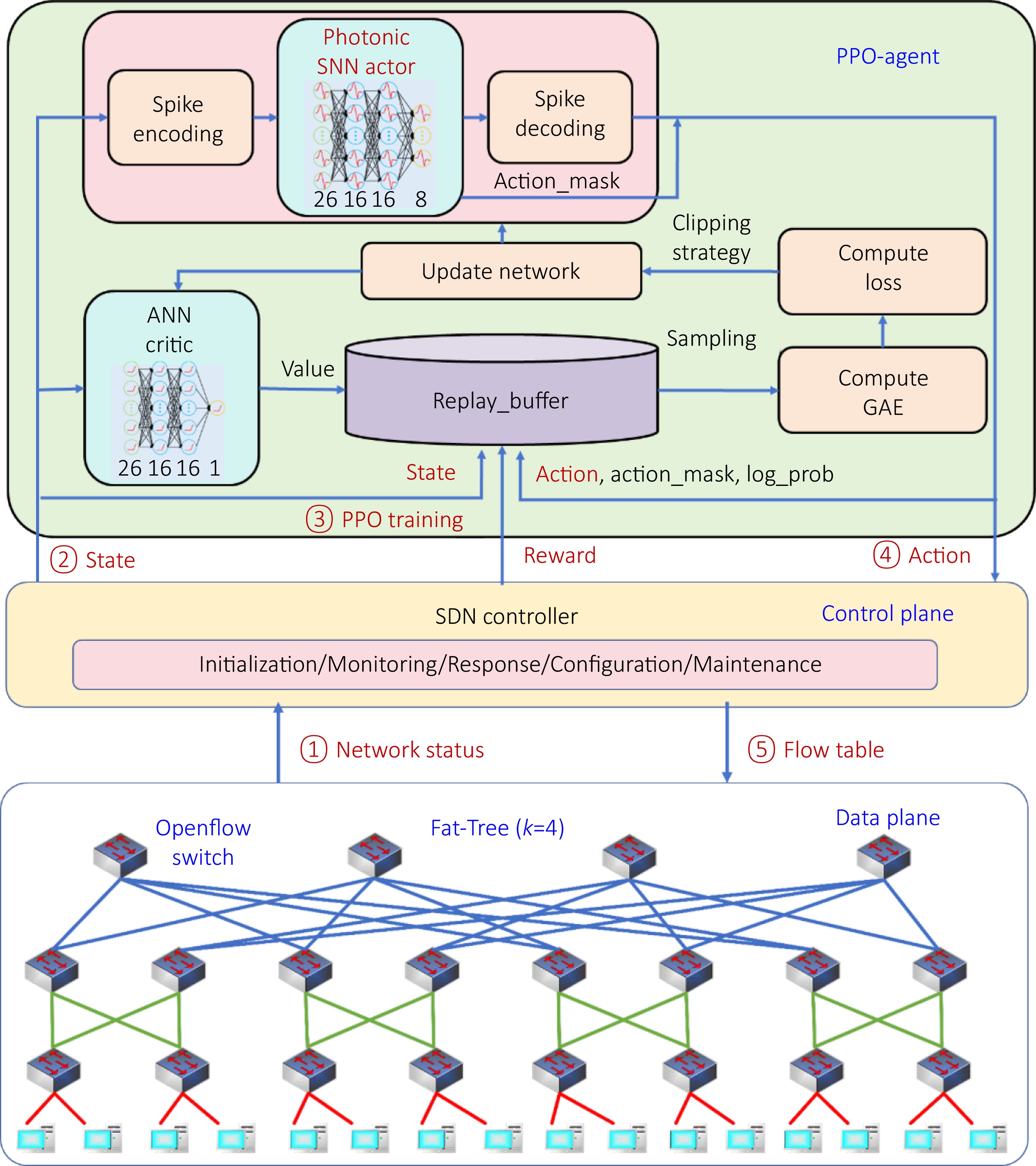
Intelligent routing plays a key role in modern communication infrastructure, including data centers, computing networks, and future 6G networks. Although reinforcement learning (RL) has shown great potential for intelligent routing, its practical deployment remains constrained by high energy consumption and decision latency. Here, we propose a photonic spiking RL architecture that implements a proximal policy optimization (PPO)–based intelligent routing algorithm.
The performance of the proposed approach is systematically evaluated on a software-defined network (SDN) with a fat-tree topology. The results demonstrate that, under various baseline traffic rate conditions, the PPO-based routing strategy significantly outperforms the conventional Dijkstra algorithm in key performance metrics, including throughput, packet loss rate, average latency, and load balance. Furthermore, a hardware-software collaborative framework of the spiking Actor network is realized for three typical baseline traffic rates, utilizing a photonic synapse chip based on a Mach-Zehnder interferometer (MZI) array and a photonic spiking neuron chip based on distributed feedback lasers with a saturable absorber (DFB-SAs). Experimental validation on 640 state–action pairs shows that the inference accuracy of the hardware-software collaborative framework is consistent with that of the pure algorithmic implementation.
The impacts of different hidden-layer scales in the spiking Actor network and varying network size of fat-tree topology are further analyzed. The integration of photonic spiking RL with SDN-based routing establishes a novel paradigm for intelligent routing optimization, featuring ultra-low latency and high energy efficiency. This approach exhibits broad application prospects in real-time network optimization scenarios, including large-scale data centers, computing networks, satellite Internet systems, and future 6G networks.
Ultrafast all-optical modulation of wide-bandwidth pulses enabled by silicon-metasurfaces
Kaloyan Georgiev, Khosro Zangeneh Kamali, Anton A. Trifonov, Giulia Crotti, Lyuben Petrov, Stefan Georgiev, Hristo Iliev, Lei Xu, Unai Arregui Leon, Mohsen Rahmani, Giuseppe Della Valle, Ivan Buchvarov, Dragomir Neshev
Opto-Electronic Advances
2026-09-15
Physics-informed neural fields enable blind aberration correction for partially coherent quantitative phase imaging
Shun Zhou, Xingyu Huang, Linpeng Lu, Habib Ullah, Kaiyu Du, Maciej Trusiak, Malgorzata Kujawinska, Yuzhen Zhang, Yao Fan, Qian Chen, Qinrong Zhang, Chao Zuo
Opto-Electronic Science
2026-08-26
Heterogeneously integrated micro-ring with SnS₂ for dual-functional optical modulation and photodetection
Jinyi Du, Lidan Lu, Xu Zhang, Bofei Zhu, Wenbo Bo, Yingjie Xu, Guang Chen, Yanlin He, Guanghui Ren, Xiaoping Lou, Zheng You, Lianqing Zhu
Opto-Electronic Advances
2026-08-25
Hardware-aware lightweight photonic spiking neural network for pattern classification
Shuiying Xiang, Yahui Zhang, Shangxuan Shi, Haowen Zhao, Dianzhuang Zheng, Xingxing Guo, Yanan Han, Ye Tian, Liyue Zhang, Yuechun Shi, Yue Hao
Opto-Electronic Advances
2026-08-25
PhyspeNet: An empirical physics-aware network for adaptive speckle reconstructive spectrometry
Junrui Liang, Min Jiang, Jun Li, Zhongming Huang, Junhong He, Yanting Guo, Yanzhao Ke, Jun Ye, Jiangming Xu, Jinyong Leng, Pu Zhou
Opto-Electronic Advances
2026-08-25
A 36 × 240 Gbps hybrid mode/wavelength division multiplexing transmitter using lithium niobate on insulator
Mingyu Zhu, Weihan Wang, Ruitao Ma, Aoyun Gao, Chun Gao, Zexu Wang, Fei Huang, Zhenyuan Bao, Dajian Liu, Jiaxuan Gan, Zejie Yu, Huan Li, Weike Zhao, Daoxin Dai
Opto-Electronic Advances
2026-08-25