(Peer-Reviewed) Ultra-sensitive multi-band infrared polarization photodetector based on 1T'-MoTe₂/2H-MoTe₂ van der Waals heterostructure
Yuting Pan 潘雨婷 ¹ ³, Lidan Lu 鹿利单 ¹, Bofei Zhu 祝博飞 ², Chunhua An 安春华 ⁴, Jing Yu 喻靖 ¹, Guanghui Ren 任广辉 ⁵, Jian Zhen Ou 欧建臻 ⁵, Mingli Dong 董明利 ¹, Zheng You 尤政 ², Lianqing Zhu 祝连庆 ¹
¹ School of Instrument Science and Opto-Electronics Engineering, Beijing Information Science and Technology University, Beijing 100192, China
中国 北京 北京信息科技大学仪器科学与光电工程学院
² Department of Precision Instruments, Tsinghua University, Beijing 100084, China
中国 北京 清华大学机械工程学院 精密仪器系
³ School of Opto-electronic Engineering, Changchun University of Science and Technology, Changchun 130022, China
中国 长春 长春理工大学光电工程学院
⁴ School of Precision Instruments and Optoelectronic Engineering, Tianjin University, Tianjin 300072, China
中国 天津 天津大学精密仪器与光电子工程学院
⁵ School of Engineering, RMIT University, Melbourne 3000, Australia
Opto-Electronic Advances, 2026-02-09
Abstract
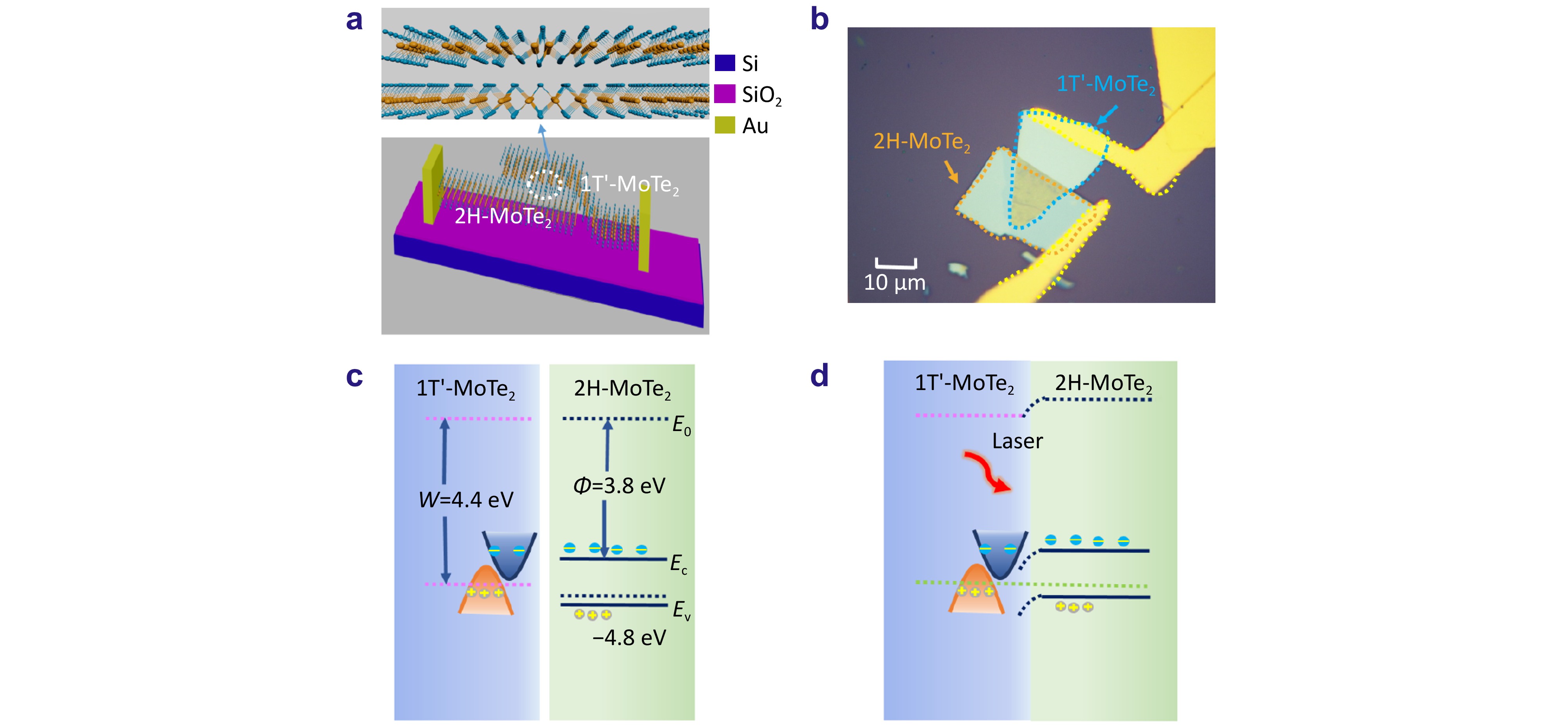
Near infrared polarized photodetectors are widely used, and van der Waals heterostructures based on transition metal dichalcogenides are important platforms for device research and application. Homologous polymorphic two-dimensional chalcogenides refer to two-dimensional chalcogenides with the same chemical composition but different crystal structures. Homologous polymorphic two-dimensional chalcogenides have shown great potential in near-infrared detection due to their unique bandgap characteristics, exciton effects, and controllable optoelectronic properties.
This paper studies a near-infrared polarized photodetector based on 1T'-MoTe₂/2H-MoTe₂ structure, in which the semimetallic 1T'-MoTe₂ has attracted attention due to its low work function and excellent electrical performance. 1T'-MoTe₂ and 2H-MoTe₂ form a favorable bandgap structure after forming a heterojunction, which improves carrier separation efficiency and photoelectric response. This device exhibits excellent high-sensitivity optoelectronic detection performance in the wideband region (532–2200 nm), such as significant high responsivity (3.06 A·W–1) under 1310 nm laser, specific detectivity (3.2 × 10⁹ Jones), good external quantum efficiency (289%), and fast rise and decay response times of 10.56 ms/6.26 ms.
In addition, the device has polarization detection capability, achieving a high polarization sensitivity of 20.1. The device has successfully achieved imaging from visible light to near-infrared light, highlighting the potential of 1T'-MoTe₂/2H-MoTe₂ heterojunction as a polarization sensitive detector.
A 36 × 240 Gbps hybrid mode/wavelength division multiplexing transmitter using lithium niobate on insulator
Mingyu Zhu, Weihan Wang, Ruitao Ma, Aoyun Gao, Chun Gao, Zexu Wang, Fei Huang, Zhenyuan Bao, Dajian Liu, Jiaxuan Gan, Zejie Yu, Huan Li, Weike Zhao, Daoxin Dai
Opto-Electronic Advances
2026-08-25
Light-perception-based interactive control of an underwater digital twin hand
Jinlong Lu, Chao Zhang, Hengchang Nong, Dongying Wang, Hongyu Zhou, Junjie Weng, Yuehua Deng, Yang Yu, Qiang Bian, Jianfa Zhang, Chaofan Zhang, Zhenrong Zhang, Junbo Yang
Opto-Electronic Advances
2026-07-10
Unlocking home-based nocturnal health management: A fiber-optic approach for early detection of cardiorespiratory rhythm disorders
Hanyu Jin, Hao Li, Zhuolin Chen, Liangye Li, Zurui Wang, Kai Zhou, Weijian Hang, Zhipeng Chen, Junfeng Chen, Kai Shen, Jianfeng Wen, Chen Chen, Cunzheng Fan, Zhijun Yan, Feng Wang, Qizhen Sun
Opto-Electronic Advances
2026-07-10
A flexible wireless system for prospective photodynamic therapy applications
Rolan Mansour, Bhavani Yalagala, Vikas Vikas, Nikolas Bruce, Fawziye Tarhini, Georgios N. Arvanitakis, Mohammed Mughal, Jamie Blanche, Ahmad Taha, Jonathan Copper, Muhammad Imran, Karin Williams, Karin Oien, Mahmoud Wagih, Hadi Heidari, Robert Hadfield, David Flynn
Opto-Electronic Advances
2026-07-10
Parallel bright-field and multi-order edge imaging via wide field-of-view trichannel metalens
Xiaotong Li, Yeseul Kim, Youngsun Jeon, Junhwa Seong, Jaekyung Kim, Peng Tang, Shiqi Hu, Harit Keawmuang, Beomha Yang, Dongmin Jeon, Le Dai, Weiyan Li, Xiaodong Cai, Jinhui Shi, Yong-Sang Ryu, Trevon Badloe, Junsuk Rho
Opto-Electronic Advances
2026-07-10