(Peer-Reviewed) Ambient-energy-driven space-time-coding metasurface for space-frequency-division multiplexing wireless communications
Han Wei Tian 田翰闱 ¹, Chao Song 宋超 ¹, Dong Jie Wang 王东杰 ¹, Qian Zhu 朱潜 ¹, Tie Jun Cui 崔铁军 ¹, Wei Xiang Jiang 蒋卫祥 ¹ ²
¹ State Key Laboratory of Millimeter Waves, School of Information Science and Engineering, Southeast University, Nanjing 210096, China
中国 南京 东南大学信息科学与工程学院 毫米波国家重点实验室
² Purple Mountain Laboratories, Nanjing 211111, China
中国 南京 紫金山实验室
Opto-Electronic Advances, 2026-02-12
Abstract
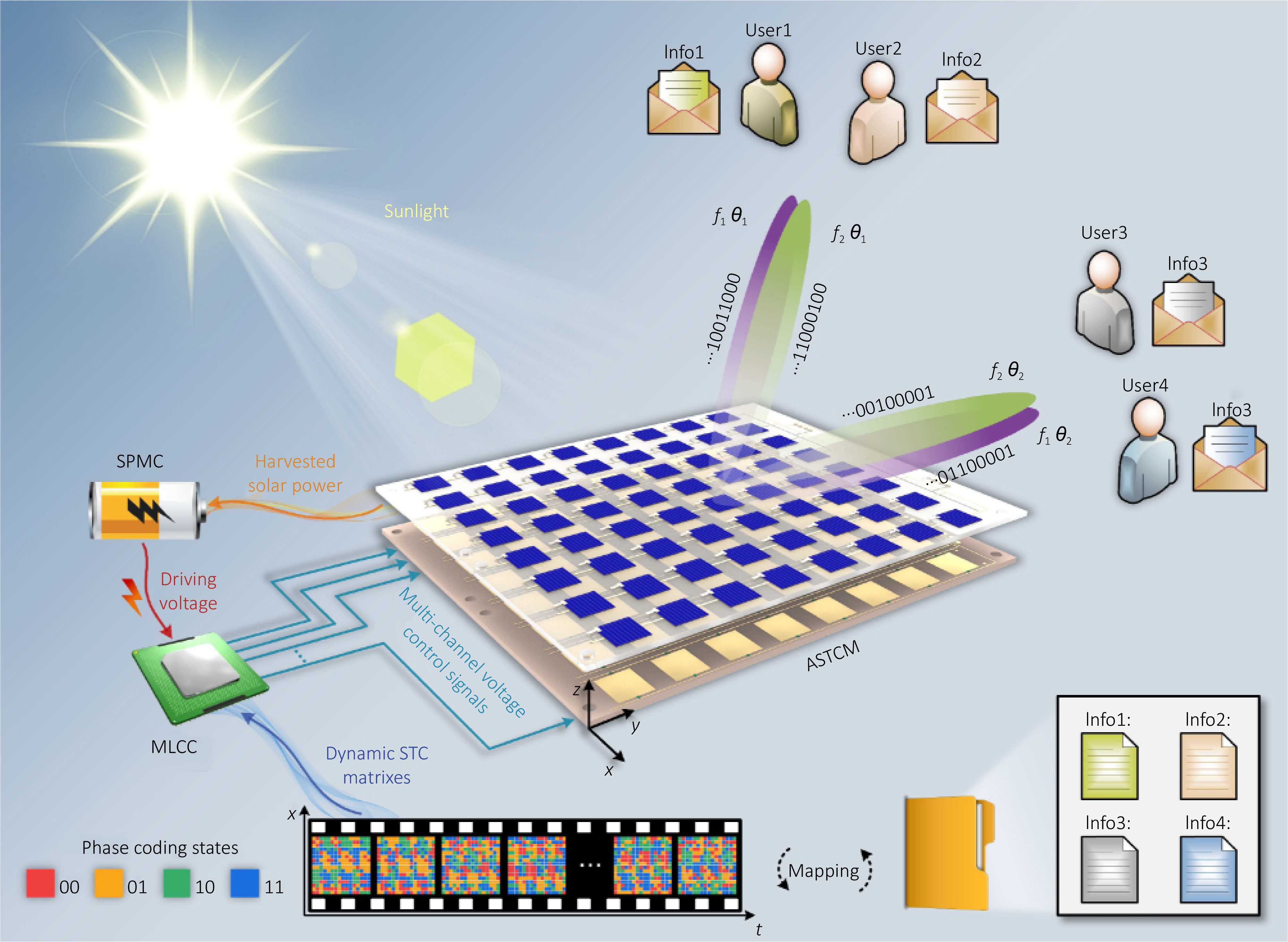
Programmable metasurfaces have shown exceptional potentials in wireless communications due to their capability to manipulate electromagnetic (EM) waves dynamically and flexibly. However, the large-scale application and flexible deployment of programmable metasurfaces still face challenges of high communication capacity requirements and stringent energy constraints. Here, we report an ambient-energy-driven space-time-coding metasurface to address these issues.
On one hand, the metasurface can achieve efficient space-frequency-division multiplexing manipulations by dynamically controlling multiple frequencies and the spatial propagation directions of reflection EM waves. On the other hand, the shared-aperture ambient solar energy harvesting capability and low power consumption characteristic of the metasurface enable it to be self-powered without relying on any external power supply. To demonstrate these remarkable features, a four-channel wireless communication system prototype is built using the programmable metasurface. Experimental results confirm that four distinct images can be transmitted to four user terminals simultaneously, independently, and in real time with remarkably low energy consumption per bit.
Such innovative metasurface provides a simple and effective approach for integrating ambient energy harvesting, multi-dimensional microwave manipulation, and direct information modulation on a single physical platform, which will advance the wireless communications in cost-effectiveness, enhanced capacity, energy efficiency, and environmental friendliness.
Ultrafast all-optical modulation of wide-bandwidth pulses enabled by silicon-metasurfaces
Kaloyan Georgiev, Khosro Zangeneh Kamali, Anton A. Trifonov, Giulia Crotti, Lyuben Petrov, Stefan Georgiev, Hristo Iliev, Lei Xu, Unai Arregui Leon, Mohsen Rahmani, Giuseppe Della Valle, Ivan Buchvarov, Dragomir Neshev
Opto-Electronic Advances
2026-09-15
Physics-informed neural fields enable blind aberration correction for partially coherent quantitative phase imaging
Shun Zhou, Xingyu Huang, Linpeng Lu, Habib Ullah, Kaiyu Du, Maciej Trusiak, Malgorzata Kujawinska, Yuzhen Zhang, Yao Fan, Qian Chen, Qinrong Zhang, Chao Zuo
Opto-Electronic Science
2026-08-26
Heterogeneously integrated micro-ring with SnS₂ for dual-functional optical modulation and photodetection
Jinyi Du, Lidan Lu, Xu Zhang, Bofei Zhu, Wenbo Bo, Yingjie Xu, Guang Chen, Yanlin He, Guanghui Ren, Xiaoping Lou, Zheng You, Lianqing Zhu
Opto-Electronic Advances
2026-08-25
Hardware-aware lightweight photonic spiking neural network for pattern classification
Shuiying Xiang, Yahui Zhang, Shangxuan Shi, Haowen Zhao, Dianzhuang Zheng, Xingxing Guo, Yanan Han, Ye Tian, Liyue Zhang, Yuechun Shi, Yue Hao
Opto-Electronic Advances
2026-08-25
PhyspeNet: An empirical physics-aware network for adaptive speckle reconstructive spectrometry
Junrui Liang, Min Jiang, Jun Li, Zhongming Huang, Junhong He, Yanting Guo, Yanzhao Ke, Jun Ye, Jiangming Xu, Jinyong Leng, Pu Zhou
Opto-Electronic Advances
2026-08-25
A 36 × 240 Gbps hybrid mode/wavelength division multiplexing transmitter using lithium niobate on insulator
Mingyu Zhu, Weihan Wang, Ruitao Ma, Aoyun Gao, Chun Gao, Zexu Wang, Fei Huang, Zhenyuan Bao, Dajian Liu, Jiaxuan Gan, Zejie Yu, Huan Li, Weike Zhao, Daoxin Dai
Opto-Electronic Advances
2026-08-25