(Peer-Reviewed) Scene-level passive polarization 3D imaging
Xin Wang 王鑫 ¹, Pingli Han 韩平丽 ¹, Xiyuan Luo 罗熙媛 ¹, Qianqian Liu 刘倩倩 ¹, Tong Zhang 张桐 ¹, Xue Dong 董雪 ¹, Meng Xiang 相萌 ¹, Jinpeng Liu 刘金鹏 ¹, Yanyan Liu 刘严严 ², Fei Liu 刘飞 ¹ ³
¹ School of Optoelectronic Engineering, Xidian University, Xi'an 710071, China
中国 西安 西安电子科技大学光电工程学院
² National Key Laboratory of Electromagnetic Space Security, Tianjin 300308, China
中国 天津 电磁空间安全全国重点实验室
³ State Key Laboratory of Electromechanical Integrated Manufacturing of High-Performance Electronic Equipments, Xidian University, Xi’an 710071, China
中国 西安 西安电子科技大学高性能电子装备机电集成制造全国重点实验室
Opto-Electronic Advances, 2026-02-12
Abstract
Scene-level passive 3D imaging under natural conditions is highly challenging yet urgently demanded. Polarization 3D provides possibility but impeded by two major obstacles brought by natural large scenes: discontinuities of multiple targets and dynamic reconstruction. This study proposed a scene-level passive polarization 3D imaging method, integrating binocular stereo and polarization.
We abstract the discontinuous targets reconstruction into a minimization problem. The pixel-level normal direction from polarization and the absolute scale information from binocular stereo vision then work as mutual constraints for iterative optimization of the problem. By iterating for final solution, the challenge of reconstructing discontinuous targets was tackled, and true depth was also recovered. The true depth then provides a reference for solving inter-frame scale inconsistencies which hinders dynamic reconstruction by the designed scale normalization strategy which globally aligns multi-view measurement data.
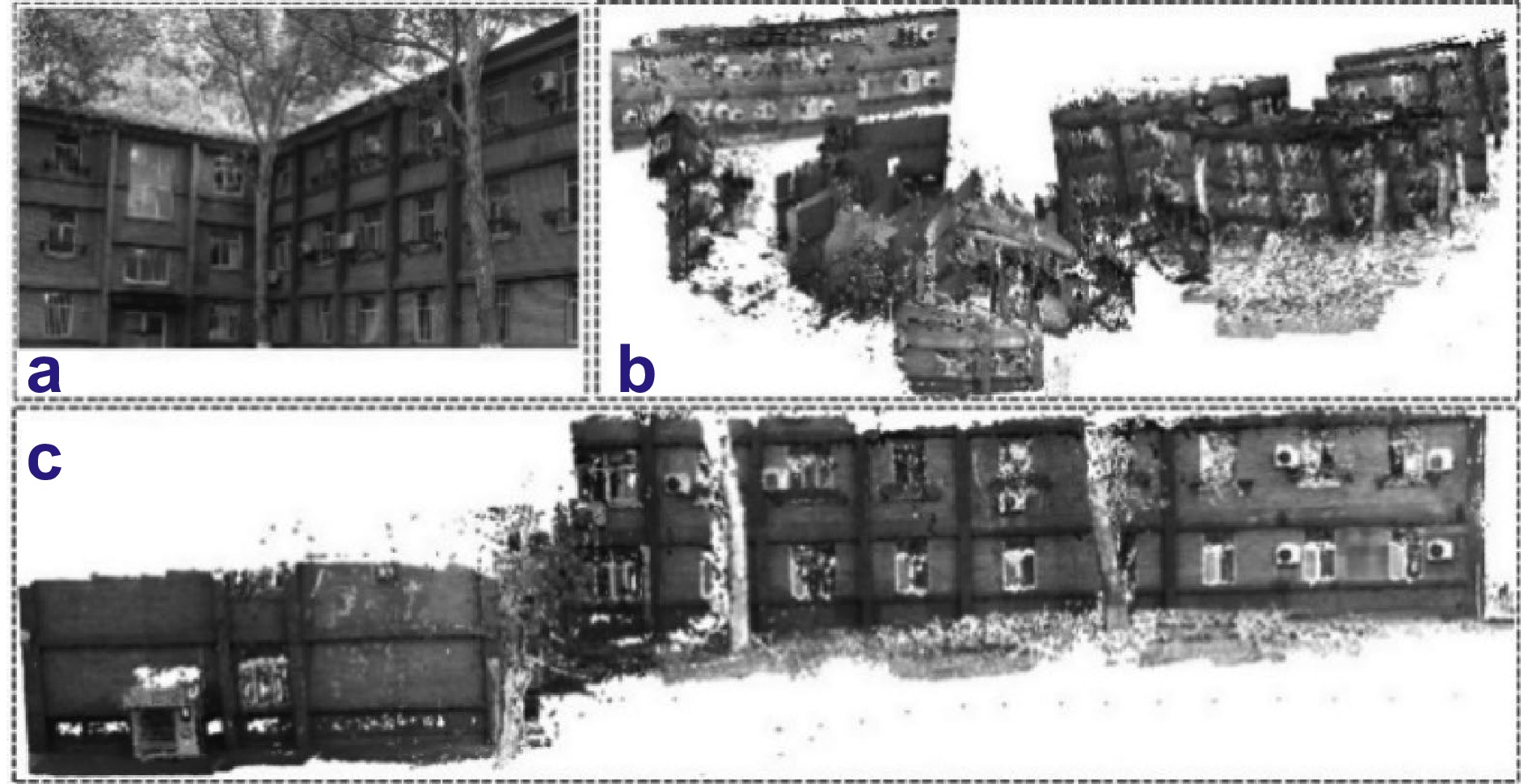
Scene-level 3D structure was finally reconstructed through multi-frame point cloud fusion. We showcase wide-scene, high-accuracy passive video reconstructions on natural field scenes. Our passive polarization stereo represents a major advancement in scene-level 3D imaging and may find broad applications in fields requiring passive 3D imaging solutions.
Light-perception-based interactive control of an underwater digital twin hand
Jinlong Lu, Chao Zhang, Hengchang Nong, Dongying Wang, Hongyu Zhou, Junjie Weng, Yuehua Deng, Yang Yu, Qiang Bian, Jianfa Zhang, Chaofan Zhang, Zhenrong Zhang, Junbo Yang
Opto-Electronic Advances
2026-07-10
Unlocking home-based nocturnal health management: A fiber-optic approach for early detection of cardiorespiratory rhythm disorders
Hanyu Jin, Hao Li, Zhuolin Chen, Liangye Li, Zurui Wang, Kai Zhou, Weijian Hang, Zhipeng Chen, Junfeng Chen, Kai Shen, Jianfeng Wen, Chen Chen, Cunzheng Fan, Zhijun Yan, Feng Wang, Qizhen Sun
Opto-Electronic Advances
2026-07-10
A flexible wireless system for prospective photodynamic therapy applications
Rolan Mansour, Bhavani Yalagala, Vikas Vikas, Nikolas Bruce, Fawziye Tarhini, Georgios N. Arvanitakis, Mohammed Mughal, Jamie Blanche, Ahmad Taha, Jonathan Copper, Muhammad Imran, Karin Williams, Karin Oien, Mahmoud Wagih, Hadi Heidari, Robert Hadfield, David Flynn
Opto-Electronic Advances
2026-07-10
Parallel bright-field and multi-order edge imaging via wide field-of-view trichannel metalens
Xiaotong Li, Yeseul Kim, Youngsun Jeon, Junhwa Seong, Jaekyung Kim, Peng Tang, Shiqi Hu, Harit Keawmuang, Beomha Yang, Dongmin Jeon, Le Dai, Weiyan Li, Xiaodong Cai, Jinhui Shi, Yong-Sang Ryu, Trevon Badloe, Junsuk Rho
Opto-Electronic Advances
2026-07-10