(Peer-Reviewed) Perovskite nanocrystals in glass for high efficiency and ultra-high resolution dynamic holographic multicolor display
Chao Ruan 阮超 ¹, Xinkuo Li 李昕阔 ¹, Ke Sun 孙轲 ², Jianrong Qiu 邱建荣 ¹, Dezhi Tan 谭德志 ¹
¹ State Key Laboratory of Extreme Photonics and Instrumentation, College of Optical Science and Engineering, and School of Materials Science and Engineering, Zhejiang University, Hangzhou 310027, China
中国 杭州 浙江大学 光电科学与工程学院 材料科学与工程学院 极端光学技术与仪器全国重点实验室
² China International Science & Technology Cooperation Base for Laser Processing Robotics, Wenzhou University, Wenzhou 325035, China
中国 温州 温州大学激光加工机器人国家国际科技合作基地
Opto-Electronic Advances, 2026-03-25
Abstract
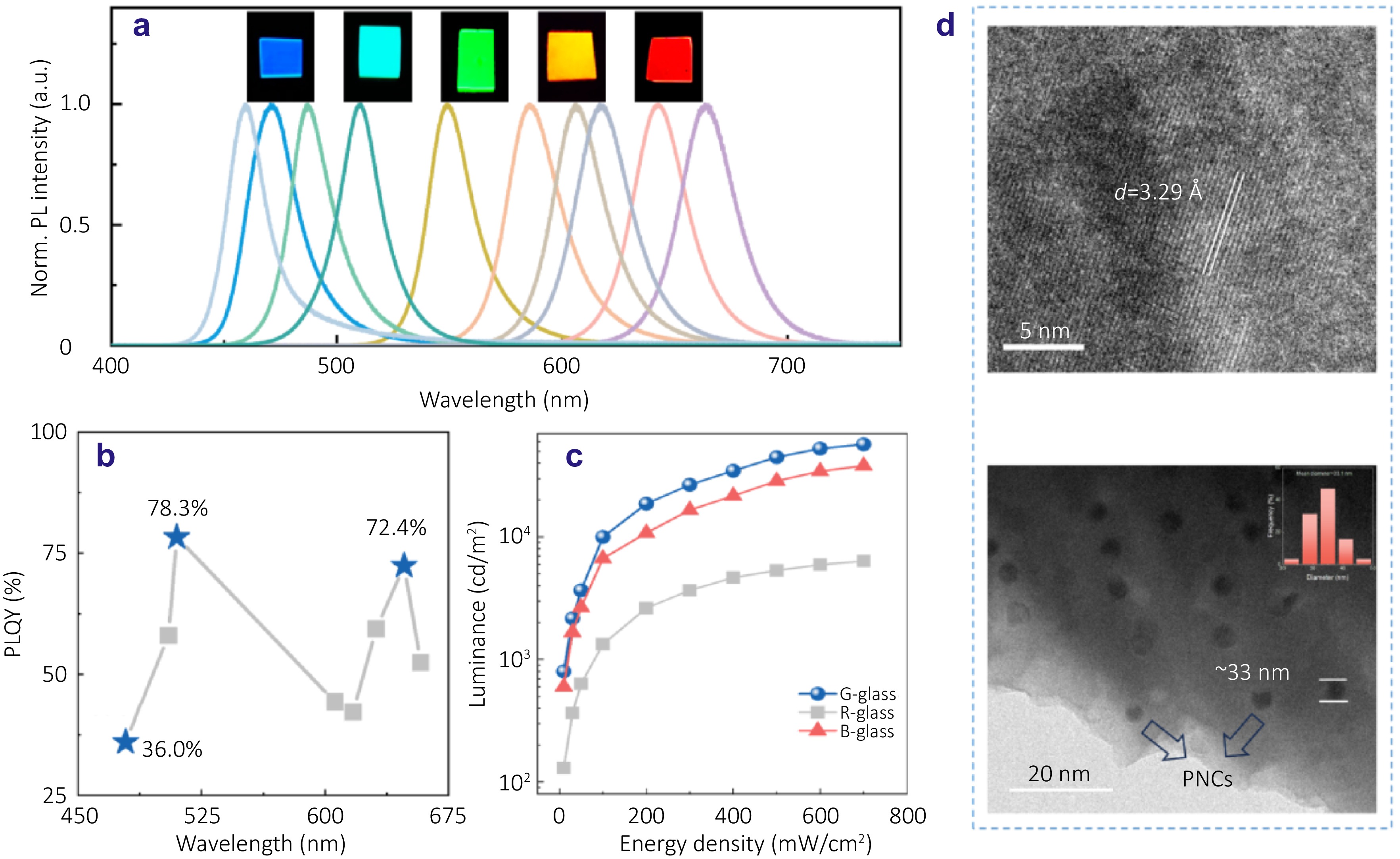
Incorporating perovskite nanocrystals (PNCs) in the glass matrix has been demonstrated to be an effective route to improve their stability for long-term operation. However, simultaneously achieving high luminance and high photoluminescence (PL) quantum yield (QY) is challenging. Herein, we report a strategy that employs fluoride ion doping to modify the three-dimensional glass network, thereby optimizing the crystallization behavior of PNCs and achieving both high luminance and high PLQY in full-spectrum.
Leveraging these high-performance transparent composites, we constructed a dynamic holographic multicolor display system by integrating with a spatial light modulator (SLM), achieving a pixel density as high as 20,247 pixels per inch (PPI). We further propose a vertically stacked, multilayer full-color display architecture that overcomes the limitations of color filters in light-utilization efficiency and the bottlenecks of conventional planar sub-pixel layouts in terms of spatial utilization and resolution.
Heterogeneously integrated micro-ring with SnS₂ for dual-functional optical modulation and photodetection
Jinyi Du, Lidan Lu, Xu Zhang, Bofei Zhu, Wenbo Bo, Yingjie Xu, Guang Chen, Yanlin He, Guanghui Ren, Xiaoping Lou, Zheng You, Lianqing Zhu
Opto-Electronic Advances
2026-08-25
Hardware-aware lightweight photonic spiking neural network for pattern classification
Shuiying Xiang, Yahui Zhang, Shangxuan Shi, Haowen Zhao, Dianzhuang Zheng, Xingxing Guo, Yanan Han, Ye Tian, Liyue Zhang, Yuechun Shi, Yue Hao
Opto-Electronic Advances
2026-08-25
PhyspeNet: An empirical physics-aware network for adaptive speckle reconstructive spectrometry
Junrui Liang, Min Jiang, Jun Li, Zhongming Huang, Junhong He, Yanting Guo, Yanzhao Ke, Jun Ye, Jiangming Xu, Jinyong Leng, Pu Zhou
Opto-Electronic Advances
2026-08-25
A 36 × 240 Gbps hybrid mode/wavelength division multiplexing transmitter using lithium niobate on insulator
Mingyu Zhu, Weihan Wang, Ruitao Ma, Aoyun Gao, Chun Gao, Zexu Wang, Fei Huang, Zhenyuan Bao, Dajian Liu, Jiaxuan Gan, Zejie Yu, Huan Li, Weike Zhao, Daoxin Dai
Opto-Electronic Advances
2026-08-25
Light-perception-based interactive control of an underwater digital twin hand
Jinlong Lu, Chao Zhang, Hengchang Nong, Dongying Wang, Hongyu Zhou, Junjie Weng, Yuehua Deng, Yang Yu, Qiang Bian, Jianfa Zhang, Chaofan Zhang, Zhenrong Zhang, Junbo Yang
Opto-Electronic Advances
2026-07-10