(Peer-Reviewed) Modelling-guided inverse design strategy for semitransparent perovskite photovoltaics with customized colors
Seok-Beom Seo ¹, Rira Kang ², Eun-Joo Lee ¹, So-Yeon Ju ², Min Jae Lee ², Byunghong Lee ², Sun-Kyung Kim ¹
¹ Department of Applied Physics, Kyung Hee University, Yongin-si, Gyeonggi-do 17104, Republic of Korea
² Energy Devices Research Team, Hyundai Motor Group, Uiwang-si, Gyeonggi-do 16082, Republic of Korea
Opto-Electronic Advances, 2026-02-12
Abstract
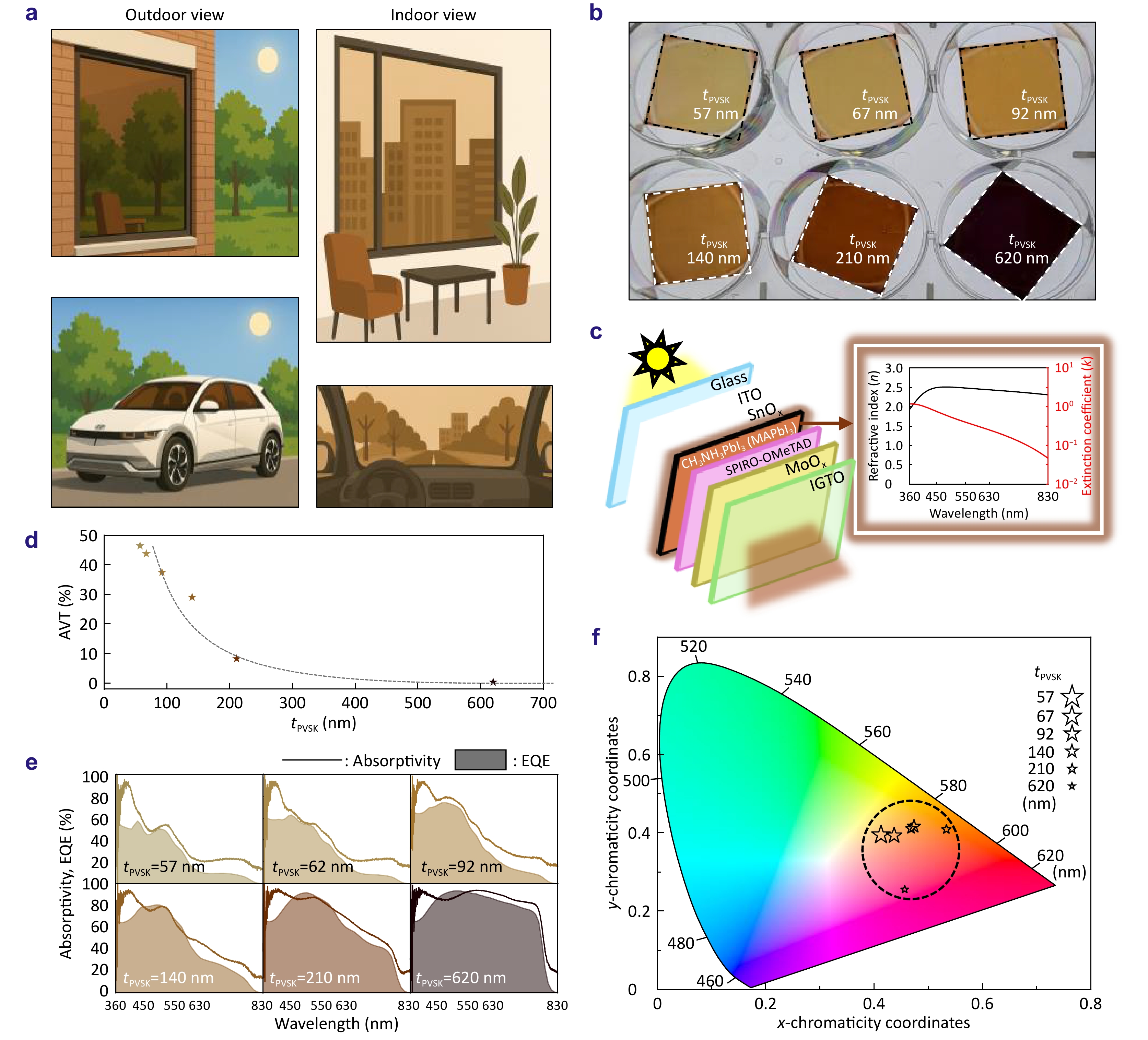
Urban architects increasingly seek solar windows that deliver both energy generation and aesthetic value. However, existing color-engineering strategies rely on absorptive metal layers or lack control over the achievable colors. Here, we present a modelling-guided inverse design strategy that integrates an all-dielectric (ZnS/MgF2) multilayer into semitransparent perovskite photovoltaics, enabling user-defined colors with minimal spectral loss.
Leveraging an active learning algorithm, we mapped the attainable color gamut for ZnS/MgF2-coated devices with distinct perovskite absorber thicknesses and average visible transmittance (AVT) values. As a representative case, a device with a 110 nm-thick absorber on glass or polyethylene terephthalate (PET), initially exhibiting a reddish-brown tint, was transformed into vivid cyan using a 600 nm-thick all-dielectric multilayer.
This tuning retained high AVT—6.5% on glass and 5.3% on PET—while enhancing power conversion efficiency by 20.9% and 10.4%, respectively. Real-world imaging confirmed enhanced aesthetics with see-through visibility, underscoring the practical potential of the inverse-design framework. Moreover, this approach is readily transferable to other thin film photovoltaics, providing a versatile route toward color customizable, transmittance-tunable, and high-efficiency solar windows for buildings, vehicles, and wearable electronics.
Ultrafast all-optical modulation of wide-bandwidth pulses enabled by silicon-metasurfaces
Kaloyan Georgiev, Khosro Zangeneh Kamali, Anton A. Trifonov, Giulia Crotti, Lyuben Petrov, Stefan Georgiev, Hristo Iliev, Lei Xu, Unai Arregui Leon, Mohsen Rahmani, Giuseppe Della Valle, Ivan Buchvarov, Dragomir Neshev
Opto-Electronic Advances
2026-09-15
Physics-informed neural fields enable blind aberration correction for partially coherent quantitative phase imaging
Shun Zhou, Xingyu Huang, Linpeng Lu, Habib Ullah, Kaiyu Du, Maciej Trusiak, Malgorzata Kujawinska, Yuzhen Zhang, Yao Fan, Qian Chen, Qinrong Zhang, Chao Zuo
Opto-Electronic Science
2026-08-26
Heterogeneously integrated micro-ring with SnS₂ for dual-functional optical modulation and photodetection
Jinyi Du, Lidan Lu, Xu Zhang, Bofei Zhu, Wenbo Bo, Yingjie Xu, Guang Chen, Yanlin He, Guanghui Ren, Xiaoping Lou, Zheng You, Lianqing Zhu
Opto-Electronic Advances
2026-08-25
Hardware-aware lightweight photonic spiking neural network for pattern classification
Shuiying Xiang, Yahui Zhang, Shangxuan Shi, Haowen Zhao, Dianzhuang Zheng, Xingxing Guo, Yanan Han, Ye Tian, Liyue Zhang, Yuechun Shi, Yue Hao
Opto-Electronic Advances
2026-08-25
PhyspeNet: An empirical physics-aware network for adaptive speckle reconstructive spectrometry
Junrui Liang, Min Jiang, Jun Li, Zhongming Huang, Junhong He, Yanting Guo, Yanzhao Ke, Jun Ye, Jiangming Xu, Jinyong Leng, Pu Zhou
Opto-Electronic Advances
2026-08-25
A 36 × 240 Gbps hybrid mode/wavelength division multiplexing transmitter using lithium niobate on insulator
Mingyu Zhu, Weihan Wang, Ruitao Ma, Aoyun Gao, Chun Gao, Zexu Wang, Fei Huang, Zhenyuan Bao, Dajian Liu, Jiaxuan Gan, Zejie Yu, Huan Li, Weike Zhao, Daoxin Dai
Opto-Electronic Advances
2026-08-25