(Peer-Reviewed) High-speed and large-capacity visible light communication for 6G: advances and perspectives
Nan Chi 迟楠 ¹ ² ³, Zhilan Lu 卢芝蓝 ¹, Fujie Li 李甫杰 ¹, Haoyu Zhang 张昊宇 ¹, Yunkai Wang 汪昀楷 ¹, Xinyi Liu 刘心怡 ¹, Zhiwu Chen 陈志武 ¹, Zhe Feng 冯哲 ¹, Zhuoran Hu 胡卓然 ¹, Zhixue He 贺志学 ⁴, Ziwei Li 李子薇 ¹, Chao Shen 沈超 ¹, Junwen Zhang 张俊文 ¹
¹ Key Laboratory for the Information Science of Electromagnetic Waves (MoE), College of Future Information Technology, Fudan University, Shanghai 200433, China
中国 上海 复旦大学未来信息创新学院 电磁波信息科学教育部重点实验室
² Shanghai Engineering Research Center of Low-Earth-Orbit Satellite Communication and Applications, Shanghai 200433, China
中国 上海 上海低轨卫星通信与应用工程技术研究中心
³ Shanghai Collaborative Innovation Center of Low-Earth-Orbit Satellite Communication Technology, Shanghai 200433, China
中国 上海 上海市低轨卫星通信技术协同创新中心
⁴ Peng Cheng Laboratory, Shenzhen 518055, China
中国 深圳 鹏城实验室
Opto-Electronic Technology, 2026-03-20
Abstract
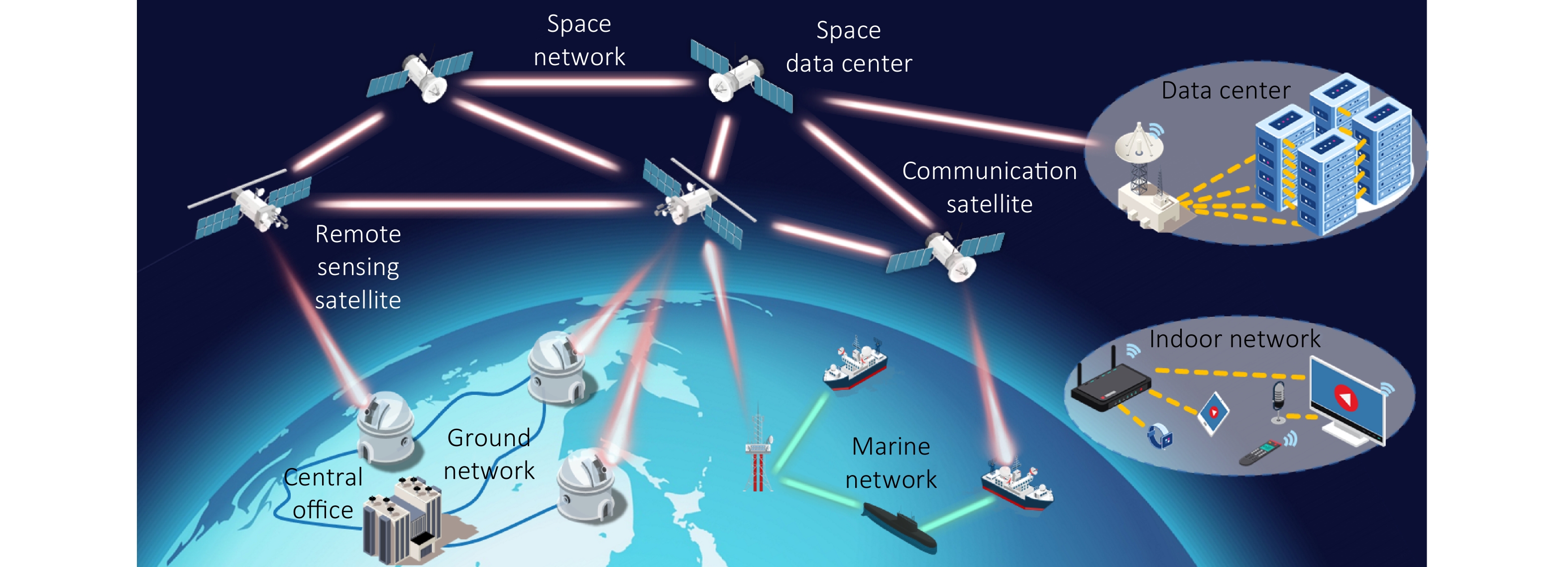
The sixth generation (6G) of mobile communications aims to establish high-speed, large-capacity space-air-ground-sea integrated networks (SAGSINs) to support the rapidly growing data traffic driven by big data and large-scale artificial intelligence. Visible light communication (VLC), operating in the 380–780 nm spectrum, has emerged as a promising optical wireless technology owing to its abundant spectral resources, high achievable data rates, and immunity to electromagnetic interference. These advantages make VLC a strong candidate for three-dimensional integrated communication networks.
This review summarizes recent advances in visible light communication, focusing on key enabling technologies including transmitter and receiver devices, advanced signal processing algorithms, multi-aperture reception, and beamforming techniques. Representative demonstrations of large-capacity VLC systems based on multi-dimensional multiplexing are reviewed. Finally, the challenges and future research directions of VLC are discussed.
Light-perception-based interactive control of an underwater digital twin hand
Jinlong Lu, Chao Zhang, Hengchang Nong, Dongying Wang, Hongyu Zhou, Junjie Weng, Yuehua Deng, Yang Yu, Qiang Bian, Jianfa Zhang, Chaofan Zhang, Zhenrong Zhang, Junbo Yang
Opto-Electronic Advances
2026-07-10
Unlocking home-based nocturnal health management: A fiber-optic approach for early detection of cardiorespiratory rhythm disorders
Hanyu Jin, Hao Li, Zhuolin Chen, Liangye Li, Zurui Wang, Kai Zhou, Weijian Hang, Zhipeng Chen, Junfeng Chen, Kai Shen, Jianfeng Wen, Chen Chen, Cunzheng Fan, Zhijun Yan, Feng Wang, Qizhen Sun
Opto-Electronic Advances
2026-07-10
A flexible wireless system for prospective photodynamic therapy applications
Rolan Mansour, Bhavani Yalagala, Vikas Vikas, Nikolas Bruce, Fawziye Tarhini, Georgios N. Arvanitakis, Mohammed Mughal, Jamie Blanche, Ahmad Taha, Jonathan Copper, Muhammad Imran, Karin Williams, Karin Oien, Mahmoud Wagih, Hadi Heidari, Robert Hadfield, David Flynn
Opto-Electronic Advances
2026-07-10
Parallel bright-field and multi-order edge imaging via wide field-of-view trichannel metalens
Xiaotong Li, Yeseul Kim, Youngsun Jeon, Junhwa Seong, Jaekyung Kim, Peng Tang, Shiqi Hu, Harit Keawmuang, Beomha Yang, Dongmin Jeon, Le Dai, Weiyan Li, Xiaodong Cai, Jinhui Shi, Yong-Sang Ryu, Trevon Badloe, Junsuk Rho
Opto-Electronic Advances
2026-07-10