(Peer-Reviewed) Multi-dimensional photodetection: from material intrinsic properties and metasurface engineering to silicon photonic integration
Wenqi Liu 刘文祺 ¹, Zilan Tang 唐梓岚 ¹, Qingzhao Hua 花清照 ¹, Liang Liu 刘靓 ¹, Xiaoxia Wang 王晓霞 ¹, Anlian Pan 潘安练 ¹ ²
¹ Hunan Institute of Optoelectronic Integration and Key Laboratory for MicroNano Physics and Technology of Hunan Province, State Key Laboratory of Chemo/Biosensing and Chemometrics, College of Materials Science and Engineering, Hunan University, Changsha 410082, China
中国 长沙 湖南大学材料科学与工程学院 微纳结构物理与应用技术湖南省重点实验室 湖南光电集成创新研究院 化学生物传感全国重点实验室
² School of Physics and Electronics, Hunan Normal University, Changsha 410081, China
中国 长沙 湖南师范大学物理与电子科学学院
Opto-Electronic Technology, 2026-03-20
Abstract
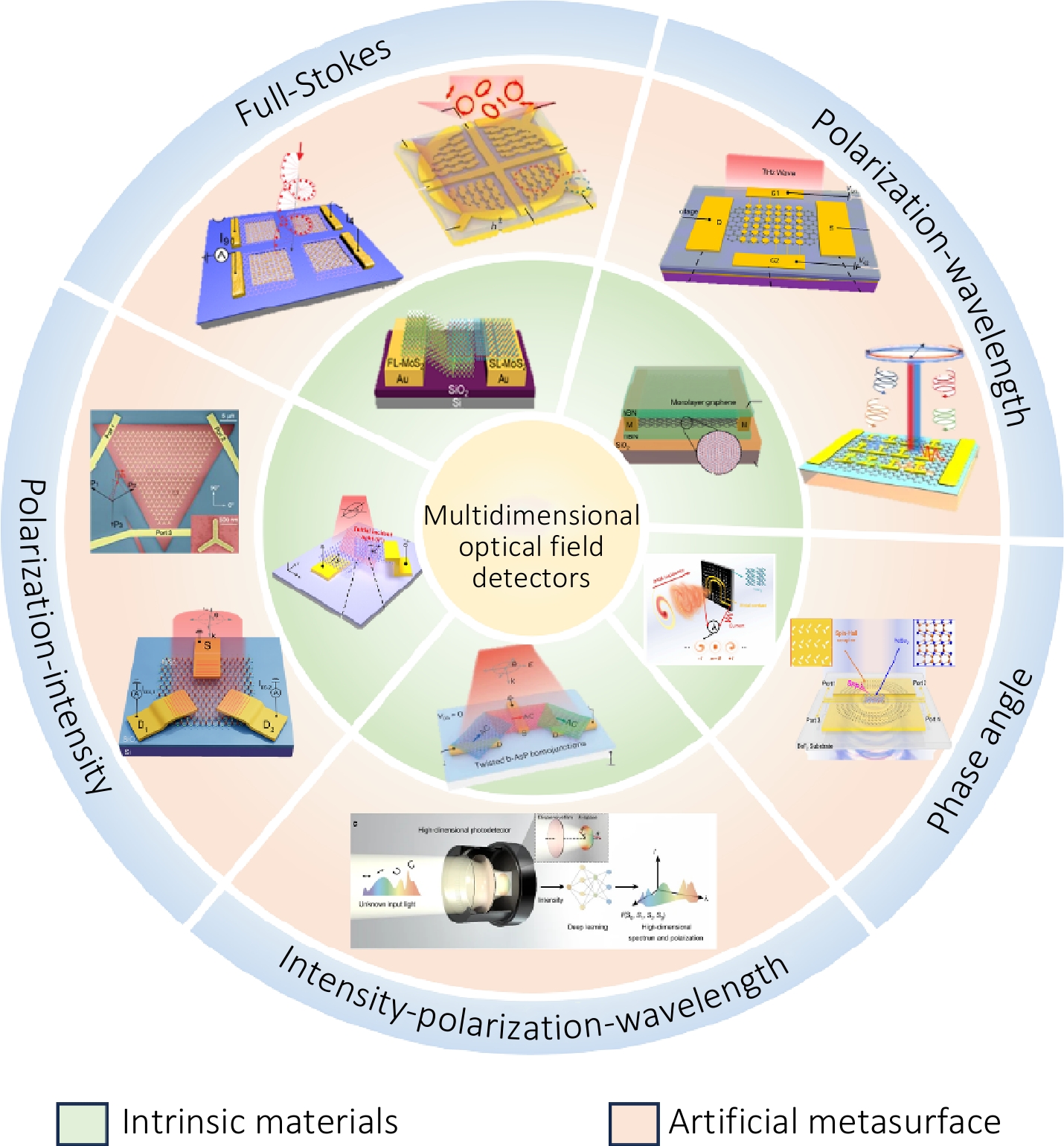
Integrated photodetectors capable of decoding multi-dimensional optical information are essential for modern information technologies and are widely applicable in areas such as autonomous driving, optical communications, and remote sensing. Recent progress in this field has been driven by the synergy among advances in low-dimensional materials, micro/nanofabrication technologies, and computational algorithms, which have enabled notable developments in integrable multidimensional optical-field detectors.
In this review, we first introduce some basic principles of multi-dimensional light detection and outline the critical strategies for frontend optical encoding and backend computational decoding. Subsequently, we discuss detection schemes based on the intrinsic optical properties of low-dimensional materials. We then move to metasurface architectures that use subwavelength structural engineering to enable multi-dimensional light field detection.
Furthermore, we summarize recent research on silicon-photonic integrated multidimensional photodetection that combines sensing and computing units. To conclude, we summarize key challenges, such as wafer-scale synthesis and interface engineering, and envision a future in which photodetectors evolve from simple signal converters into programmable, intelligent systems capable of comprehensive light-field perception.
Light-perception-based interactive control of an underwater digital twin hand
Jinlong Lu, Chao Zhang, Hengchang Nong, Dongying Wang, Hongyu Zhou, Junjie Weng, Yuehua Deng, Yang Yu, Qiang Bian, Jianfa Zhang, Chaofan Zhang, Zhenrong Zhang, Junbo Yang
Opto-Electronic Advances
2026-07-10
Unlocking home-based nocturnal health management: A fiber-optic approach for early detection of cardiorespiratory rhythm disorders
Hanyu Jin, Hao Li, Zhuolin Chen, Liangye Li, Zurui Wang, Kai Zhou, Weijian Hang, Zhipeng Chen, Junfeng Chen, Kai Shen, Jianfeng Wen, Chen Chen, Cunzheng Fan, Zhijun Yan, Feng Wang, Qizhen Sun
Opto-Electronic Advances
2026-07-10
A flexible wireless system for prospective photodynamic therapy applications
Rolan Mansour, Bhavani Yalagala, Vikas Vikas, Nikolas Bruce, Fawziye Tarhini, Georgios N. Arvanitakis, Mohammed Mughal, Jamie Blanche, Ahmad Taha, Jonathan Copper, Muhammad Imran, Karin Williams, Karin Oien, Mahmoud Wagih, Hadi Heidari, Robert Hadfield, David Flynn
Opto-Electronic Advances
2026-07-10
Parallel bright-field and multi-order edge imaging via wide field-of-view trichannel metalens
Xiaotong Li, Yeseul Kim, Youngsun Jeon, Junhwa Seong, Jaekyung Kim, Peng Tang, Shiqi Hu, Harit Keawmuang, Beomha Yang, Dongmin Jeon, Le Dai, Weiyan Li, Xiaodong Cai, Jinhui Shi, Yong-Sang Ryu, Trevon Badloe, Junsuk Rho
Opto-Electronic Advances
2026-07-10