(Peer-Reviewed) Dual quasi-BIC resonances synergized laser cooling in halide perovskite metasurface
Ying Che 车颖 ¹ ², Peng Lu 卢鹏 ³, Yang Li 李洋 ¹ ², Junhao Zeng 曾浚壕 ¹ ², Mengxia Hu 胡孟霞 ¹ ², Fei Qin 秦飞 ¹ ², Tianyue Zhang 张天悦 ³ ⁴, Xiangping Li 李向平 ¹ ²
¹ Guangdong Provincial Key Laboratory of Optical Fiber Sensing and Communications, Institute of Photonics Technology, College of Physics & Optoelectronic Engineering, Jinan University, Guangzhou 510632, China
中国 广州 暨南大学物理与光电工程学院光子技术研究院 广东省光纤传感与通信技术重点实验室
² International Cooperation Joint Laboratory for Optoelectronic Hybrid Integrated Circuits, Jinan University, Guangzhou 510632, China
中国 广州 暨南大学 教育部光电混合集成电路国际合作联合实验室
³ School of Integrated Circuits, Beijing University of Posts and Telecommunications, Beijing 100876, China
中国 北京 北京邮电大学集成电路学院
⁴ State Key Laboratory of Information Photonics and Optical Communications, Beijing 100876, China
中国 北京 信息光子学与光通信国家重点实验室
Opto-Electronic Technology, 2026-03-20
Abstract
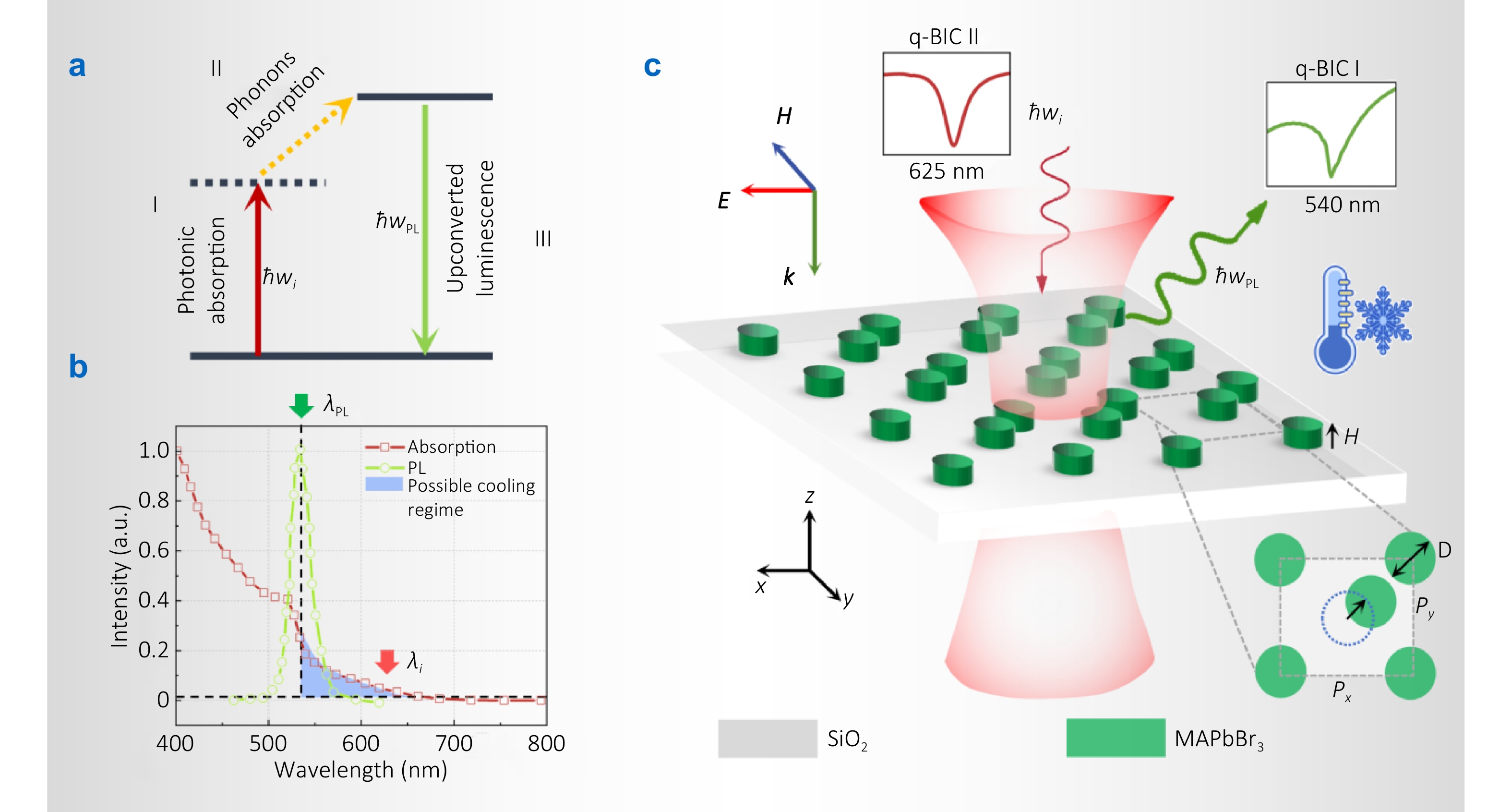
Halide perovskites, recognized for efficient upconversion photoluminescence and high quantum yields, present a promising platform for laser refrigeration. Their high refractive index further enables the design of nanostructures that support strong Mie-type resonances, leading to subwavelength light confinement and enhanced laser cooling performance.
In this work, we theoretically propose and numerically demonstrate a metasurface composed of nanostructured halide perovskite with tailored asymmetry, supporting dual-band quasi-bound states in the continuum (q-BICs) that simultaneously enhance optical excitation and upconversion photoluminescence. The perovskite metasurface exhibits a significant enhancement in optical absorption compared with the unpatterned perovskite film, along with a pronounced Purcell effect at the emission wavelength.
Thermodynamic modelling further indicates net cooling down to –201 °C from room temperature under continuous laser illumination, exceeding the liquid-nitrogen cooling threshold. These findings establish design principles for mechanically refrigerant-free thermal management and open a pathway toward integrated cryogenic photonic platforms.
Light-perception-based interactive control of an underwater digital twin hand
Jinlong Lu, Chao Zhang, Hengchang Nong, Dongying Wang, Hongyu Zhou, Junjie Weng, Yuehua Deng, Yang Yu, Qiang Bian, Jianfa Zhang, Chaofan Zhang, Zhenrong Zhang, Junbo Yang
Opto-Electronic Advances
2026-07-10
Unlocking home-based nocturnal health management: A fiber-optic approach for early detection of cardiorespiratory rhythm disorders
Hanyu Jin, Hao Li, Zhuolin Chen, Liangye Li, Zurui Wang, Kai Zhou, Weijian Hang, Zhipeng Chen, Junfeng Chen, Kai Shen, Jianfeng Wen, Chen Chen, Cunzheng Fan, Zhijun Yan, Feng Wang, Qizhen Sun
Opto-Electronic Advances
2026-07-10
A flexible wireless system for prospective photodynamic therapy applications
Rolan Mansour, Bhavani Yalagala, Vikas Vikas, Nikolas Bruce, Fawziye Tarhini, Georgios N. Arvanitakis, Mohammed Mughal, Jamie Blanche, Ahmad Taha, Jonathan Copper, Muhammad Imran, Karin Williams, Karin Oien, Mahmoud Wagih, Hadi Heidari, Robert Hadfield, David Flynn
Opto-Electronic Advances
2026-07-10
Parallel bright-field and multi-order edge imaging via wide field-of-view trichannel metalens
Xiaotong Li, Yeseul Kim, Youngsun Jeon, Junhwa Seong, Jaekyung Kim, Peng Tang, Shiqi Hu, Harit Keawmuang, Beomha Yang, Dongmin Jeon, Le Dai, Weiyan Li, Xiaodong Cai, Jinhui Shi, Yong-Sang Ryu, Trevon Badloe, Junsuk Rho
Opto-Electronic Advances
2026-07-10