(Peer-Reviewed) A 4096-element 3D-integrated Si-SiN optical phased array for high-power coherent LiDAR
Han Wang 汪寒 ¹ ², Weimin Xie 谢伟民 ¹ ², Xin Yan 颜欣 ¹ ², Jiaqi Li 李嘉祺 ¹ ², Youxi Lu 路侑锡 ⁴, Ping Jiang 蒋平 ⁴, Feng Li 李枫 ³, Kai Jin 晋凯 ¹ ², Xu Yang 杨旭 ³, Jiali Jiang 姜佳丽 ³, Keran Deng 邓可然 ⁵, Weishuai Chen 陈伟帅 ⁴, Jing Luo 罗京 ⁴, Li Jin 金里 ⁴, Junbo Feng 冯俊波 ⁴, Kai Wei 魏凯 ¹ ²
¹ State Key Laboratory of Extreme Photonics and Instrumentation, Zhejiang Key Laboratory of Autonomous Optoelectronic Perception, College of Optical Science and Engineering, Zhejiang University, Hangzhou 310027, China
中国 杭州 浙江大学光电科学与工程学院 极端光学技术与仪器全国重点实验室 全省光电自主感知重点实验室
² ZJU-Hangzhou Global Scientific and Technological Innovation Center, Zhejiang University, Hangzhou 311215, China
中国 杭州 浙江大学杭州国际科创中心
³ National Laboratory on Adaptive Optics, Chengdu 610209, China
中国 成都 自适应光学全国重点实验室
⁴ United Microelectronics Center Co., Ltd (CUMEC), Chongqing 401332, China
中国 重庆 联合微电子中心有限责任公司
⁵ Chongqing Normal University, College of Physics and Optoelectronic Engineering, Chongqing 401331, China
中国 重庆 重庆师范大学物理与光电工程学院
Opto-Electronic Technology, 2026-03-20
Abstract
Integrated optical phased arrays (OPAs) are pivotal for next-generation solid-state light detection and ranging (LiDAR), offering high-speed, inertia-free beam steering in a compact form factor. However, achieving high angular resolution alongside multi-watt emission power remains a formidable challenge.
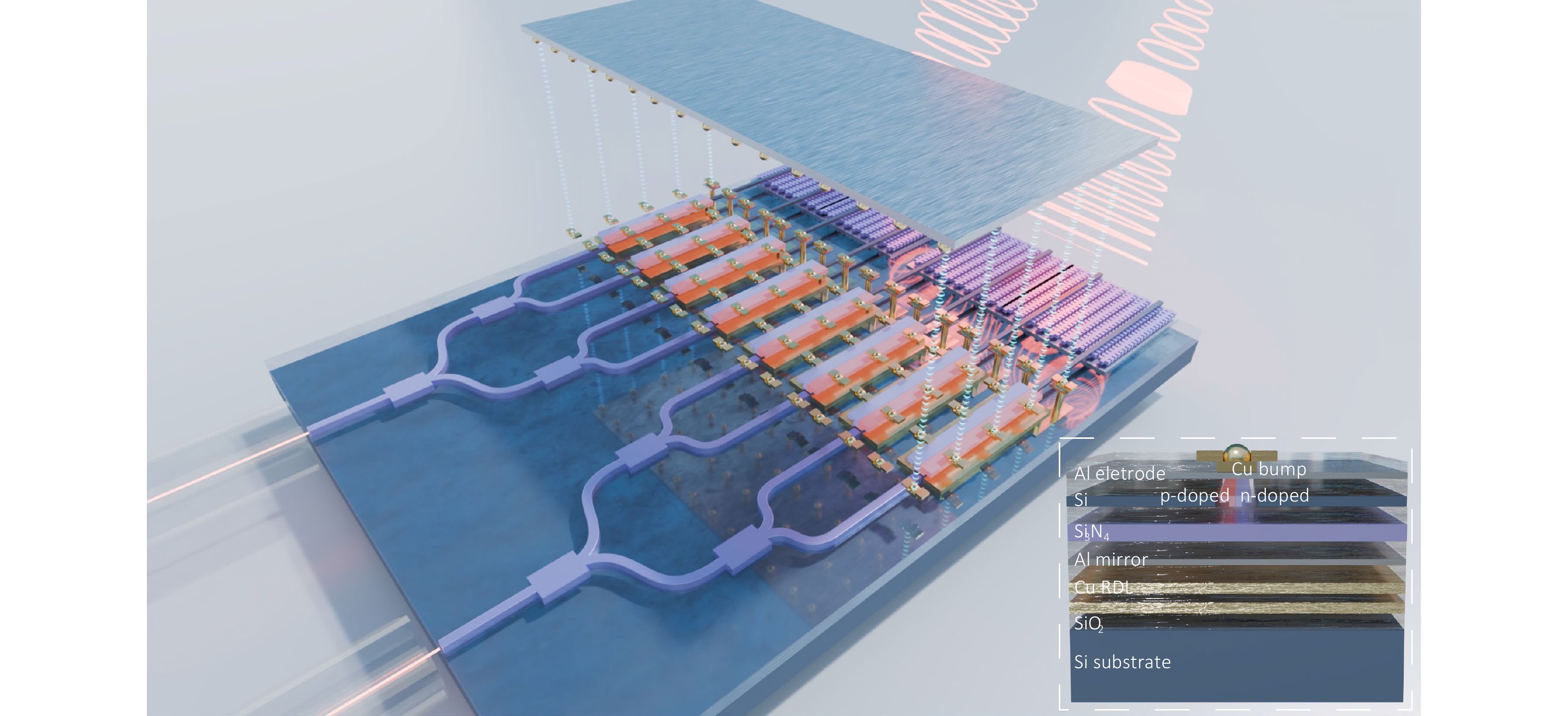
In this work, we present a 3D-integrated silicon-silicon nitride (Si-SiN) hybrid OPA comprising 4096 (4 × 1024) elements, packaged with a CMOS driver chip via flip-chip bonding. The proposed heterogeneous Si-SiN architecture leverages PN carrier-depletion phase shifting with sub-nanosecond response capability, currently demonstrating a 2 μs CMOS-driven beam switching time and ultra-low-power (1.5 μW/π), while delivering an angular resolution of 0.038° × 0.017° (FWHM) and a total main-lobe CW emission power of 1.5 W at a 20 W high-power injection.
This approach effectively circumvents silicon's nonlinear limitations while maintaining high-density integration. System-level validations include indoor coherent detection and a four-channel phase-locked synthetic aperture scheme that successfully compresses the beam divergence to 300 μrad. This architecture provides a scalable roadmap for the development of high-performance, long-range solid-state LiDAR systems.
Light-perception-based interactive control of an underwater digital twin hand
Jinlong Lu, Chao Zhang, Hengchang Nong, Dongying Wang, Hongyu Zhou, Junjie Weng, Yuehua Deng, Yang Yu, Qiang Bian, Jianfa Zhang, Chaofan Zhang, Zhenrong Zhang, Junbo Yang
Opto-Electronic Advances
2026-07-10
Unlocking home-based nocturnal health management: A fiber-optic approach for early detection of cardiorespiratory rhythm disorders
Hanyu Jin, Hao Li, Zhuolin Chen, Liangye Li, Zurui Wang, Kai Zhou, Weijian Hang, Zhipeng Chen, Junfeng Chen, Kai Shen, Jianfeng Wen, Chen Chen, Cunzheng Fan, Zhijun Yan, Feng Wang, Qizhen Sun
Opto-Electronic Advances
2026-07-10
A flexible wireless system for prospective photodynamic therapy applications
Rolan Mansour, Bhavani Yalagala, Vikas Vikas, Nikolas Bruce, Fawziye Tarhini, Georgios N. Arvanitakis, Mohammed Mughal, Jamie Blanche, Ahmad Taha, Jonathan Copper, Muhammad Imran, Karin Williams, Karin Oien, Mahmoud Wagih, Hadi Heidari, Robert Hadfield, David Flynn
Opto-Electronic Advances
2026-07-10
Parallel bright-field and multi-order edge imaging via wide field-of-view trichannel metalens
Xiaotong Li, Yeseul Kim, Youngsun Jeon, Junhwa Seong, Jaekyung Kim, Peng Tang, Shiqi Hu, Harit Keawmuang, Beomha Yang, Dongmin Jeon, Le Dai, Weiyan Li, Xiaodong Cai, Jinhui Shi, Yong-Sang Ryu, Trevon Badloe, Junsuk Rho
Opto-Electronic Advances
2026-07-10