(Peer-Reviewed) Halide perovskite volatile unipolar nanomemristor
Abolfazl Mahmoodpoor ¹ ², Prokhor A. Alekseev ² ³, Ksenia A. Gasnikova ² ³, Kuzmenko Natalia ⁴, Artem Larin ², Sergey Makarov ¹ ², Aleksandra Furasova ¹ ²
¹ Qingdao Innovation and Development Center, Harbin Engineering University, Qingdao 266000, China
中国 青岛 哈尔滨工程大学青岛创新发展基地
² ITMO University, School of Physics and Engineering, Kronverkskiy pr. 49, 197101, St. Petersburg, Russia
³ Ioffe Institute, 194021 Polytechnicheskaya 26, St. Petersburg, Russia
⁴ ITMO University, Research Center for Optical Materials Science, Kronverkskiy pr. 49, 197101, St. Petersburg, Russia
Opto-Electronic Advances, 2025-10-15
Abstract
Halide perovskites is a recently emerged platform for the creation of efficient memristors. In turn, single-crystal inorganic perovskite would be new low-cost and flexible memory devices because of their excellent resistive switching (RS) properties, without risk of chemical and mechanical stress-generated degradation, compared with the operational instability of general thin-film perovskite memristors.
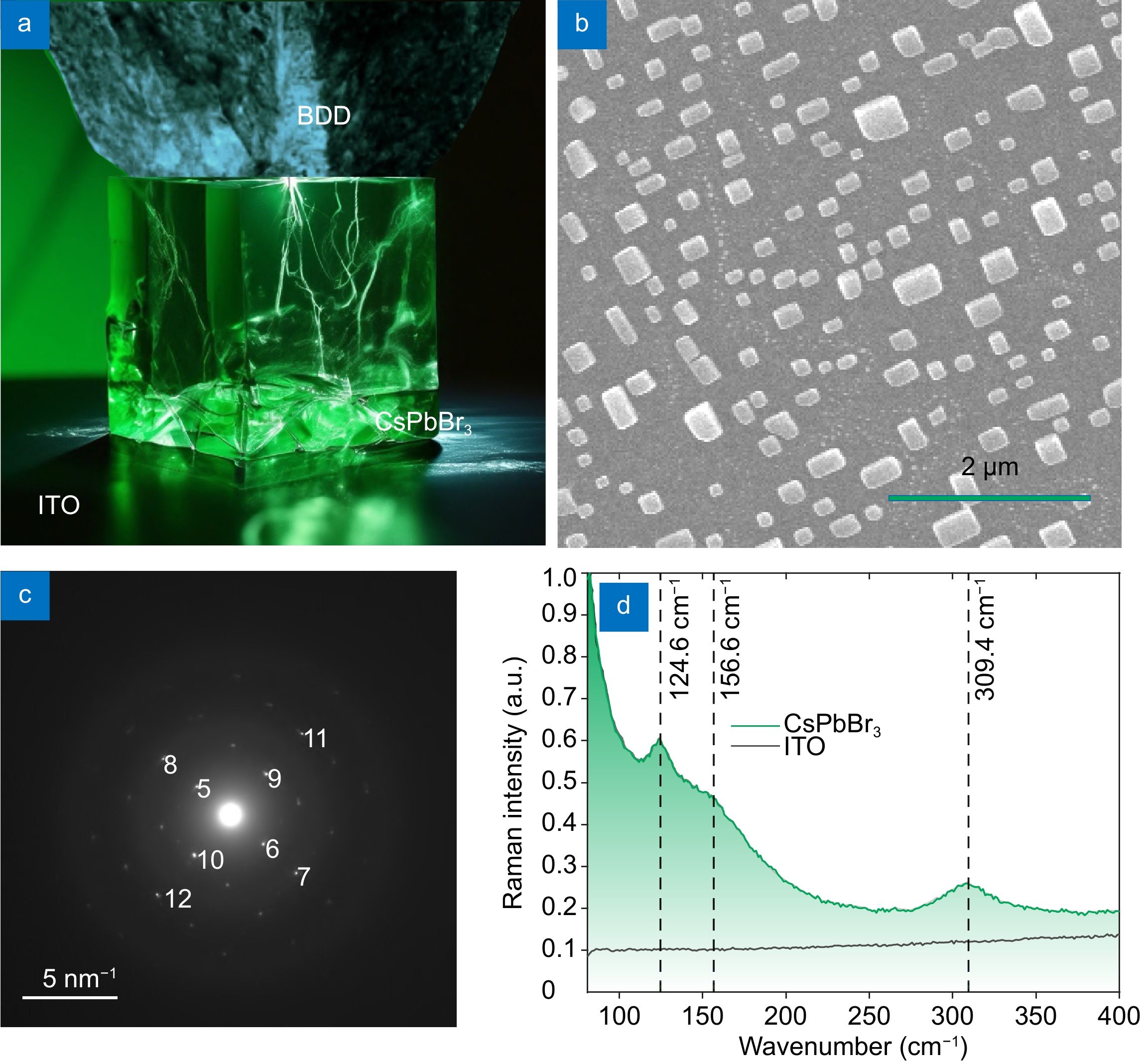
Moreover, miniaturization of perovskite memristors would be useful for creating high-density memory devices. Here we demonstrate the smallest CsPbBr3 perovskite nanomemristor with volatile unipolar RS characteristics which depends on the size of a single-crystal as a resistive layer due to its overall structural stability and low sensitivity to atmosphere conditions that helps to keep the stable RS switching over 1500 times with the lowest consumption power of 70 nW.
To better understand the RS mechanism, we provide a comprehensive simulation of the evolution of mixed ionic-electronic charge carriers under current-voltage (I-V) tests using a one-dimensional drift-diffusion model. Because of the nonreactive nature of the contacts, the main mechanism of resistive state switching is potential barrier modulation of the Schottky contacts through the accumulation of migrating ions at the interfaces. Our findings pave the way for ultracompact memristors as well as shed light on RS mechanism in non-filamentary perovskite-based memory devices.
Heterogeneously integrated micro-ring with SnS₂ for dual-functional optical modulation and photodetection
Jinyi Du, Lidan Lu, Xu Zhang, Bofei Zhu, Wenbo Bo, Yingjie Xu, Guang Chen, Yanlin He, Guanghui Ren, Xiaoping Lou, Zheng You, Lianqing Zhu
Opto-Electronic Advances
2026-08-25
Hardware-aware lightweight photonic spiking neural network for pattern classification
Shuiying Xiang, Yahui Zhang, Shangxuan Shi, Haowen Zhao, Dianzhuang Zheng, Xingxing Guo, Yanan Han, Ye Tian, Liyue Zhang, Yuechun Shi, Yue Hao
Opto-Electronic Advances
2026-08-25
PhyspeNet: An empirical physics-aware network for adaptive speckle reconstructive spectrometry
Junrui Liang, Min Jiang, Jun Li, Zhongming Huang, Junhong He, Yanting Guo, Yanzhao Ke, Jun Ye, Jiangming Xu, Jinyong Leng, Pu Zhou
Opto-Electronic Advances
2026-08-25
A 36 × 240 Gbps hybrid mode/wavelength division multiplexing transmitter using lithium niobate on insulator
Mingyu Zhu, Weihan Wang, Ruitao Ma, Aoyun Gao, Chun Gao, Zexu Wang, Fei Huang, Zhenyuan Bao, Dajian Liu, Jiaxuan Gan, Zejie Yu, Huan Li, Weike Zhao, Daoxin Dai
Opto-Electronic Advances
2026-08-25
Light-perception-based interactive control of an underwater digital twin hand
Jinlong Lu, Chao Zhang, Hengchang Nong, Dongying Wang, Hongyu Zhou, Junjie Weng, Yuehua Deng, Yang Yu, Qiang Bian, Jianfa Zhang, Chaofan Zhang, Zhenrong Zhang, Junbo Yang
Opto-Electronic Advances
2026-07-10