(Peer-Reviewed) Fast-zoom and high-resolution sparse compound-eye camera based on dual-end collaborative optimization
Yi Zheng 郑奕 ¹, Hao-Ran Zhang 张浩然 ¹, Xiao-Wei Li 李晓为 ¹, You-Ran Zhao 赵悠然 ¹, Zhao-Song Li 李赵松 ¹, Ye-Hao Hou 侯页好 ¹, Chao Liu 刘超 ¹ ², Qiong-Hua Wang 王琼华 ¹ ²
¹ School of Instrumentation and Optoelectronic Engineering, Beihang University, Beijing 100191, China
中国 北京 北京航空航天大学仪器科学与光电工程学院
² State Key Laboratory of Virtual Reality Technology and Systems, Beihang University, Beijing 100191, China
中国 北京 北京航空航天大学虚拟现实技术与系统国家重点实验室
Opto-Electronic Advances, 2025-06-19
Abstract
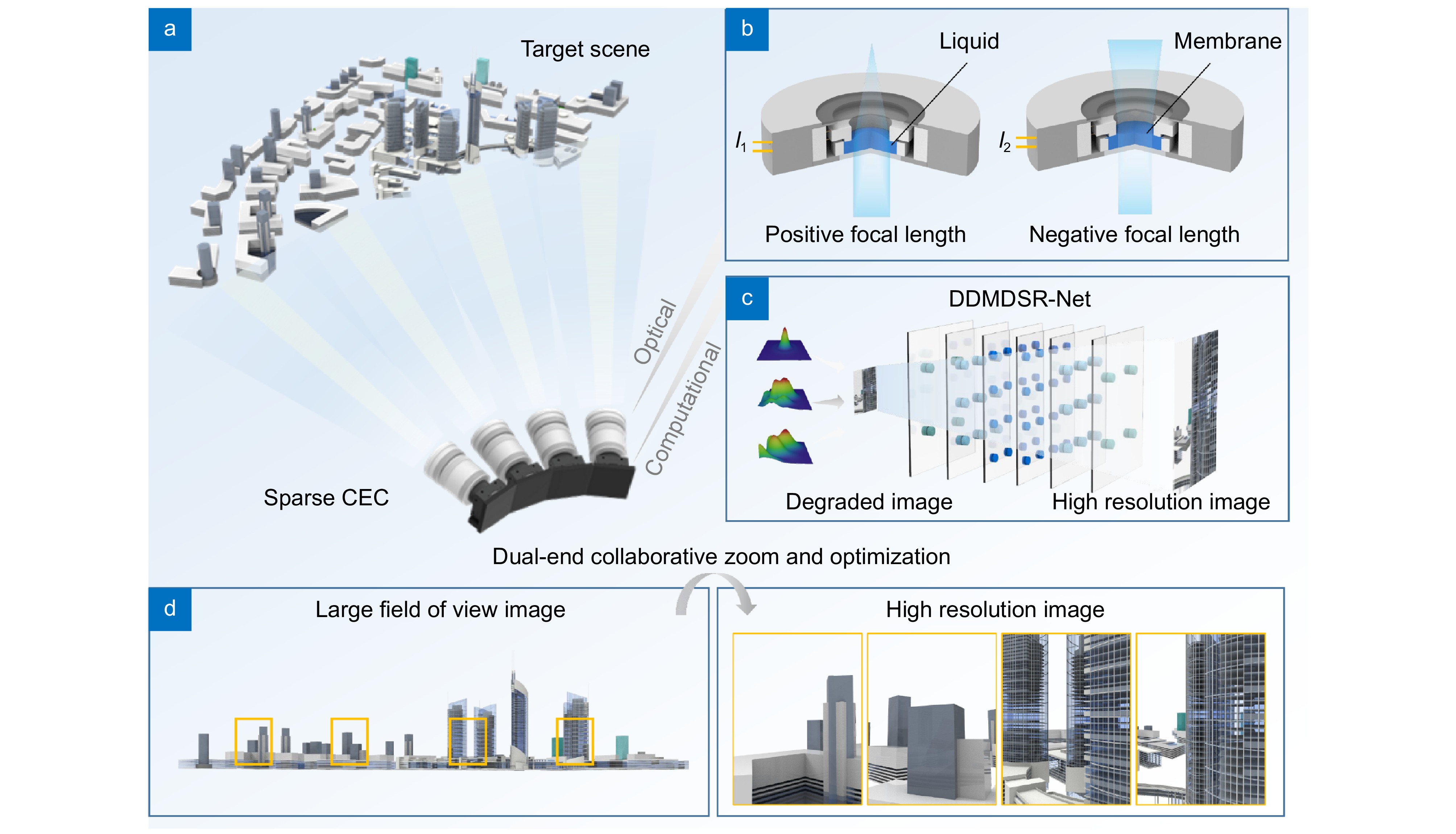
Due to the limitations of spatial bandwidth product and data transmission bandwidth, the field of view, resolution, and imaging speed constrain each other in an optical imaging system. Here, a fast-zoom and high-resolution sparse compound-eye camera (CEC) based on dual-end collaborative optimization is proposed, which provides a cost-effective way to break through the trade-off among the field of view, resolution, and imaging speed.
In the optical end, a sparse CEC based on liquid lenses is designed, which can realize large-field-of-view imaging in real time, and fast zooming within 5 ms. In the computational end, a disturbed degradation model driven super-resolution network (DDMDSR-Net) is proposed to deal with complex image degradation issues in actual imaging situations, achieving high-robustness and high-fidelity resolution enhancement.
Based on the proposed dual-end collaborative optimization framework, the angular resolution of the CEC can be enhanced from 71.6" to 26.0", which provides a solution to realize high-resolution imaging for array camera dispensing with high optical hardware complexity and data transmission bandwidth. Experiments verify the advantages of the CEC based on dual-end collaborative optimization in high-fidelity reconstruction of real scene images, kilometer-level long-distance detection, and dynamic imaging and precise recognition of targets of interest.
Heterogeneously integrated micro-ring with SnS₂ for dual-functional optical modulation and photodetection
Jinyi Du, Lidan Lu, Xu Zhang, Bofei Zhu, Wenbo Bo, Yingjie Xu, Guang Chen, Yanlin He, Guanghui Ren, Xiaoping Lou, Zheng You, Lianqing Zhu
Opto-Electronic Advances
2026-08-25
Hardware-aware lightweight photonic spiking neural network for pattern classification
Shuiying Xiang, Yahui Zhang, Shangxuan Shi, Haowen Zhao, Dianzhuang Zheng, Xingxing Guo, Yanan Han, Ye Tian, Liyue Zhang, Yuechun Shi, Yue Hao
Opto-Electronic Advances
2026-08-25
PhyspeNet: An empirical physics-aware network for adaptive speckle reconstructive spectrometry
Junrui Liang, Min Jiang, Jun Li, Zhongming Huang, Junhong He, Yanting Guo, Yanzhao Ke, Jun Ye, Jiangming Xu, Jinyong Leng, Pu Zhou
Opto-Electronic Advances
2026-08-25
A 36 × 240 Gbps hybrid mode/wavelength division multiplexing transmitter using lithium niobate on insulator
Mingyu Zhu, Weihan Wang, Ruitao Ma, Aoyun Gao, Chun Gao, Zexu Wang, Fei Huang, Zhenyuan Bao, Dajian Liu, Jiaxuan Gan, Zejie Yu, Huan Li, Weike Zhao, Daoxin Dai
Opto-Electronic Advances
2026-08-25
Light-perception-based interactive control of an underwater digital twin hand
Jinlong Lu, Chao Zhang, Hengchang Nong, Dongying Wang, Hongyu Zhou, Junjie Weng, Yuehua Deng, Yang Yu, Qiang Bian, Jianfa Zhang, Chaofan Zhang, Zhenrong Zhang, Junbo Yang
Opto-Electronic Advances
2026-07-10