(Peer-Reviewed) Partially coherent optical chip enables physical-layer public-key encryption
Bo Wu 吴波 ¹, Wenkai Zhang 张文凯 ¹, Hailong Zhou 周海龙 ¹, Jianji Dong 董建绩 ¹, Yilun Wang 王逸伦 ², Xinliang Zhang 张新亮 ¹
¹ Wuhan National Laboratory for Optoelectronics, School of Optical and Electronic Information, Huazhong University of Science and Technology, Wuhan 430074, China
中国 武汉 华中科技大学光学与电子信息学院 武汉光电国家研究中心
² College of Science, National University of Defense Technology, Changsha 410073, China
中国 长沙 中国人民解放军国防科技大学理学院
Opto-Electronic Advances, 2025-11-25
Abstract
Public-key encryption is essential for secure communications, eliminating the need for pre-shared keys. However, traditional schemes such as RSA (Rivest-Shamir-Adleman) and elliptic curve cryptography rely on computational complexity, making them increasingly susceptible to advances in computing power and algorithms. Physical-layer encryption, which leverages the intrinsic properties of physical systems, offers a promising alternative with security rooted in physics. Despite progress in this field, public-key encryption at the optical layer remains largely unexplored.
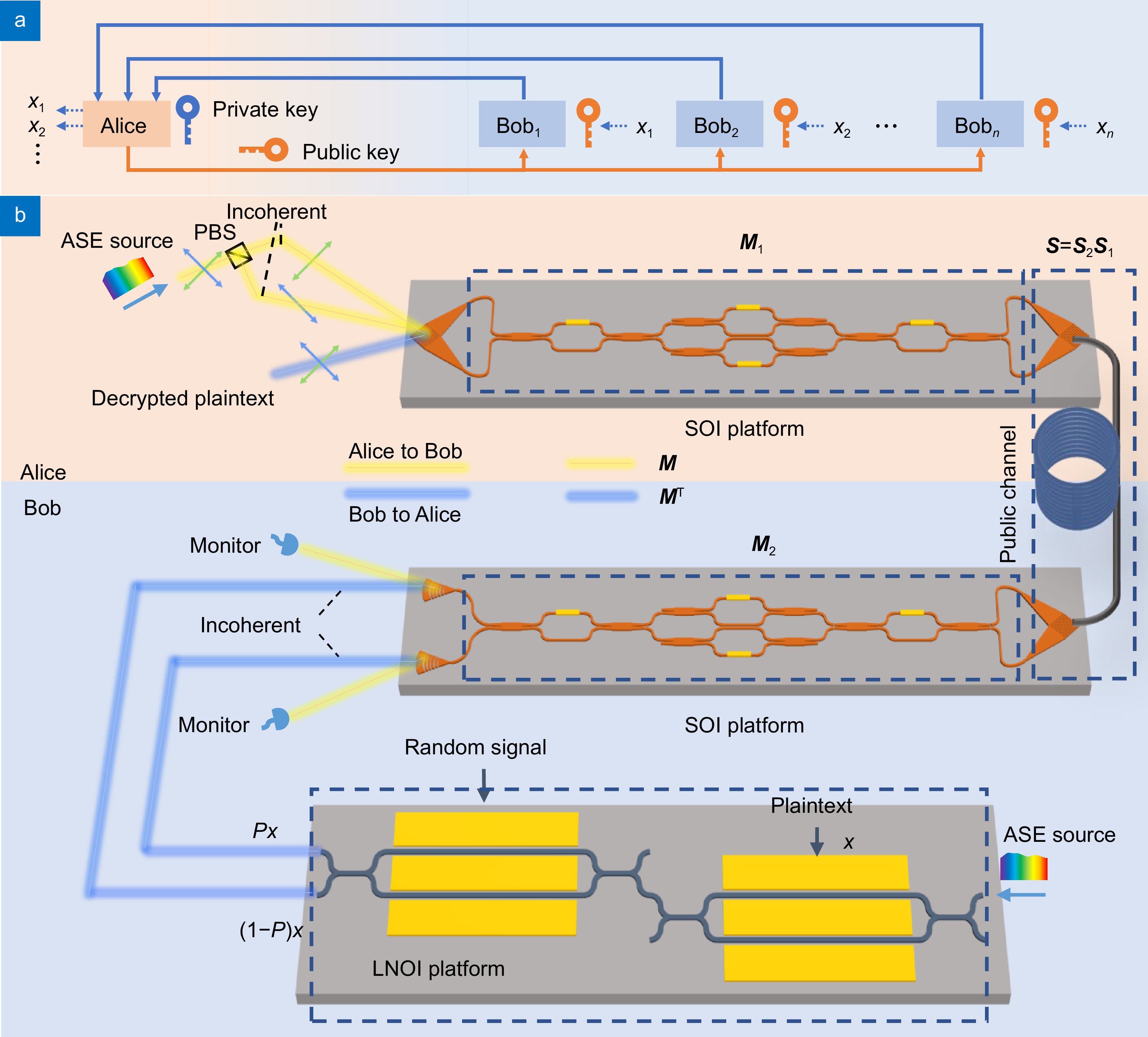
Here, we propose a novel optical public-key encryption scheme based on partially coherent light sources. The cryptographic keys are encoded in the incoherent optical transmission matrix of an on-chip Mach-Zehnder interferometer mesh, providing high complexity and resilience to computational attacks. We experimentally demonstrate encrypted image transmission over 40 km of optical fiber with high decryption fidelity and achieve a 10 Gbit/s optical encryption rate using a lithium niobate photonic chip.
This represents the first implementation of public-key encryption at the physical optical layer. The approach offers key advantages in security, cost, energy efficiency, and compatibility with commercial optical communication systems. By integrating public-key encryption into photonic hardware, this work opens a new direction for secure and high-speed optical communications in next-generation networks.
Ultrafast all-optical modulation of wide-bandwidth pulses enabled by silicon-metasurfaces
Kaloyan Georgiev, Khosro Zangeneh Kamali, Anton A. Trifonov, Giulia Crotti, Lyuben Petrov, Stefan Georgiev, Hristo Iliev, Lei Xu, Unai Arregui Leon, Mohsen Rahmani, Giuseppe Della Valle, Ivan Buchvarov, Dragomir Neshev
Opto-Electronic Advances
2026-09-15
Physics-informed neural fields enable blind aberration correction for partially coherent quantitative phase imaging
Shun Zhou, Xingyu Huang, Linpeng Lu, Habib Ullah, Kaiyu Du, Maciej Trusiak, Malgorzata Kujawinska, Yuzhen Zhang, Yao Fan, Qian Chen, Qinrong Zhang, Chao Zuo
Opto-Electronic Science
2026-08-26
Heterogeneously integrated micro-ring with SnS₂ for dual-functional optical modulation and photodetection
Jinyi Du, Lidan Lu, Xu Zhang, Bofei Zhu, Wenbo Bo, Yingjie Xu, Guang Chen, Yanlin He, Guanghui Ren, Xiaoping Lou, Zheng You, Lianqing Zhu
Opto-Electronic Advances
2026-08-25
Hardware-aware lightweight photonic spiking neural network for pattern classification
Shuiying Xiang, Yahui Zhang, Shangxuan Shi, Haowen Zhao, Dianzhuang Zheng, Xingxing Guo, Yanan Han, Ye Tian, Liyue Zhang, Yuechun Shi, Yue Hao
Opto-Electronic Advances
2026-08-25
PhyspeNet: An empirical physics-aware network for adaptive speckle reconstructive spectrometry
Junrui Liang, Min Jiang, Jun Li, Zhongming Huang, Junhong He, Yanting Guo, Yanzhao Ke, Jun Ye, Jiangming Xu, Jinyong Leng, Pu Zhou
Opto-Electronic Advances
2026-08-25
A 36 × 240 Gbps hybrid mode/wavelength division multiplexing transmitter using lithium niobate on insulator
Mingyu Zhu, Weihan Wang, Ruitao Ma, Aoyun Gao, Chun Gao, Zexu Wang, Fei Huang, Zhenyuan Bao, Dajian Liu, Jiaxuan Gan, Zejie Yu, Huan Li, Weike Zhao, Daoxin Dai
Opto-Electronic Advances
2026-08-25