(Peer-Reviewed) In-situ and ex-situ twisted bilayer liquid crystal computing platform for reconfigurable image processing
Kang Zeng 曾康 ¹, Yougang Ke 柯友刚 ¹, Zhangming Hong 洪张名 ¹, Linzhou Zeng 曾林舟 ¹, Xinxing Zhou 周新星 ²
¹ School of Information Science and Engineering, Hunan Institute of Science and Technology, Yueyang 414006, China
中国 岳阳 湖南科技学院信息工程学院
² Key Laboratory of Low-Dimensional Quantum Structures and Quantum Control of Ministry of Education, School of Physics and Electronics, Hunan Normal University, Changsha 410081, China
中国 长沙 湖南师范大学物理与电子科学学院 低维量子结构与调控教育部重点实验室
Opto-Electronic Advances, 2025-12-25
Abstract
All-optical image processing has been viewed as a promising technique for its high computation speed and low power consumption. However, current methods are often restricted to few functionalities and low reconfigurabilities, which cannot meet the growing demand for device integration and scenario adaptation in next-generation vision regimes.
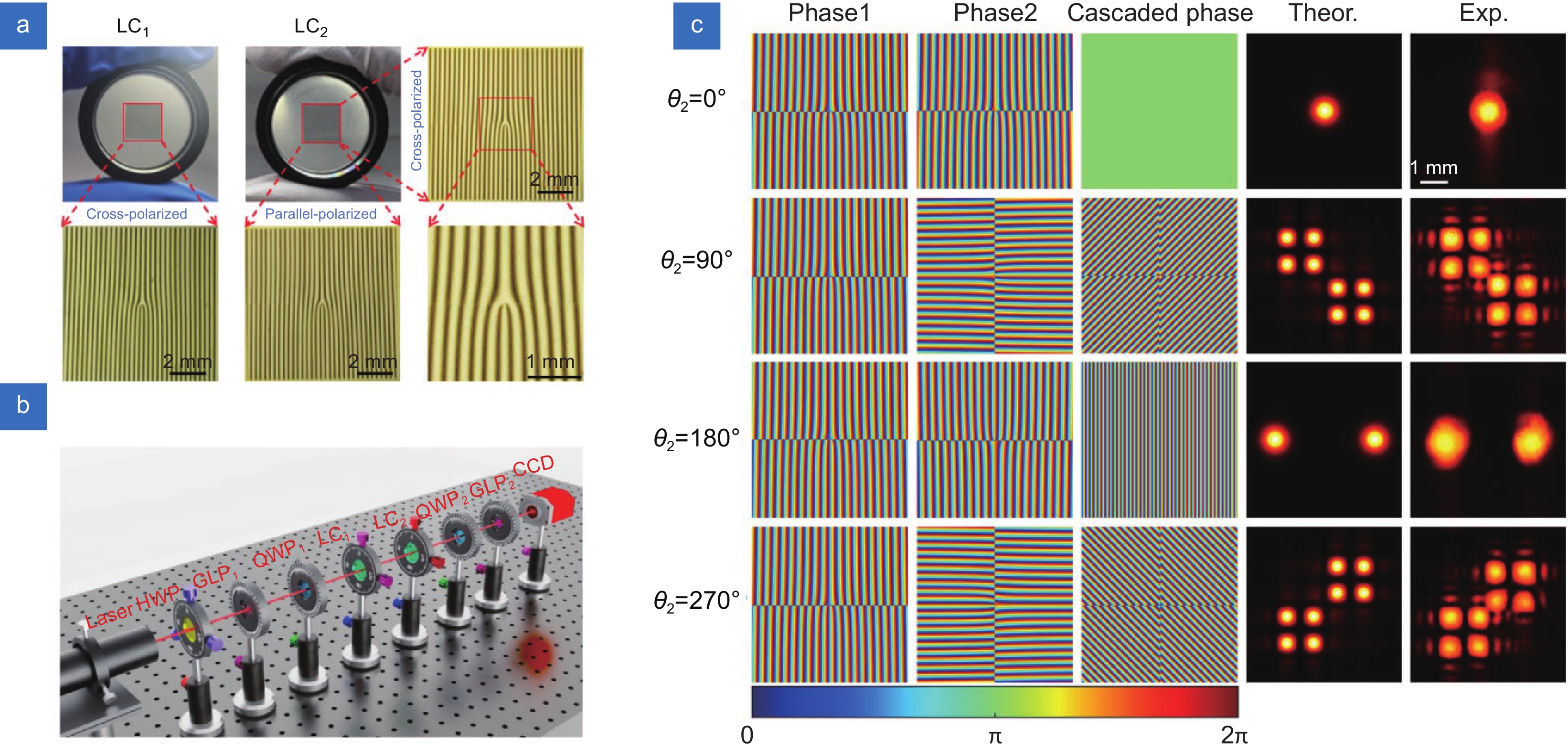
Here, we propose and experimentally demonstrate a bilayer liquid crystal computing platform for reconfigurable image processing. Under different in-situ/ex-situ twisted/untwisted conditions of the layers, our approach allows for eight kinds of image processing functions, including one/two-channel bright field imaging, one/two-channel vortex filtering, horizontally/vertically one-dimensional edge detection, vertex detection, and photonic spin Hall effect-based resolution adjustable edge detection.
A unified theoretical framework for this scheme is established on the transfer function theory, which coincides well with the experimental results. The proposed method offers an easily-switchable multi-functional solution to optical image processing by introducing mechanical degrees of freedom, which may enable emerging applications in computer vision, autonomous driving, and biomedical microscopy.
Heterogeneously integrated micro-ring with SnS₂ for dual-functional optical modulation and photodetection
Jinyi Du, Lidan Lu, Xu Zhang, Bofei Zhu, Wenbo Bo, Yingjie Xu, Guang Chen, Yanlin He, Guanghui Ren, Xiaoping Lou, Zheng You, Lianqing Zhu
Opto-Electronic Advances
2026-08-25
Hardware-aware lightweight photonic spiking neural network for pattern classification
Shuiying Xiang, Yahui Zhang, Shangxuan Shi, Haowen Zhao, Dianzhuang Zheng, Xingxing Guo, Yanan Han, Ye Tian, Liyue Zhang, Yuechun Shi, Yue Hao
Opto-Electronic Advances
2026-08-25
PhyspeNet: An empirical physics-aware network for adaptive speckle reconstructive spectrometry
Junrui Liang, Min Jiang, Jun Li, Zhongming Huang, Junhong He, Yanting Guo, Yanzhao Ke, Jun Ye, Jiangming Xu, Jinyong Leng, Pu Zhou
Opto-Electronic Advances
2026-08-25
A 36 × 240 Gbps hybrid mode/wavelength division multiplexing transmitter using lithium niobate on insulator
Mingyu Zhu, Weihan Wang, Ruitao Ma, Aoyun Gao, Chun Gao, Zexu Wang, Fei Huang, Zhenyuan Bao, Dajian Liu, Jiaxuan Gan, Zejie Yu, Huan Li, Weike Zhao, Daoxin Dai
Opto-Electronic Advances
2026-08-25
Light-perception-based interactive control of an underwater digital twin hand
Jinlong Lu, Chao Zhang, Hengchang Nong, Dongying Wang, Hongyu Zhou, Junjie Weng, Yuehua Deng, Yang Yu, Qiang Bian, Jianfa Zhang, Chaofan Zhang, Zhenrong Zhang, Junbo Yang
Opto-Electronic Advances
2026-07-10