(Peer-Reviewed) IncepHoloRGB: multi-wavelength network model for full-color 3D computer-generated holography
Xuan Yu 余轩 ¹, Zhilin Teng 滕智琳 ¹, Xuhao Fan 范旭浩 ¹, Tianchi Liu 刘天驰 ², Wenbin Chen 陈文彬 ¹, Xinger Wang 王星儿 ¹, Zhe Zhao 赵喆 ¹, Wei Xiong 熊伟 ¹ ³, Hui Gao 高辉 ¹ ³
¹ Wuhan National Laboratory for Optoelectronics and School of Optical and Electronic Information, Huazhong University of Science and Technology, Wuhan 430074, China
中国 武汉 华中科技大学光学与电子信息学院 武汉光电国家实验室
² National Key Laboratory of Science and Technology on Multispectral Information Processing, School of Artificial Intelligence and Automation, Huazhong University of Science and Technology, Wuhan 430074, China
中国 武汉 华中科技大学人工智能与自动化学院 多谱信息处理技术国家级重点实验室
³ Optics Valley Laboratory, Wuhan 430074, China
中国 武汉 湖北光谷实验室
Opto-Electronic Advances, 2025-10-25
Abstract
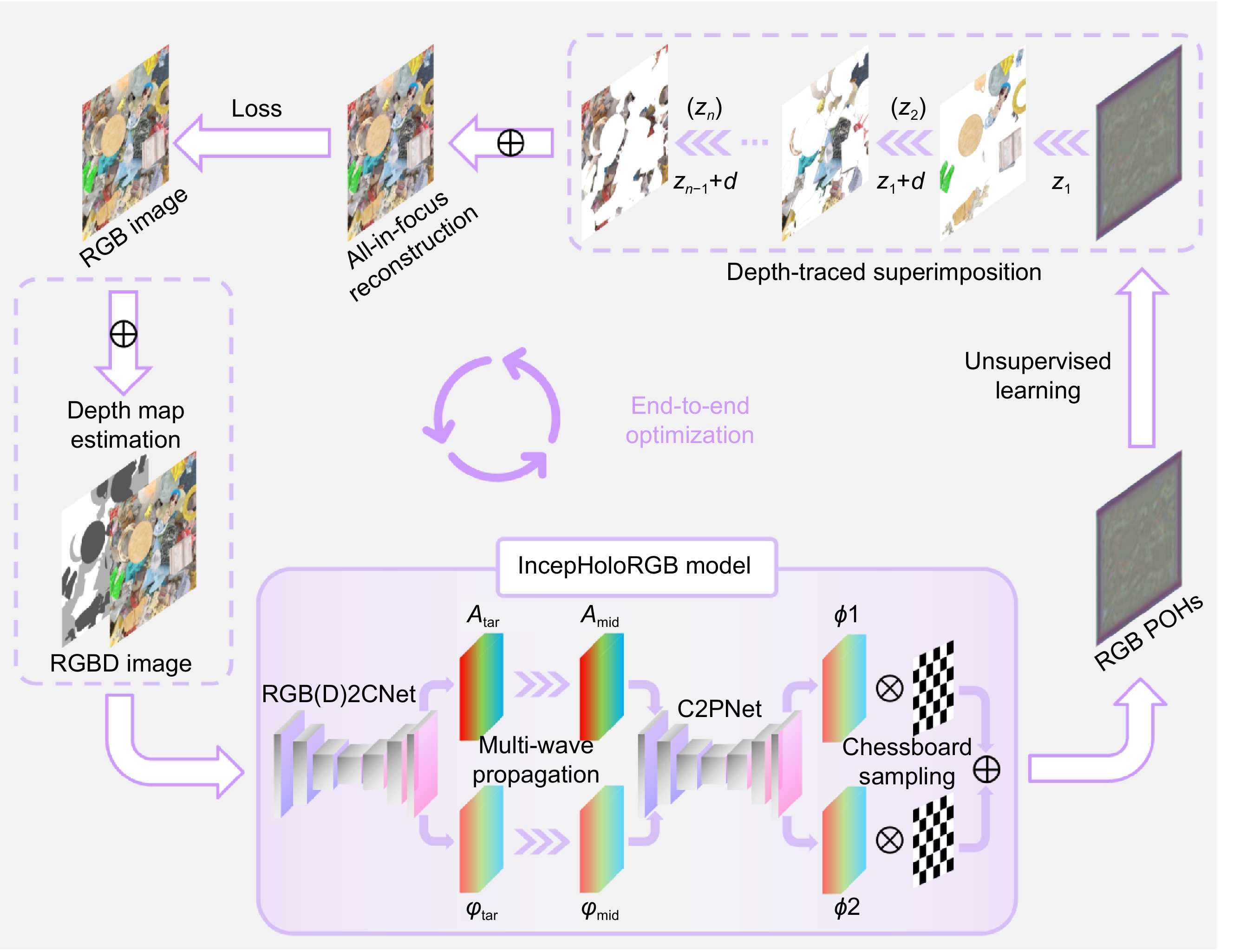
The popularity of deep learning has boosted computer-generated holography (CGH) as a vibrant research field, particularly physics-driven unsupervised learning. Nevertheless, present unsupervised CGH models have not yet explored the potential of generating full-color 3D holograms through a unified framework. In this study, we propose a lightweight multi-wavelength network model capable of high-fidelity and efficient full-color hologram generation in both 2D and 3D display, called IncepHoloRGB.
The high-speed simultaneous generation of RGB holograms at 191 frames per second (FPS) are based on Inception sampling blocks and multi-wavelength propagation module integrated with depth-traced superimposition, achieving an average structural similarity (SSIM) of 0.88 and peak signal-to-noise ratio (PSNR) of 29.00 on the DIV2K test set in reconstruction.
Full-color reconstruction of numerical simulations and optical experiments show that IncepHoloRGB is versatile to diverse scenarios and can obtain authentic full-color holographic 3D display within a unified network model, paving the way for applications towards real-time dynamic naked-eye 3D display, virtual and augmented reality (VR/AR) systems.
Ultrafast all-optical modulation of wide-bandwidth pulses enabled by silicon-metasurfaces
Kaloyan Georgiev, Khosro Zangeneh Kamali, Anton A. Trifonov, Giulia Crotti, Lyuben Petrov, Stefan Georgiev, Hristo Iliev, Lei Xu, Unai Arregui Leon, Mohsen Rahmani, Giuseppe Della Valle, Ivan Buchvarov, Dragomir Neshev
Opto-Electronic Advances
2026-09-15
Physics-informed neural fields enable blind aberration correction for partially coherent quantitative phase imaging
Shun Zhou, Xingyu Huang, Linpeng Lu, Habib Ullah, Kaiyu Du, Maciej Trusiak, Malgorzata Kujawinska, Yuzhen Zhang, Yao Fan, Qian Chen, Qinrong Zhang, Chao Zuo
Opto-Electronic Science
2026-08-26
Heterogeneously integrated micro-ring with SnS₂ for dual-functional optical modulation and photodetection
Jinyi Du, Lidan Lu, Xu Zhang, Bofei Zhu, Wenbo Bo, Yingjie Xu, Guang Chen, Yanlin He, Guanghui Ren, Xiaoping Lou, Zheng You, Lianqing Zhu
Opto-Electronic Advances
2026-08-25
Hardware-aware lightweight photonic spiking neural network for pattern classification
Shuiying Xiang, Yahui Zhang, Shangxuan Shi, Haowen Zhao, Dianzhuang Zheng, Xingxing Guo, Yanan Han, Ye Tian, Liyue Zhang, Yuechun Shi, Yue Hao
Opto-Electronic Advances
2026-08-25
PhyspeNet: An empirical physics-aware network for adaptive speckle reconstructive spectrometry
Junrui Liang, Min Jiang, Jun Li, Zhongming Huang, Junhong He, Yanting Guo, Yanzhao Ke, Jun Ye, Jiangming Xu, Jinyong Leng, Pu Zhou
Opto-Electronic Advances
2026-08-25
A 36 × 240 Gbps hybrid mode/wavelength division multiplexing transmitter using lithium niobate on insulator
Mingyu Zhu, Weihan Wang, Ruitao Ma, Aoyun Gao, Chun Gao, Zexu Wang, Fei Huang, Zhenyuan Bao, Dajian Liu, Jiaxuan Gan, Zejie Yu, Huan Li, Weike Zhao, Daoxin Dai
Opto-Electronic Advances
2026-08-25