(Peer-Reviewed) Integrated photonic synapses, neurons, memristors, and neural networks for photonic neuromorphic computing
Shufei Han 韩书菲 ¹ ², Weihong Shen 沈微宏 ¹ ², Min Gu 顾敏 ¹ ², Qiming Zhang 张启明 ¹ ²
¹ School of Artificial Intelligence Science and Technology, University of Shanghai for Science and Technology, Shanghai 200093, China
中国 上海 上海理工大学智能科技学院
² Institute of Photonic Chips, University of Shanghai for Science and Technology, Shanghai 200093, China
中国 上海 上海理工大学光子芯片研究院
Opto-Electronic Technology, 2025-12-25
Abstract
Rising demands for bandwidth, speed, and energy efficiency are reshaping the landscape of computing beyond the limits of von Neumann electronics. Neuromorphic photonics—using light to emulate neural computation—offers ultrafast, massively parallel, and low-energy information processing, positioning integrated photonic neural networks (IPNNs) as promising hardware for next-generation artificial intelligence (AI).
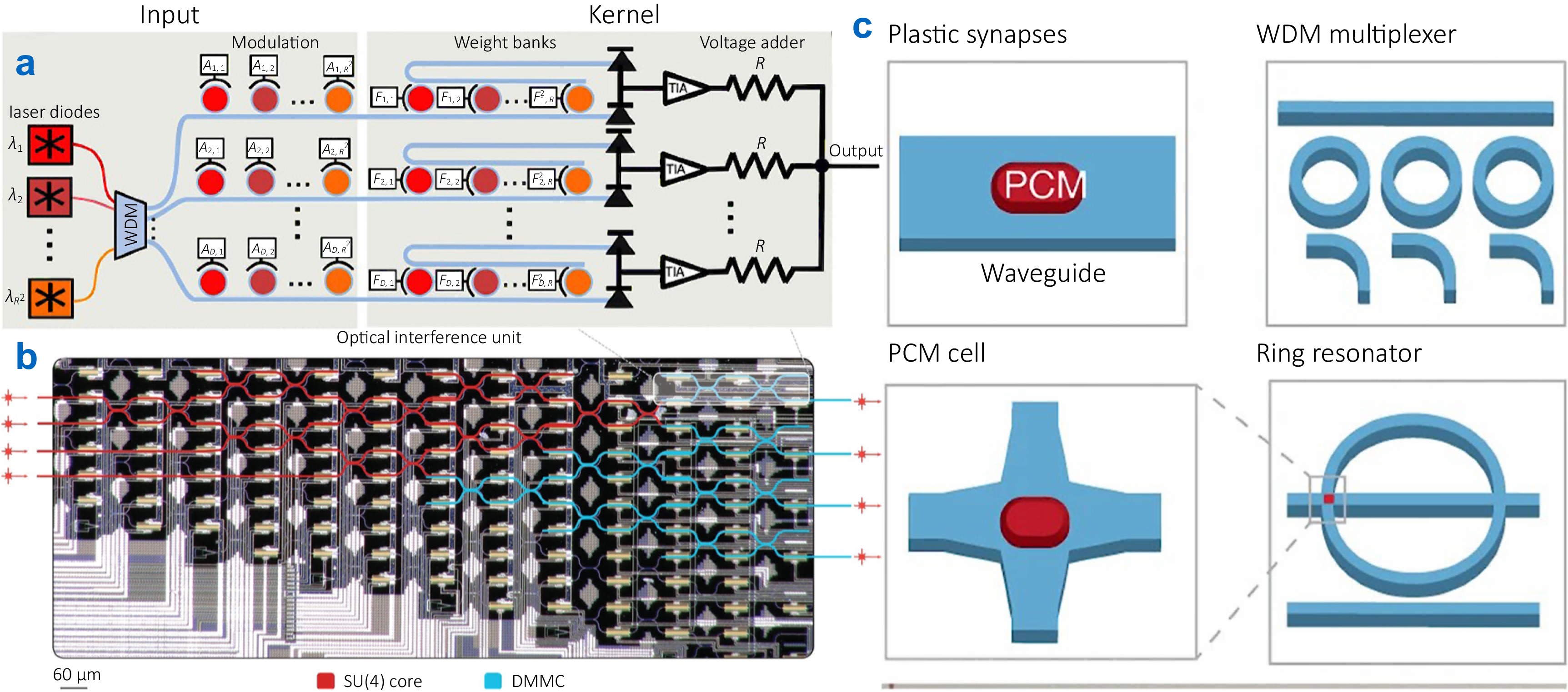
By combining the architectural efficiency of neuromorphic models with the physical advantages of integrated photonics, IPNNs enable high-speed and programmable linear operations during the in-plane optical transmission, while leaving room for compact and reconfigurable on-chip optical nonlinearities and memory functions. Firstly, we review the concepts and principles of key building blocks in IPNN, that are photonic synapses, neurons, and photonic memristors which offer optical memory and storage capabilities.
And then, we summarize the representative IPNN architectures and their recent advances, including coherent, parallel, diffractive, and reservoir computing, for photonic neuromorphic computing with high throughput and high efficiency. Finally, we outline practical considerations—calibration and stability of large-scale networks, routes toward co-integration with electronics, diffractive–interferometric hybrid architectures, and programmable photonic architectures for general AI purposes.
We highlight a forward outlook on enabling IPNN with low energy consumption, robust photonic operations, and efficient training strategies, aiming to guide the maturation of general-purpose, low-power photonic AI.
Unlocking home-based nocturnal health management: A fiber-optic approach for early detection of cardiorespiratory rhythm disorders
Hanyu Jin, Hao Li, Zhuolin Chen, Liangye Li, Zurui Wang, Kai Zhou, Weijian Hang, Zhipeng Chen, Junfeng Chen, Kai Shen, Jianfeng Wen, Chen Chen, Cunzheng Fan, Zhijun Yan, Feng Wang, Qizhen Sun
Opto-Electronic Advances
2026-07-10
A flexible wireless system for prospective photodynamic therapy applications
Rolan Mansour, Bhavani Yalagala, Vikas Vikas, Nikolas Bruce, Fawziye Tarhini, Georgios N. Arvanitakis, Mohammed Mughal, Jamie Blanche, Ahmad Taha, Jonathan Copper, Muhammad Imran, Karin Williams, Karin Oien, Mahmoud Wagih, Hadi Heidari, Robert Hadfield, David Flynn
Opto-Electronic Advances
2026-07-10
Parallel bright-field and multi-order edge imaging via wide field-of-view trichannel metalens
Xiaotong Li, Yeseul Kim, Youngsun Jeon, Junhwa Seong, Jaekyung Kim, Peng Tang, Shiqi Hu, Harit Keawmuang, Beomha Yang, Dongmin Jeon, Le Dai, Weiyan Li, Xiaodong Cai, Jinhui Shi, Yong-Sang Ryu, Trevon Badloe, Junsuk Rho
Opto-Electronic Advances
2026-07-10