(Peer-Reviewed) Advanced applications of pulsed laser deposition in electrocatalysts for hydrogen-electric conversion systems
Yuanyuan Zhou 周圆圆 ¹ ³, Yong Wang 王勇 ¹, Ke Zhang 张科 ¹, Huaqian Leng 冷华倩 ¹, Peter Müller-Buschbaum ², Nian Li 李念 ¹ ², Liang Qiao 乔梁 ¹
¹ School of Physics, University of Electronic Science and Technology of China, Chengdu 611731, China
中国 成都 电子科技大学物理学院
² Technical University of Munich, TUM School of Natural Sciences, Department of Physics, Chair for Functional Materials, James-Franck-Str. 1, Garching 85748, Germany
³ Chongqing University of Technology, College of Chemistry & Chemical Engineering, Chongqing 400054, China
中国 重庆 重庆理工大学化学化工学院
Opto-Electronic Advances, 2025-11-25
Abstract
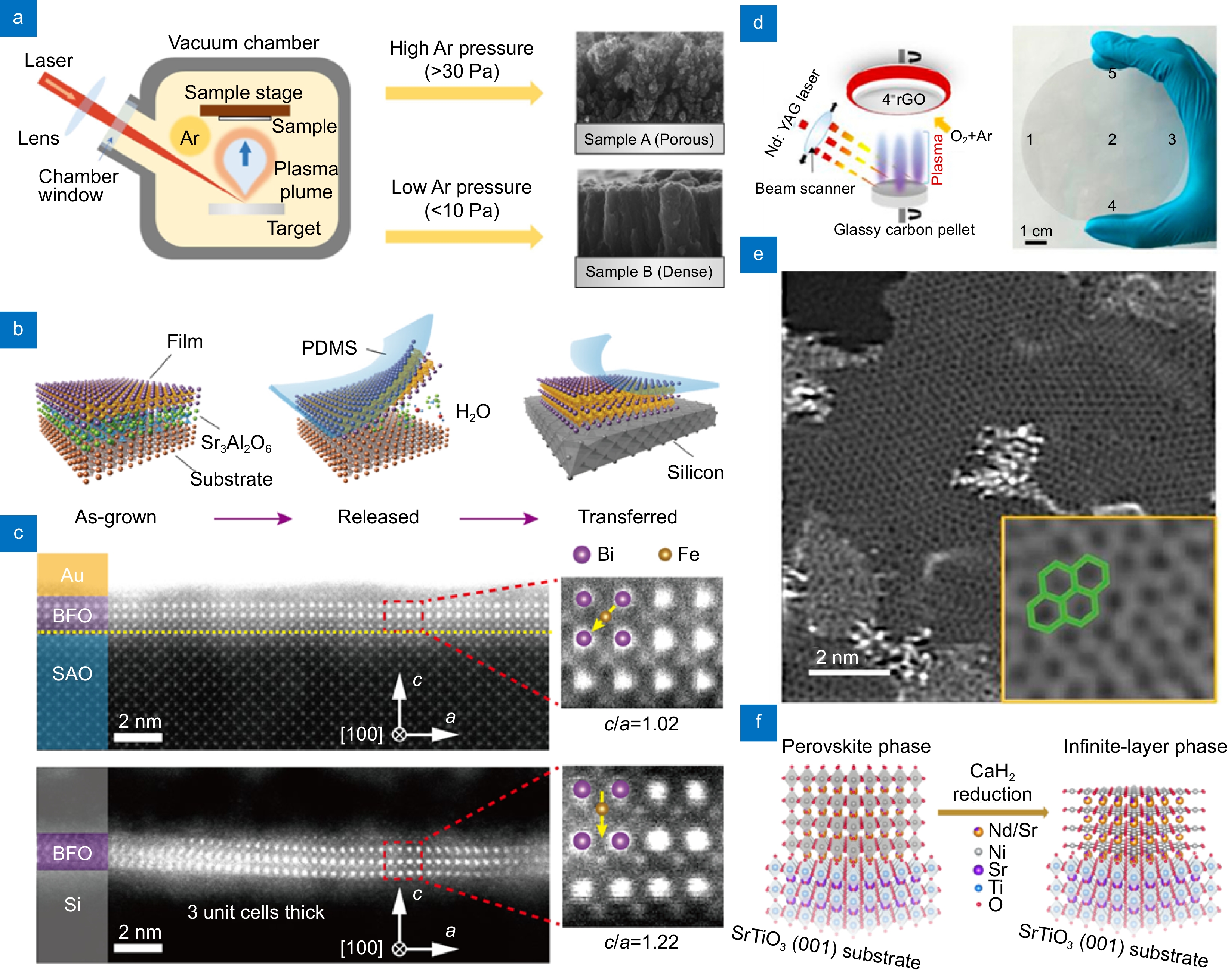
Pulsed laser deposition (PLD), as an advanced synthesis technology with unparalleled control over thin films, has evolved into a universal platform for optoelectronic materials engineering. Its unique advantages including precise stoichiometric transfer, heterogeneous structure preparation and in-situ monitoring enable the design of opto-electrocatalysts with controllable active sites.
Traditional methods struggle to pinpoint active sites in hydrogen technologies such as fuel cells and water electrolysis, impeding catalyst customization and mechanistic understanding. Nevertheless, PLD remains underused here despite its outstanding performances in targeted photo-assisted electrocatalysts design. This review systematically explores the breakthrough achievements and provides detailed insights into photo-enhanced water electrolysis and fuel cells based on PLD. Beginning with the fundamentals of epitaxial film growth and film classification, particularly emphasis the related in situ optical analysis techniques.
It subsequently highlights recent advances in electro-oxidation and reduction reactions of H2 and O2, demonstrating the control capabilities of PLD in precisely correlating the structure and activity at the atomic level. Finally, the review concludes by proposing scalable fabrication strategies and performance optimization frameworks to bridge fundamental insights with industrial-scale optoelectronic integration systems.
Ultrafast all-optical modulation of wide-bandwidth pulses enabled by silicon-metasurfaces
Kaloyan Georgiev, Khosro Zangeneh Kamali, Anton A. Trifonov, Giulia Crotti, Lyuben Petrov, Stefan Georgiev, Hristo Iliev, Lei Xu, Unai Arregui Leon, Mohsen Rahmani, Giuseppe Della Valle, Ivan Buchvarov, Dragomir Neshev
Opto-Electronic Advances
2026-09-15
Physics-informed neural fields enable blind aberration correction for partially coherent quantitative phase imaging
Shun Zhou, Xingyu Huang, Linpeng Lu, Habib Ullah, Kaiyu Du, Maciej Trusiak, Malgorzata Kujawinska, Yuzhen Zhang, Yao Fan, Qian Chen, Qinrong Zhang, Chao Zuo
Opto-Electronic Science
2026-08-26
Heterogeneously integrated micro-ring with SnS₂ for dual-functional optical modulation and photodetection
Jinyi Du, Lidan Lu, Xu Zhang, Bofei Zhu, Wenbo Bo, Yingjie Xu, Guang Chen, Yanlin He, Guanghui Ren, Xiaoping Lou, Zheng You, Lianqing Zhu
Opto-Electronic Advances
2026-08-25
Hardware-aware lightweight photonic spiking neural network for pattern classification
Shuiying Xiang, Yahui Zhang, Shangxuan Shi, Haowen Zhao, Dianzhuang Zheng, Xingxing Guo, Yanan Han, Ye Tian, Liyue Zhang, Yuechun Shi, Yue Hao
Opto-Electronic Advances
2026-08-25
PhyspeNet: An empirical physics-aware network for adaptive speckle reconstructive spectrometry
Junrui Liang, Min Jiang, Jun Li, Zhongming Huang, Junhong He, Yanting Guo, Yanzhao Ke, Jun Ye, Jiangming Xu, Jinyong Leng, Pu Zhou
Opto-Electronic Advances
2026-08-25
A 36 × 240 Gbps hybrid mode/wavelength division multiplexing transmitter using lithium niobate on insulator
Mingyu Zhu, Weihan Wang, Ruitao Ma, Aoyun Gao, Chun Gao, Zexu Wang, Fei Huang, Zhenyuan Bao, Dajian Liu, Jiaxuan Gan, Zejie Yu, Huan Li, Weike Zhao, Daoxin Dai
Opto-Electronic Advances
2026-08-25