(Peer-Reviewed) Scale-invariant 3D face recognition using computer-generated holograms and the Mellin transform
Yongwei Yao 姚勇伟 ¹, Yaping Zhang 张亚萍 ¹ ², Huanrong He 何欢荣 ¹, Xianfeng David Gu 顾险峰 ³, Daping Chu 初大平 ⁴, Ting-Chung Poon 潘定中 ⁵
¹ Yunnan Provincial Key Laboratory of Modern Information Optics (LMIO), Kunming University of Science and Technology, Kunming 650500, China
中国 昆明 昆明理工大学 云南省现代信息光学重点实验室
² Cambridge Digital Humanities (CDH), University of Cambridge, Cambridge CB2 1RX, UK
³ Computer Science Department, SUNY at Stony Brook, Stony Brook, New York 11794, USA
⁴ Centre for Photonic Devices and Sensors, University of Cambridge, 9 JJ Thomson Avenue, Cambridge CB3 0FA, UK
⁵ Bradley Department of Electrical and Computer Engineering, Virginia Tech, Blacksburg, VA 24061, USA
Opto-Electronic Advances, 2025-11-25
Abstract
We present a novel method for scale-invariant 3D face recognition by integrating computer-generated holography with the Mellin transform. This approach leverages the scale-invariance property of the Mellin transform to address challenges related to variations in 3D facial sizes during recognition.
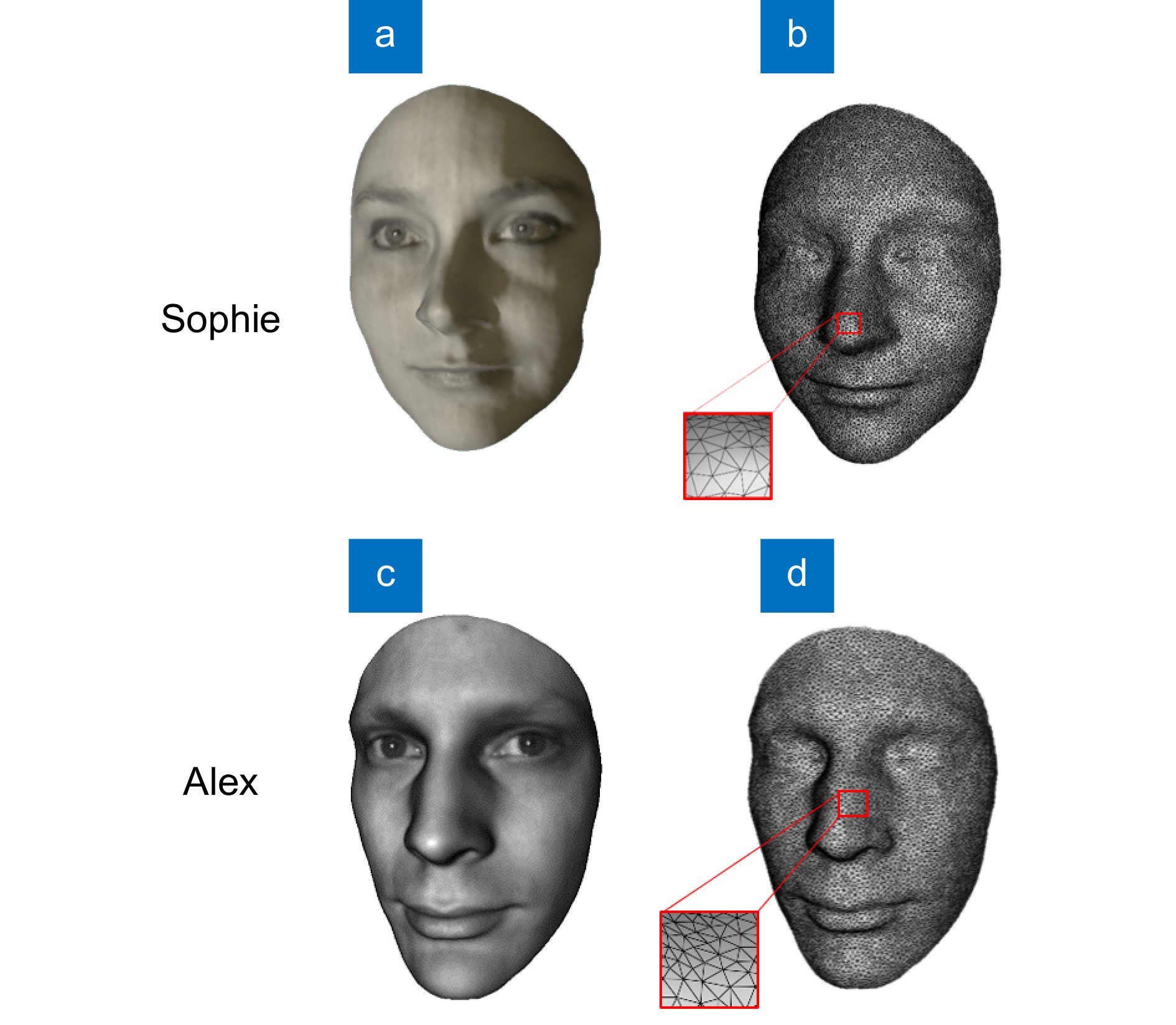
By applying the Mellin transform to computer-generated holograms and performing correlation between them, which, to the best of our knowledge, is being done for the first time, we have developed a robust recognition framework capable of managing significant scale variations without compromising recognition accuracy. Digital holograms of 3D faces are generated from a face database, and the Mellin transform is employed to enable robust recognition across scale factors ranging from 0.4 to 2.0. Within this range, the method achieves 100% recognition accuracy, as confirmed by both simulation-based and hybrid optical/digital experimental validations.
Numerical calculations demonstrate that our method significantly enhances the accuracy and reliability of 3D face recognition, as evidenced by the sharp correlation peaks and higher peak-to-noise ratio (PNR) values than that of using conventional holograms without the Mellin transform. Additionally, the hybrid optical/digital joint transform correlation hardware further validates the method's effectiveness, demonstrating its capability to accurately identify and distinguish 3D faces at various scales. This work provides a promising solution for advanced biometric systems, especially for those which require 3D scale-invariant recognition.
Ultrafast all-optical modulation of wide-bandwidth pulses enabled by silicon-metasurfaces
Kaloyan Georgiev, Khosro Zangeneh Kamali, Anton A. Trifonov, Giulia Crotti, Lyuben Petrov, Stefan Georgiev, Hristo Iliev, Lei Xu, Unai Arregui Leon, Mohsen Rahmani, Giuseppe Della Valle, Ivan Buchvarov, Dragomir Neshev
Opto-Electronic Advances
2026-09-15
Physics-informed neural fields enable blind aberration correction for partially coherent quantitative phase imaging
Shun Zhou, Xingyu Huang, Linpeng Lu, Habib Ullah, Kaiyu Du, Maciej Trusiak, Malgorzata Kujawinska, Yuzhen Zhang, Yao Fan, Qian Chen, Qinrong Zhang, Chao Zuo
Opto-Electronic Science
2026-08-26
Heterogeneously integrated micro-ring with SnS₂ for dual-functional optical modulation and photodetection
Jinyi Du, Lidan Lu, Xu Zhang, Bofei Zhu, Wenbo Bo, Yingjie Xu, Guang Chen, Yanlin He, Guanghui Ren, Xiaoping Lou, Zheng You, Lianqing Zhu
Opto-Electronic Advances
2026-08-25
Hardware-aware lightweight photonic spiking neural network for pattern classification
Shuiying Xiang, Yahui Zhang, Shangxuan Shi, Haowen Zhao, Dianzhuang Zheng, Xingxing Guo, Yanan Han, Ye Tian, Liyue Zhang, Yuechun Shi, Yue Hao
Opto-Electronic Advances
2026-08-25
PhyspeNet: An empirical physics-aware network for adaptive speckle reconstructive spectrometry
Junrui Liang, Min Jiang, Jun Li, Zhongming Huang, Junhong He, Yanting Guo, Yanzhao Ke, Jun Ye, Jiangming Xu, Jinyong Leng, Pu Zhou
Opto-Electronic Advances
2026-08-25
A 36 × 240 Gbps hybrid mode/wavelength division multiplexing transmitter using lithium niobate on insulator
Mingyu Zhu, Weihan Wang, Ruitao Ma, Aoyun Gao, Chun Gao, Zexu Wang, Fei Huang, Zhenyuan Bao, Dajian Liu, Jiaxuan Gan, Zejie Yu, Huan Li, Weike Zhao, Daoxin Dai
Opto-Electronic Advances
2026-08-25