(Peer-Reviewed) Unsupervised learning enabled label-free single-pixel imaging for resilient information transmission through unknown dynamic scattering media
Fujie Li 李甫杰 ¹, Haoyu Zhang 张昊宇 ¹, Zhilan Lu 卢芝蓝 ¹, Li Yao 姚力 ¹, Yuan Wei 魏圆 ¹, Ziwei Li 李子薇 ¹, Feng Bao 鲍峰 ¹, Junwen Zhang 张俊文 ¹, Yingjun Zhou 周盈君 ¹, Nan Chi 迟楠 ¹ ²
¹ Key Laboratory for the Information Science of Electromagnetic Waves (MoE), Department of Communication Science and Engineering, Fudan University, Shanghai 200433, China
中国 上海 复旦大学电磁波信息科学教育部重点实验室
² Shanghai Engineering Research Center of Low-Earth-Orbit Satellite Communication and Applications, and Shanghai Collaborative Innovation Center of Low-Earth-Orbit Satellite Communication Technology, Shanghai 200433, China
中国 上海 上海低轨卫星通信与应用工程技术研究中心 上海市低轨卫星通信技术协同创新中心
Opto-Electronic Advances, 2025-10-25
Abstract
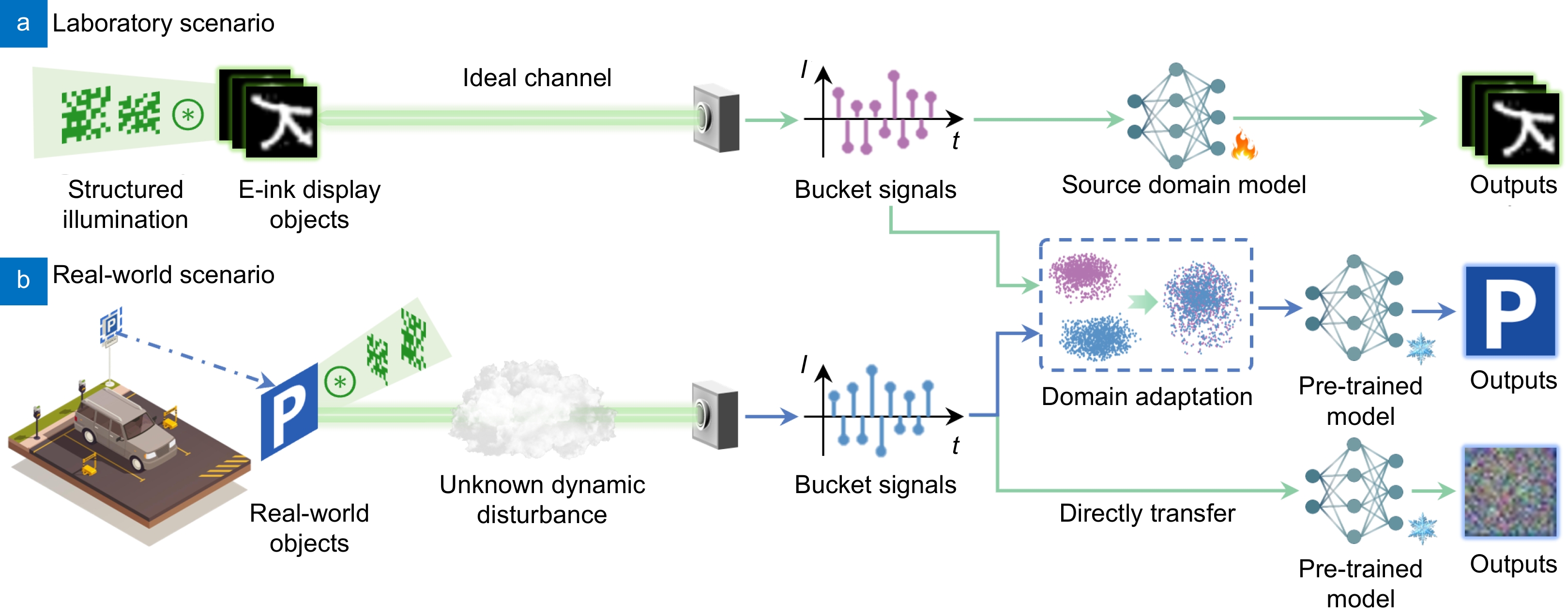
Single-pixel imaging (SPI) is a prominent scattering media imaging technique that allows image transmission via one-dimensional detection under structured illumination, with applications spanning from long-range imaging to microscopy. Recent advancements leveraging deep learning (DL) have significantly improved SPI performance, especially at low compression ratios. However, most DL-based SPI methods proposed so far rely heavily on extensive labeled datasets for supervised training, which are often impractical in real-world scenarios.
Here, we propose an unsupervised learning-enabled label-free SPI method for resilient information transmission through unknown dynamic scattering media. Additionally, we introduce a physics-informed autoencoder framework to optimize encoding schemes, further enhancing image quality at low compression ratios. Simulation and experimental results demonstrate that high-efficiency data transmission with structural similarity exceeding 0.9 is achieved through challenging turbulent channels.
Moreover, experiments demonstrate that in a 5 m underwater dynamic turbulent channel, USAF target imaging quality surpasses traditional methods by over 13 dB. The compressive encoded transmission of 720×720 resolution video exceeding 30 seconds with great fidelity is also successfully demonstrated. These preliminary results suggest that our proposed method opens up a new paradigm for resilient information transmission through unknown dynamic scattering media and holds potential for broader applications within many other scattering media imaging technologies.
Recent progress on mid-infrared and terahertz dual-comb spectroscopy
Zhuoren Wan, Min Li, Binbin Liu, Yu Xia, Yuan Chen, Xiuxiu Zhang, Dongxu Zhu, Yan Dai, Sinan Tao, Hua Li, Ming Yan, Heping Zeng
Opto-Electronic Technology
2026-09-30
Electrically switchable bright-field and interference-synthesized edge-enhanced imaging with a polarization-multiplexed metalens
Xiaotong Li, Junhwa Seong, Yeseul Kim, Kwang-Suk Oh, Shiqi Hu, Le Dai, Harit Keawmuang, Beomha Yang, Minseok Choi, Youngsun Jeon, Cherry Park, Weiyan Li, Tianxu Jia, Han Zhu, Xiaodong Cai, Qi Zheng, Jinhui Shi, Young-Ki Kim, Yuchuan Shao, Trevon Badloe, Junsuk Rho
Opto-Electronic Science
2026-09-20
3D-printed copper water cooling system assisted fabrication of 10.6-μm high-power CO₂ laser resistance reflectors
Hongfei Jiao, Binbin Jiang, Xinshang Niu, Yifan Wang, Dongdong Li, Jun Yu, Xiaochuan Ji, Jingjing Xia, Jinlong Zhang, Xinbin Cheng, Zhanshan Wang
Opto-Electronic Advances
2026-09-15
Ultrafast all-optical modulation of wide-bandwidth pulses enabled by silicon-metasurfaces
Kaloyan Georgiev, Khosro Zangeneh Kamali, Anton A. Trifonov, Giulia Crotti, Lyuben Petrov, Stefan Georgiev, Hristo Iliev, Lei Xu, Unai Arregui Leon, Mohsen Rahmani, Giuseppe Della Valle, Ivan Buchvarov, Dragomir Neshev
Opto-Electronic Advances
2026-09-15