(Preprint) Instance Segmentation in 3D Scenes using Semantic Superpoint Tree Networks
Zhihao Liang ¹ ², Zhihao Li ³, Songcen Xu 许松岑 ³, Mingkui Tan 谭明奎 ¹, Kui Jia 贾奎 ¹ ⁴ ⁵
¹ South China University of Technology
华南理工大学
² DexForce Technology Co., Ltd.
跨维(广州)智能科技有限公司
³ Noah’s Ark Lab, Huawei Technologies
华为诺亚方舟实验室
⁴ Pazhou Laboratory
琶洲实验室 (人工智能与数字经济广东省实验室)
⁵ Peng Cheng Laboratory
鹏城实验室
arXiv, 2021-08-17
Abstract
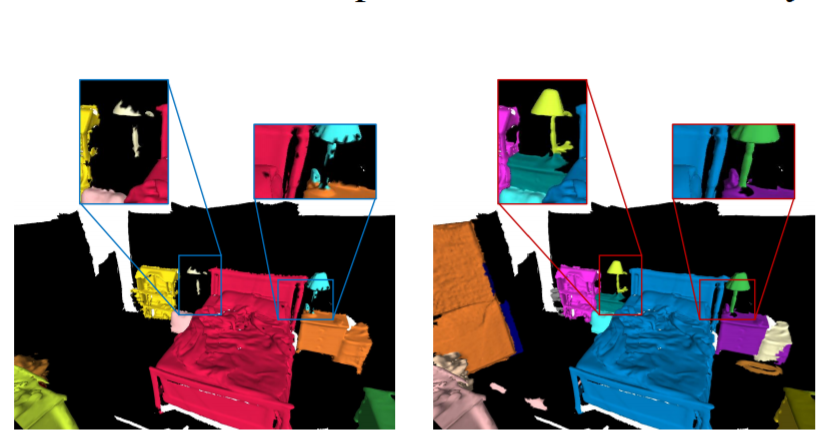
Instance segmentation in 3D scenes is fundamental in many applications of scene understanding. It is yet challenging due to the compound factors of data irregularity and uncertainty in the numbers of instances. State-of-the-art methods largely rely on a general pipeline that first learns point-wise features discriminative at semantic and instance levels, followed by a separate step of point grouping for proposing object instances. While promising, they have the shortcomings that (1) the second step is not supervised by the main objective of instance segmentation, and (2) their point-wise feature learning and grouping are less effective to deal with data irregularities, possibly resulting in fragmented segmentations.
To address these issues, we propose in this work an end-to-end solution of Semantic Superpoint Tree Network (SSTNet) for proposing object instances from scene points. Key in SSTNet is an intermediate, semantic superpoint tree (SST), which is constructed based on the learned semantic features of superpoints, and which will be traversed and split at intermediate tree nodes for proposals of object instances. We also design in SSTNet a refinement module, termed CliqueNet, to prune superpoints that may be wrongly grouped into instance proposals.
Experiments on the benchmarks of ScanNet and S3DIS show the efficacy of our proposed method. At the time of submission, SSTNet ranks top on the ScanNet (V2) leaderboard, with 2% higher of mAP than the second best method.
Massively parallel and programmable photonic differential equation solver
Jiahao Wang, Wen Chen, Zhou Zhou, Dongyu Hu, Zile Li, Peng Chen, Yan-qing Lu, Shuang Zhang, Cheng-Wei Qiu, Shaohua Yu, Guoxing Zheng
Opto-Electronic Advances
2026-05-15
Femtosecond laser rapid customization of high-performance anti-reflection windows
Yulong Ding, Xiang Jiang, Cong Wang, Xianshi Jia, Linpeng Liu, Weina Han, Zheng Gao, Shiyu Wang, Nai Lin, Dejin Yan, Ji'an Duan
Opto-Electronic Science
2026-04-23
Ppt-level volatile organic compounds detection via microsecond-pulse-enhanced mid-infrared photoacoustic
Senyu Wang, Liang Zhao, Hongyu Luo, Xiangyu Zhao, Jianfeng Li, Wei Wang, Hao Lei, Mingrui Jiang, Jinlong Wan, Binxing Zhao, Bincheng Li, Yong Liu
Opto-Electronic Science
2026-04-23
AI-assisted metaphotonics
Minsung Kang, Seokju Choi, Kaixi Fu, Xiaoyuan Liu, Zhun Wei, Lei Jin, Hao Wang, Olivier J. F. Martin, Joel K. W. Yang, Sunae So, Trevon Badloe
Opto-Electronic Advances
2026-04-17
Terahertz imaging technology: progress and applications
Yuyuan Tian, Xiaoyin Chen, Zhuocheng Zhang, Qianze Yan, Yiming Liu, Chengliang Deng, Min Wan, Jiang Li, Xiaoqiuyan Zhang, Lu Rong, Elizaveta Tsiplakova, Nikolay Petrov, Xinke Wang, Liguo Zhu, Min Hu, Yan Zhang
Opto-Electronic Technology
2026-03-30